

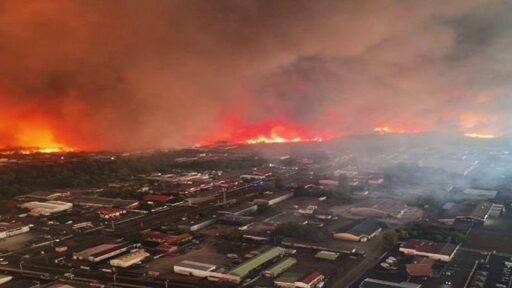
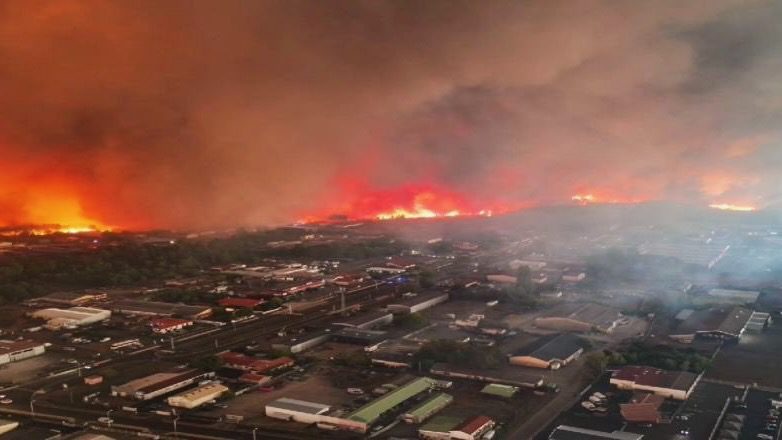
Firefighters in France and Spain are working hard to contain devastating wildfires ahead of another heatwave expected to hit parts of Europe starting Tuesday, July 28. Tens of thousands of hectares of land have been scorched, and over 200,000 people were forced to evacuate their homes in France alone. Blazes are also ongoing in Italy, and the seasonal prognosis for the entire northern Mediterranean coast remains alarming.
Europe has faced increasingly difficult wildfire seasons, exacerbated by climate change and austerity measures. Each summer, the amount of land lost to fires appears to surpass previous records. For example, according to some media estimates, the fire that reached 15 kilometers from Bordeaux caused devastation comparable to that experienced in World War II. Many people have lost their homes, and some, including firefighters, died during this year’s response.
Read more: “We cannot eat grenades once the grains no longer grow:” European peace movements organize against militarization
International organizations and trade unions have continuously warned about the notable impacts of climate change on the region. Extreme weather events – not only wildfires, but also storms and floods – have been raging throughout the continent. Wildfires have become more frequent and extensive in southern Europe and have also appeared in northern areas, signaling an urgent need to adapt response services. But while European Commission officials recently called for member states to pay due attention to fire and emergency response services, policies on the ground tell a different story – including on the measures promoted by the EU.
“While the total area burnt by wildfires increased by 10% between 2023 and 2024, Eurostat figures released this week show that the share of budgets spent on firefighting services has flattened, at around 0.5% of government expenditure,” the European Trade Union Confederation (ETUC) and the European Public Services Union (EPSU) warned at the end of last year’s fire season. This trend, aligned with the EU’s own austerity instructions and fiscal rules, has translated into a falling number of firefighters. Even countries that saw more damage from fires, such as Cyprus, Portugal, and Croatia, did not stray from this scenario, observing staff reductions of 6%, 4%, and 3% respectively in 2024.
Read more: Austerity linked to over 1 million preventable deaths in EU
In an earlier release, EPSU warned that France was the European country to suffer the highest loss of firefighters between 2021 and 2022. The country also saw workforce reductions in other services crucial for fire response. The National Forestry Office (ONF) fell from 15,000 to 8,000 employees over 40 years, while Météo-France lost approximately one-third of its staff in 15 years, emphasized the French General Confederation of Labor (CGT).
This decline has coincided with aging equipment and shortages. Among other things, recent fires reminded the public that France lacks sufficient water bomber aircraft to meet its needs. Only a fraction of the Canadair planes promised during Emmanuel Macron’s presidency have actually been purchased, with only two expected to be delivered before 2033, noted left party La France Insoumise. According to the party, this correlates strongly with cuts to public services promoted by Macron and his political affiliates, including former prime minister Gabriel Attal.
Agricultural, forestry, and defense policies championed over the past decades have only made matters worse. Measures aimed at maximizing forest profitability and promoting monoculture have increased overall vulnerability to extreme weather events, emphasized the union organization Solidaires.
“Emmanuel Macron has doubled the military budget over the past ten years, but France still doesn’t have enough Canadair aircraft,” presidential candidate Jean-Luc Mélenchon pointed out in a recent interview with Reporterre. “In France, we know how to build the best fighter jet in the world, but we’re still not capable of building one to scoop up water and pour it on trees! How is that possible?”
Read more: Insurgent left candidate may spoil far right’s plans in 2027 French presidential election
Additionally, Mélenchon emphasized that the impact of wildfires, along with related heatwaves and droughts, will be felt for years. “We will also face challenges that are harder to quantify: the psychological and social impact,” he said. “I’m thinking of the shock caused by the thousands of deaths that are devastating thousands of families. I’m thinking of the people who are deeply distressed by the overcrowding in an overheated environment and feel abandoned.”
La France Insoumise and other progressive organizations continue to call for a decisive break from the neoliberal model that created this perfect storm of climate and public service vulnerability. “The succession of record-breaking heatwaves and massive wildfires comes as no surprise,” Solidaires summarized. “Scientists have been warning about these phenomena for decades. They serve as a stark reminder of the urgent need to act and completely change course.”
From BT News via This RSS Feed.