

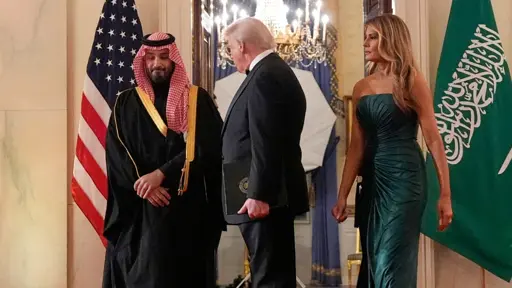
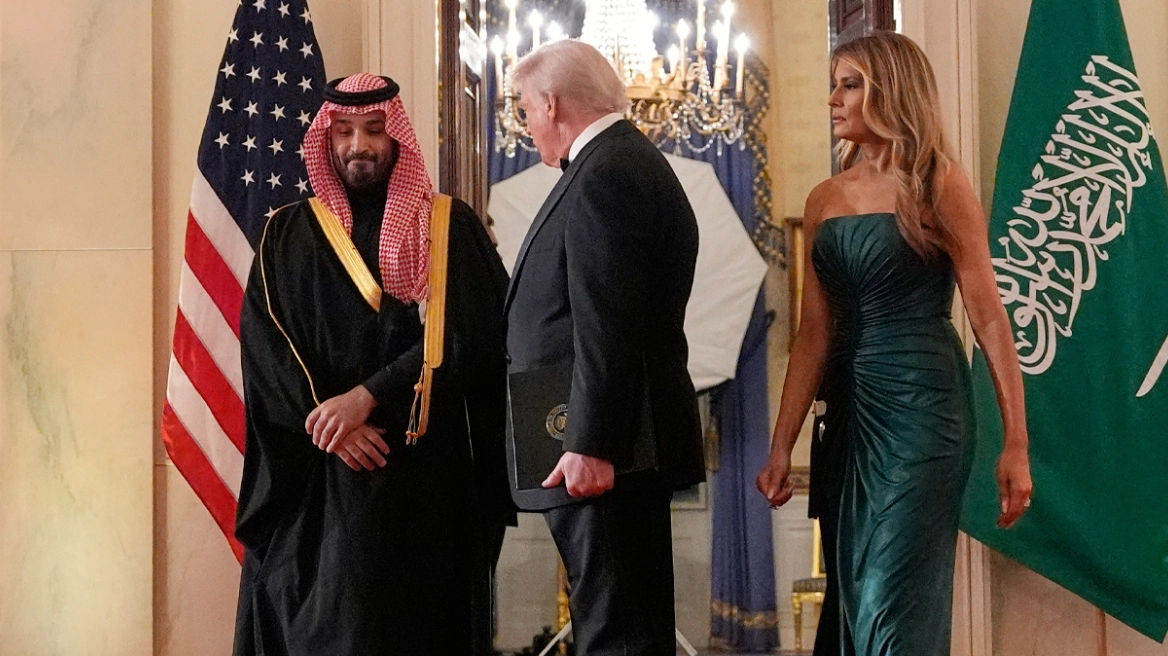
On July 22, the United States and Saudi Arabia signed what Washington calls a “peaceful nuclear cooperation agreement.” The agreement has been presented as a commercial arrangement that will help Saudi Arabia diversify its energy system while creating a vast new market for US-based nuclear companies. But its significance goes far beyond the construction of power stations. By permitting the possibility that Saudi Arabia might eventually enrich uranium on its own soil, while apparently exempting the kingdom from the most intrusive international inspections, Washington has further weakened the already fragile international regime against nuclear proliferation.
The timing could hardly be more revealing. The United States has waged an illegal war of aggression against Iran on the grounds that Iran must not be permitted to retain an independent uranium-enrichment capacity, even though Iran is a party to the Non-Proliferation Treaty (NPT) and has repeatedly stated that its program is intended for peaceful purposes. Yet Washington is now prepared to open precisely this technological door for Saudi Arabia, whose crown prince, Mohammed bin Salman, has publicly said that the kingdom would seek a nuclear weapon if Iran obtained one.
The issue, therefore, is not simply whether Saudi Arabia intends to build a bomb. The deeper issue is the replacement of universal rules by a system of political permissions. Under this system, enrichment is intolerable when conducted by an adversary but negotiable when desired by an ally. Nuclear technology, like so much else in the imperial order, is governed not by law but by hierarchy.
What has been agreed?
The agreement signed by US Energy Secretary Chris Wright and Saudi Energy Minister Prince Abdulaziz bin Salman is known as a 123 agreement, after Section 123 of the US Atomic Energy Act. Such an agreement provides the legal framework required before US companies can transfer major nuclear equipment, materials, and technical knowledge to another country. The agreement was accompanied by a separate bilateral safeguards arrangement and must now pass through a period of review in the US Congress.
The US Department of Energy describes the arrangement as the foundation of a “decades-long, multi-billion-dollar partnership. US companies, including reactor manufacturers such as Westinghouse, are expected to compete for contracts to construct Saudi Arabia’s civilian nuclear infrastructure. Riyadh argues that nuclear electricity will allow it to reduce the domestic consumption of oil and natural gas, leaving a larger share of its hydrocarbons available for export. The program is also part of the kingdom’s Vision 2030 plan to expand its technological and industrial capacity.
But civilian nuclear cooperation is not, by itself, the source of controversy. Under Article IV of the Non-Proliferation Treaty, every state party has the right to develop nuclear science and energy for peaceful purposes. Saudi Arabia has as much right as any other country to construct reactors, produce electricity, and train nuclear scientists. The danger lies in the terms under which Washington appears willing to facilitate this program.
The full text has not yet been made public. Nonetheless, reports indicate that the agreement does not permanently prohibit Saudi Arabia from enriching uranium or reprocessing spent nuclear fuel. Instead, it provides for a two-year US-Saudi study into whether the kingdom should establish an indigenous enrichment facility. A future US administration could therefore authorize enrichment on Saudi soil. Although Donald Trump subsequently claimed that there would be “no enrichment” and suggested that final approval was conditional upon Saudi Arabia recognizing Israel, his intervention only deepened the confusion surrounding the agreement.
The contrast with the 2009 US agreementwith the United Arab Emirates is stark. Under that arrangement, often called the “gold standard,” the UAE permanently renounced domestic enrichment and the reprocessing of spent fuel. It also accepted the International Atomic Energy Agency’s Additional Protocol, which gives inspectors broader rights of access to facilities, information and locations that might be connected to undeclared nuclear activity.
Saudi Arabia has not accepted the Additional Protocol, and the new agreement reportedly relies instead on a bilateral US-Saudi monitoring mechanism. Washington is thus asking the world to trust an inspection arrangement negotiated by the same government whose companies stand to earn tens of billions of dollars from the program. The details of this bilateral mechanism remain unavailable to the public and, crucially, it cannot substitute for universal and independently administered IAEA verification.
The commercial and geopolitical motives are plain. Washington fears that Saudi Arabia might purchase reactors from China, Russia, or South Korea if US companies refuse to meet its conditions. The deal is therefore intended to capture a lucrative market while fastening Riyadh more securely to the United States. It is nuclear commerce presented as non-proliferation.
A blow against the nuclear order
The US-Saudi agreement does not, on the available evidence, directly violate the Non-Proliferation Treaty. Saudi Arabia joined the NPT as a non-nuclear-weapon state, and the treaty does not prohibit such states from enriching uranium for peaceful purposes. What it prohibits is the manufacture or acquisition of nuclear weapons, while requiring nuclear materials to be placed under IAEA safeguards.
This legal distinction is important. Enrichment is not identical to weaponization. Low-enriched uranium can fuel civilian reactors, whereas far higher enrichment levels are generally required for weapons. But the same basic technology can be used for both purposes. Once a country possesses enrichment plants, trained personnel and stocks of nuclear material, the time required to cross from a civilian program to a military one can be greatly shortened. This is why enrichment and reprocessing are described as sensitive parts of the nuclear fuel cycle.
The IAEA’s standard Comprehensive Safeguards Agreement verifies declared nuclear materials and facilities. The Additional Protocol, developed after the discovery of Iraq’s nuclear program in the early 1990s, gives the agency wider access and stronger tools with which to investigate undeclared activities. To allow Saudi Arabia access to sensitive technology without requiring the Additional Protocol is therefore not a technical omission. It is a conscious weakening of the verification regime.
There is also a larger political contradiction. The NPT is built upon three connected promises: non-nuclear states will not acquire nuclear weapons, they will retain access to peaceful nuclear technology, and the existing nuclear-weapon states will pursue disarmament. The third promise has been systematically violated. Rather than move towards disarmament, the recognized nuclear powers have modernized their arsenals, developed new delivery systems and incorporated nuclear weapons more deeply into their military doctrines.
Beyond the NPT stands the Treaty on the Prohibition of Nuclear Weapons, adopted at the United Nations in 2017 and in force since 2021. That treaty prohibits its parties from developing, possessing, threatening to use or assisting with nuclear weapons. Neither the United States nor Saudi Arabia is a party to it. The Comprehensive Nuclear-Test-Ban Treaty, meanwhile, has still not entered into force, largely because key states, especially the United States, have refused to ratify it. Decades of UN resolutions calling for a West Asian zone free of nuclear weapons and other weapons of mass destruction have also remained unrealized, above all because Israel refuses to join the NPT or submit its nuclear facilities to comprehensive IAEA safeguards.
This is the central hypocrisy in West Asia. Israel possesses nuclear weapons outside the NPT and faces neither sanctions nor inspections. Iran’s safeguarded nuclear program has been subjected to sabotage, assassinations, sanctions and war. Saudi Arabia, a close US partner, is now offered a potential route towards enrichment without the strongest available international inspections. Washington is not defending a non-proliferation order. It is administering a nuclear hierarchy.
The precedent will not remain confined to Saudi Arabia. Turkey, Egypt and other regional states will ask why they should renounce fuel-cycle capabilities that Washington is prepared to discuss with Riyadh. Iran will reasonably conclude that negotiated restrictions provide no security: it complied with the 2015 nuclear agreement, only for Trump to abandon it in 2018 and restore sanctions. Military attacks and nuclear double standards strengthen precisely those forces in Iran that argue that only a nuclear deterrent can prevent future aggression.
The Iran–Saudi–China Process
At first sight, the agreement appears to draw Saudi Arabia back into the strategic orbit of the United States and therefore to threaten the Iran-Saudi reconciliation facilitated by China in March 2023. But the evidence so far suggests a more complicated reality.
The Beijing agreement was never an alliance between Iran and Saudi Arabia. It restored diplomatic relations, reopened embassies and revived an earlier security cooperation agreement after seven years of estrangement. Its immediate purpose was limited but important: to prevent rivalry from becoming direct war and to establish channels through which crises could be managed.
This process has survived extraordinary pressure. It endured the Israeli assault on Gaza, the regional expansion of that war, attacks in the Red Sea and successive confrontations involving Iran, Israel, and the United States. Riyadh and Tehran continue to distrust one another, but both have powerful reasons to preserve the dialogue. Iran seeks to prevent its encirclement and reduce the effectiveness of US sanctions, while Saudi Arabia needs regional stability to carry out its economic plans and its leadership understands that neither US weapons nor US military bases can guarantee the security of its oil installations, cities, and shipping routes.
The nuclear agreement does not remove these structural interests. Indeed, it may be better understood as part of Saudi Arabia’s policy of strategic diversification. Riyadh maintains its old military relationship with Washington while deepening economic ties with China, coordinating with Russia in the oil market, building links with Pakistan, and keeping diplomatic channels open to Iran. Saudi Arabia is no longer willing to entrust all its options to a single external power. China’s role in the 2023 agreement was successful precisely because Beijing did not demand exclusive alignment. It offered neither a military bloc nor an ideological test. China is Iran’s largest oil customer and an increasingly important economic partner of Saudi Arabia and the Gulf states. Its principal interest is the security of energy supplies, shipping lanes, and infrastructure. Unlike Washington, which has repeatedly attempted to organize the region through sanctions, military bases, and war, China benefits from a regional order in which Iran and Saudi Arabia negotiate their differences.
The US-Saudi nuclear agreement will undoubtedly introduce new suspicion into Tehran’s calculations. If Saudi enrichment becomes a reality, Iran will regard it as evidence that Washington is constructing a permissive nuclear threshold for its partners while trying to destroy Iran’s own technological capacities. This could make broader nuclear diplomacy far more difficult. But it does not follow that Iran or Saudi Arabia will abandon the Beijing process. Both sides know that breaking diplomatic contact would expose them to even greater danger.
The real contradiction is therefore not between Saudi Arabia’s relations with the United States and China. It is between two conceptions of regional order. Washington offers Saudi Arabia advanced weapons, nuclear technology, and a place beneath a US security umbrella that has repeatedly failed to prevent war. The Beijing process offers no such umbrella; it offers diplomacy, commercial interdependence, and the possibility that the region’s states might manage their own disputes without permanent external supervision.
The Saudi leadership will attempt to draw benefits from both arrangements. But the US nuclear deal contains the seeds of a new regional danger. By converting non-proliferation rules into privileges distributed among friends, Washington encourages every state to acquire the technological basis for a future bomb. The only principled alternative is a universal one: no nuclear weapons for Israel, Iran, Saudi Arabia, or any other state, full and equal IAEA safeguards, implementation of the long-delayed nuclear-weapon-free zone in West Asia, and the complete abolition of nuclear arsenals, beginning with those held by the established nuclear powers.
Peace cannot be built by deciding which governments may stand closest to the nuclear threshold. It can only be built by dismantling the threshold itself.
Vijay Prashad is an Indian historian and journalist. He is the author of forty books, including Washington Bullets, Red Star Over the Third World, The Darker Nations: A People’s History of the Third World, The Poorer Nations: A Possible History of the Global South, and How the International Monetary Fund Suffocates Africa, written with Grieve Chelwa. He is the executive director of Tricontinental: Institute for Social Research, the chief correspondent for Globetrotter, and the chief editor of LeftWord Books(New Delhi). He also appeared in the films Shadow World (2016) and Two Meetings (2017).
This article was produced by Globetrotter.
From BT News via This RSS Feed.