

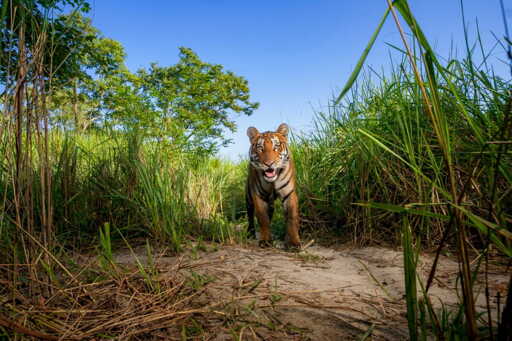
RAJAJI TIGER RESERVE, India — It is early morning in late May in the hardwood sal forests of Rajaji Tiger Reserve in north India, and the heat is rising. By afternoon it will reach 39° Celsius (102° Fahrenheit). I am squatting on the forest floor under National Highway 72, a steady rumble of traffic above, looking at the footprints of a wild elephant in a patch of moist mud that has thus far survived this scorching summer. This is the Teen Pani (Three Waters) underpass, just 400-odd meters (about 1,300 feet) in length, but good enough to allow everything from mice to elephants to pass safely beneath the highway. And it’s also good enough for T8, a Bengal tiger (Panthera tigris tigris) that occasionally walks through the area on his nocturnal perambulations, safe from the speeding vehicles above. T8 was one of five tigers relocated to Rajaji from Corbett Tiger Reserve in May 2025, and now roams extensively, and elusively, across this often human-dominated landscape. The expressway above me dates back just to 2021, and it doesn’t have sound barriers, hence the noise. But it replaced the narrower, heavily trafficked old road running from Delhi to the holy Hindu town of Haridwar and on to Dehradun, the capital of the mountain state of Uttarakhand. T8, one of five tigers translocated from Corbett Tiger Reserve to Rajaji Tiger Reserve, will hopefully use the Teen Pani underpass. This photo was made before his release into Rajaji in 2025. Image courtesy of Rajaji…This article was originally published on Mongabay
From Conservation news via This RSS Feed.