

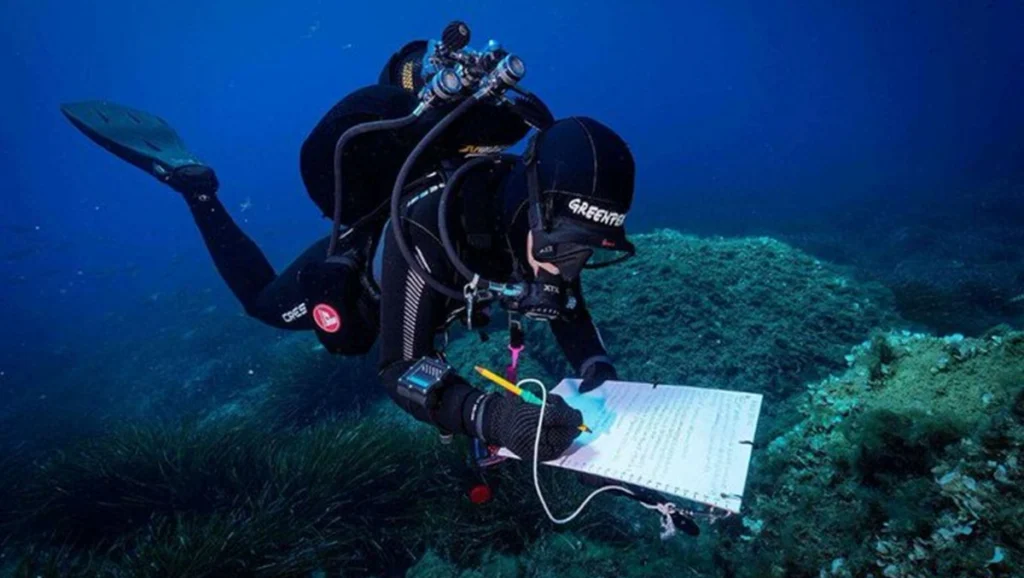
Persistent thermal anomalies are damaging marine ecosystems and accelerating biodiversity loss.
On Tuesday, Greenpeace published “Warm Sea” (Mare Caldo), an annual report showing that thermal anomalies and heat waves in Italian seas have ceased to be isolated episodes and have become a constant phenomenon affecting ecosystems down to depths of 40 meters.
RELATED:
The study, prepared in collaboration with the University of Genoa and the National Institute of Oceanography and Applied Geophysics (OGS), concludes that rising water temperatures are affecting Italy’s coastlines regardless of their location or level of environmental protection.
Scientific data collected at 14 monitoring stations during 2025 show that in several areas of the Mediterranean, marine heat waves lasted for more than 200 days, with surface temperatures ranging from 1.5 to 2.5 degrees Celsius above the climatological average.
The impact of this phenomenon is particularly severe on species that are key to the structure of rocky seabeds. The research found mortality rates of between 30% and 60% in colonies of the yellow gorgonian (Eunicella cavolini) on Elba Island and severe damage in the Asinara Island reserve. Likewise, the stony coral (Cladocora caespitosa) is showing significant deterioration in several protected areas.
I mari italiani continuano a scaldarsi. Il calore raggiunge ormai anche i fondali, fino a 30-40 metri di profondità.
È il quadro del sesto rapporto “Mare Caldo” di #Greenpeace Italia, basato sui dati raccolti nel 2025 in 14 stazioni di monitoraggio, 13 delle quali in Aree Marine… pic.twitter.com/dduIPTDubp— askanews (@askanews_ita) July 28, 2026
The text reads, “Italian seas continue to warm. The heat is now reaching the seabed, at depths of between 30 and 40 meters. This is the image from Greenpeace Italy’s sixth “Warm Sea” report, based on data collected in 2025 at 14 monitoring stations, 13 of which are located in Marine Protected Areas.”
Besides documenting the decline of native species, scientists detected the proliferation of organisms that prefer warmer waters and the expansion of invasive species such as the alga Caulerpa cylindracea, along with the spread of thermophilic fish such as the Mediterranean barracuda.
Using environmental DNA (eDNA) analysis techniques conducted with the University of Urbino in the Torre Guaceto and Asinara reserves, researchers also identified the presence of several exotic algae species that had not been detected through visual observation.
The Greenpeace report devotes a specific analysis to Elba Island, the only unprotected area in the monitoring network, where data collected since 2019 confirm a progressive deterioration in ecological conditions.
The sustained thermal anomalies recorded during the 2023-2024 period caused excess heat to penetrate into deeper layers, affecting benthic species that are poorly adapted to temperature variations.
The highest temperature anomaly recorded in the monitoring network occurred in the Asinara reserve, with a peak of 3.5 degrees above the climatological threshold during a heat wave that lasted 41 days.
Greenpeace emphasizes that although Marine Protected Areas are indispensable for improving the resilience of coastal ecosystems, “conservation work in these areas is not enough on its own” and urgently calls for a drastic reduction in global greenhouse gas emissions.
teleSUR/ JF
Sources: Greenpeace – EFE
From teleSUR English via This RSS Feed.