


Raymond Wilson
Special to ICT
Considered one of the major political, economic and social activists on the Crow Reservation during the 20th century, Robert Yellowtail fought for the rights of Native Americans and tribal sovereignty over lands, people and traditions. He also believed strongly in the importance of higher education for Native people.
Robert Summers Yellowtail was believed to have been born on Aug. 4, 1889, at Lodge Grass, Montana, near the Little Bighorn River, after the Crow had lost most of their land base and been forced to give up many of their traditional ways to live a confined life on a reservation.

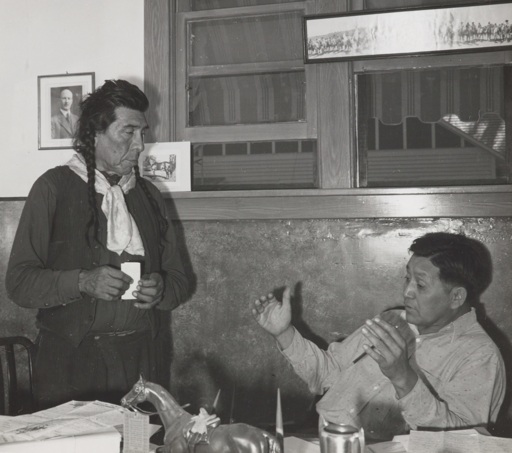
Robert Summers Yellowtail spent 11 years as superintendent for the Crow reservation from 1934 until he became tribal chairman in 1945. Credit: Historic photo
Taken to a Crow Indian boarding school at age 4, Yellowtail faced, like other Native children at those schools, physical and emotional abuse. Nonetheless, he excelled in his studies, and later attended Sherman Institute in Riverside, California, graduating in 1907.
Yellowtail wanted to become a lawyer to help his people, and he found employment working for a justice of the peace in California. He took courses at Extension Law School in Los Angeles, and later took correspondence law courses from the University of Chicago, where he received his law degree.
In 1910, the famous Crow Chief Plenty Coups enlisted Yellowtail to represent the tribe in challenging a bill filed by U.S. Senator Thomas Walsh of Montana that would have allowed homesteaders to occupy the remaining 1.8 million acres of tribal land in Montana. Yellowtail fought tenaciously for years to defeat the bill. Finally, in 1917, the proposed legislation failed, and the Crow retained their land.
As elected district representatives of the Crow Business Committee, Yellowtail and other young, educated Native reformers continued to work for and to represent their people and their rights for decades as tribal delegates sent to Washington, D.C.
Yellowtail used his outstanding speaking and writing skills in presenting his tribe’s political, economic and social objectives when Crow delegates met with Washington, D.C. officials.

Robert Yellowtail, center, superintendent of the Crow Reservation, rides in the tribal fair in 1941. Credit: Photo by Helen M. Post/Courtesy of the Amon Carter Museum of American Art
Examples of Yellowtail’s involvement in increasing Crow self-determination issues included protecting reservation land and grazing and mineral rights. He also helped to remove incompetent White Indian agents on the reservation.
In 1923, Yellowtail was among the well-known Native reformers appointed to the Committee of One Hundred to study federal Indian policies and to make recommendations.
Yellowtail became the first Crow superintendent of the reservation in 1934, a position he held for 11 years. During his tenure, he convinced White ranchers on the reservation to return 40,000 acres to the Crow, and purchased herds of buffalo, cattle and horses. Yellowtail also supported building the first Crow hospital and demanded that more Crow personnel be employed there.
He continued to emphasize Native post-secondary education and Crow traditional practices, including the revival of Native participation in the spiritual benefits and vision quests of the Sun Dance Way, led by his brother, Sun Dance Chief Thomas Yellowtail. Additionally, he praised Crow participation in World War II.
In 1945, Yellowtail became Crow tribal chairman. One of the major issues the Crow faced was opposition to the proposed construction of a dam on the Bighorn River. Yellowtail argued that the land was sacred to his people and used for grazing purposes as well.
However, Crow arguments and proposals fell on deaf ears. In 1958, President Dwight D. Eisenhower signed a bill to construct the project, which eventually was named Yellowtail Dam.
During the last two decades of his life, Yellowtail supported younger, educated leaders in their efforts to increase tribal autonomy. He helped them acquire favorable reservation coal leases as alternative fuel during the oil price increases in the 1970s.
Yellowtail was a major adviser to the 1985 documentary, “Contrary Warriors: A Film of the Crow Tribe,” which contains valuable information on his life and the Crow people.
After decades of preserving and increasing Crow sovereignty rights, Yellowtail died on June 20, 1988. He was 98.
Sources: Little Big Horn College Archives; “Contrary Warriors” documentary film (1985); Frederick E. Hoxie, “Parading through History” (1995); and Michael Oren Fitzgerald, “Yellowtail: Crow Medicine Man and Sun Dance Chief” (1991).
The post LEST WE FORGET: Robert Yellowtail appeared first on ICT.
From ICT via This RSS Feed.