

By Kasheena Camacho

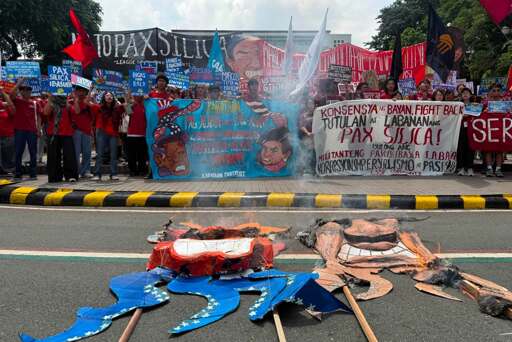
MANILA — More than 15,000 protesters from various progressive organizations and sectoral groups gathered for the People’s State of the Nation Address (PSONA) along Commonwealth Avenue, Quezon City on Monday, July 27, presenting what they described as the true state of the nation under Ferdinand Marcos Jr.—one marked by worsening poverty, corruption, and the administration’s continued subservience to U.S. interests.
Organized by Bagong Alyansang Makabayan (BAYAN), and other multisectoral organizations, the annual mobilization brought together workers, farmers, fisherfolk, women, youth, urban poor communities, health workers, environmental advocates, LGBTQIA+ groups, professionals, and other sectors ahead of Marcos Jr.’s fifth State of the Nation Address.
Throughout the program, speakers argued that the country’s worsening economic conditions, corruption, attacks on human rights, environmental degradation, and controversial development projects stem from policies that prioritize foreign and corporate interests over the welfare of Filipinos.
Workers reject Pax Silica
Several labor organizations maintained that the country’s worsening economic conditions stem from policies they said favor foreign interests over Filipino workers.
Kilusang Mayo Uno (KMU) Chairperson Jerome Adonis said workers continue to suffer from poverty wages, contractualization, rising prices, and joblessness under the Marcos administration, which he attributed to neoliberal policies and the government’s promotion of the U.S.-initiated Pax Silica project.
“No matter how much Bongbong tries to sweet-talk the public in his SONA, Filipino workers and the Filipino people can expect no genuine progress as long as the government continues to follow policies that favor foreign interests and big business—such as America’s Pax Silica.”
Adonis said promises that Pax Silica would create jobs and spur industrial development conceal what he described as its real beneficiaries.
“Workers are being dazzled with promises of jobs and development that ultimately serve America’s interests… Pax Silica will kill the local industry instead of bringing it to life.”
KMU reiterated its call for national industrialization, living wages, decent jobs, and an end to what it described as U.S. domination of the Philippine economy.
“Filipino workers and the Filipino people will hold Bongbong Marcos accountable for his subservience to the United States and his master, the mastermind behind the oppression and exploitation of workers and ordinary Filipinos, Donald Trump,” Adonis said.
BAYAN Chairperson and former Bayan Muna Representative Teodoro Casiño also criticized the proposed Pax Silica project, arguing that it serves U.S. interests rather than the country’s development.
Casiño said the project seeks to build a U.S.-controlled AI value chain by sourcing critical minerals from the Philippines and establishing data processing centers, including one planned in New Clark City. He warned that the project would exploit the country’s natural resources while further exposing the Philippines to geopolitical tensions.
“They will profit from our natural resources while making us more vulnerable to China,” Casiño said.
Sanlakas Convenor Aaron Pedrosa also criticized the country’s military agreements with the United States.
Meanwhile, Atty. Luke Espiritu of Bukluran ng Manggagawang Pilipino (BMP) said workers continue to receive wages that fall far below the cost of living.
“No worker is celebrating the P85 ($1.38) wage increase in the National Capital Region. It is merely a token increase, and workers remain trapped in starvation wages.”
Espiritu added that contractualization remains widespread, saying that more than 70 percent of Filipino workers remain contractual.
Women’s organization Gabriela also criticized the government’s tax policies.
“If the government had even a shred of shame, it would have long abolished the value-added tax.”
Communities demand accountability
Beyond labor issues, representatives from various sectors said ordinary Filipinos continue to bear the burden of inadequate public services, environmental degradation, and alleged government corruption.
Zone One Tondo Organization (ZOTO) Chairperson Orly Gallano said an estimated 6.5 million Filipinos continue to live without decent housing, while communities face rising prices of basic goods, electricity, water, and widespread unemployment. “For five decades, demolitions have remained a problem in Manila,” he said.
Gallano criticized the administration’s Pambansang Pabahay para sa Pilipino (4PH) Program, saying it has failed to address the housing backlog and remains inaccessible to poor families.
He said the housing crisis, coupled with the rising cost of living, continues to burden urban poor communities, urging the government to “end poverty and end corruption.”
Kadamay Secretary General Mimi Doringo said temporary assistance programs fail to address the roots of poverty. “Aid is not the solution to the crisis we face today. What the people need is security, not temporary assistance,” she said.
Environmental organizations warned that large-scale infrastructure and energy projects, including the proposed Pax Silica initiative, threaten communities, agricultural lands, and natural resources while benefiting foreign corporations.
Human rights organizations also lambasted what they described as the continuing climate of impunity under the Marcos administration.
Nymia Simbulan of the Philippine Alliance of Human Rights Advocates (PAHRA) said rights violations remain widespread and even normalized. “Human rights violations remain an everyday reality under the Marcos Jr. administration,” she said.
Bunyog lawyer Ricky Tomotorgo questioned the government’s anti-corruption campaign, citing the unresolved flood control controversy. “Exactly one year after the promise to investigate anomalies in the flood control projects, not a single investigation has truly moved forward,” he said.
Karapatan Secretary General Cristina “Tinay” Palabay also condemned the reported arrest of 51 youth protesters during Monday’s mobilization, saying the incident reflected the continuing repression faced by activists.
The program concluded with a cultural performance by Silak as protesters continued chanting calls against corruption, U.S. intervention, and policies they said have worsened the plight of Filipino workers and marginalized sectors. (RVO)
The post People’s SONA decries US influence, corruption under Marcos administration appeared first on Bulatlat.
From Bulatlat via This RSS Feed.