

By JOHN LESLIE
Cuba is in the grip of an acute economic, social, and political crisis. Common power outages have already spread under the blows of the heightened sanctions imposed by U.S. imperialism on the island nation in 2025-26. Multiple nationwide power grid collapses have left millions in the dark and exacerbated inflation, basic food shortages, and dengue epidemics. Agricultural production is severely hampered by the oil crisis. The medical system is in near collapse, and the infant mortality rate has surged by approximately 148%, increasing from roughly 4.0 deaths per 1000 live births in 2018 to 9.9 per 1,000 births in 2025/2026.
On July 26, Cuban President Miguel Díaz-Canel blasted the U.S. for its “maximum economic strangulation” of the country. He was addressing a rally of thousands in Pinar del Rio to mark the 73rd anniversary of the 1953 uprising, led by Fidel Castro, against former dictator Fulgencio Batista. “Cuba is the victim of a coldly calculated genocide,” Díaz-Canel said, while calling attention to the damaging effects of U.S. sanctions on the island’s health system.
According to the Center for Economic and Policy Research (CEPR), “The unparalleled hardening of U.S. sanctions against Cuba during the first Trump Administration, the Biden administration’s decision to largely maintain these policies, and the further expansion of sanctions during the second Trump administration, including a devastating fuel blockade, is very likely the primary cause of the current economic and humanitarian crisis in Cuba, which is widely considered to be the worst in the island’s contemporary history.”
According to CEPR, the fuel blockade is “by far the most damaging US unilateral measure to date—consisting in the blocking of nearly all fuel shipments from Venezuela through the use of coercive tactics employed by the US military, including the interception of tankers destined for Cuba by the US Coast guard, as well as threats, including threats of tariffs directed at countries considering exporting oil to Cuba.”
Trump imposed draconian travel restrictions for U.S. citizens and imposed restrictions on travel to the U.S. by citizens of 42 countries if they have traveled to Cuba. The U.S. has tightened restrictions on trade with Cuba’s hotels and other state-owned enterprises, placed Cuba on its list of “state sponsors of terrorism,” and choked off remittances.
Regime change is the goal
As the blockade has tightened, the Pentagon has been weighing military options in case the embargo alone is not enough to force the regime change desired by Washington. According toCBS News, “Military planners have in recent weeks examined a range of options for possible action against the island, including an Army-led air assault involving thousands of U.S. soldiers to be carried out by the 101st Airborne Division, the only unit trained for such a task, according to multiple U.S. officials with knowledge of the discussions.”
In May, the US announced an indictment against former President Raul Castro in connection with the shooting down of planes connected with a Cuban exile terrorist group, Brothers to the Rescue, in the 1990s. Castro was charged with conspiracy to kill U.S. nationals, four counts of murder and two counts of destruction of aircraft.
This raised fears that the U.S. would try to seize Castro in the same way they kidnapped Venezuelan President Nicolás Maduro. Cuban President Miguel Diaz-Canel responded to the indictment, stating that it “reveals the arrogance and frustration felt by the representatives of the empire in the face of the unshakable resolve of the Cuban Revolution and the unity and moral strength of its leadership.”
Following the U.S. imperialist re-colonization of Venezuela and the arrest of President Maduro, Cuba’s supply of oil has been choked off by the U.S. Following the logic of the so-called “Donroe” Doctrine, the U.S. is seeking to impose its will on the working masses of Latin America. While still the dominant imperialist power, the United States is unable to simply impose its will in the face of inter-imperial competition from China, a new and rising power, for markets, resources, and geopolitical position. In part, this reflects the relative decline of U.S. imperialism following years of disastrous and costly interventions in the Middle East. Trump seeks to dominate and exploit Latin America as part of the U.S. “sphere of influence.” In his drive to control Latin America, Trump has abandoned the post-World War II international order and allied himself with far-right politicians and governments.
As a component of this imperialist program of re-colonization, Cuba is firmly in the U.S. crosshairs. The goal of U.S. imperialism is nothing less than the economic and political subordination of Cuba and the erasure of every vestige of the 1959 revolution.
Red Scare 3
A newly issued report by the US State Department, “Cuba: The Capital of 21st Century Communism,” seeks to connect Cuba with left-wing and progressive movements in the U.S., claiming that the Cubans exert a high degree of influence over these movements. The document states: “The Cubans devoted themselves to recruiting, cultivating and mobilizing a global coalition of activists, intellectuals, and political groups around this cause, building a sprawling revolutionary network that shaped a disproportionate share of America’s most famous and influential extremist movements, from the Black Panthers and the Weather Underground through to Antifa. Today, that network continues to maintain ties to powerful leftist nonprofits, anti-ICE collectives, socialist groups, and Marxist militant organizations across the United States.”
The reportseeks to link the Black liberation movement, including the Black Lives Matter movement, to some sort of Cuban ”influence.” Other organizations listed include Cuba Solidarity organizations like the National Network on Cuba, the IFCO Pastors for Peace, the National Lawyers Guild, the Amazon Labor Union, Code Pink, the Party for Socialism and Liberation (PSL) and the Democratic Socialists of America (DSA). Individuals listed as some sort of Cuban agents include New York Mayor Zohran Mamdani, Congress members Maxine Waters and Ilhan Omar, Los Angeles Mayor Karen Bass, and Ben & Jerry’s co-founder Ben Cohen.
At base, this neo-McCarthyite attack on broad sectors of the left is an attempt to criminalize and marginalize international solidarity with those who are oppressed and exploited by imperialism worldwide. It also ratchets up the current regime’s attacks on the political left and erasure of civil liberties at a time when many are drawing conclusions critical of capitalism and imperialism. Both capitalist parties have been attacking Palestine solidarity for years. The Cuban people need U.S. voices speaking out against attacks on Cuba’s sovereignty and in opposition to the genocidal embargo. It is necessary to build a strong, broad united-front fightback against this assault on constitutional rights and centered on solidarity with the oppressed around the world.
Blockade effects and U.S. attacks
The historical record of U.S. attacks on Cuba goes back to before the triumph of the Cuban Revolution on Jan. 1, 1959. The United States has dominated and exploited Cuba since the 1898 Spanish-American War. The Cuban Revolution, and the consolidation of a workers’ state in the Western Hemisphere, broke this domination and was a direct challenge to Yanqui imperialism in its own backyard. Unfortunately, the revolutionary state lacked organs of real workers’ democracy and control. Since then, every U.S. administration, both Democrats and Republicans, has been an implacable opponent of the Cuban Revolution. Cuba offered a different vision of the world free of imperialist domination and inspired a generation of revolutionaries worldwide.
The U.S. blockade on Cuba has been enforced by governments of both capitalist parties. “Curiously, the most severe recrudescences of these economic sanctions—except for the Bush administration—were generally the responsibility of Democratic administrations. Indeed, in 1992, the Torricelli Act was adopted reluctantly by George H. W. Bush, who is mindful of the international complications that could result, following the declarations of the presidential candidate of the time, one William Clinton, who had praised the legislation and promised to adopt it if elected” (“The Economic War Against Cuba,” Salim Lamrani, MR Press, p.45).
According to the Washington Office on Latin America (WOLA) “a 2021 estimate by the Cuban government found that the embargo has cost the country close to $144 billion.” Salim Lamrani puts the figure much higher at $751 billion, stating that sanctions “affect all sectors of Cuban society and all categories of the population, especially the most vulnerable: children, the elderly, and women. Over 70% of all Cubans have lived in a climate of permanent economic hostility” (quoted in Salim Lamrani. p.74).
A 2013 report by the United Nations Secretary-General strongly condemned the U.S. sanctions regime as a violation of the UN Charter: “The embargo has had significant negative effects on the Cuban economy and on the standard of living of Cuban citizens. As reported by the Government of Cuba in the 2012 report of the Secretary-General on the necessity of ending the economic, commercial and financial embargo imposed by the United States of America against Cuba (A/67/118), the overall losses caused by the embargo amounted to $108 billion by the end of December 2011. The losses are attributed to the additional costs incurred by the Government of Cuba and Cuban enterprises and citizens in obtaining goods, services and finance.”
While there was an opening, and relaxation of some elements of the blockade, during the Obama administration, this progress was reversed under Trump. An article on the WOLA website reported: “In 2017, the Trump administration undid all the progress Obama achieved and more. It swiftly imposed new restrictions prohibiting U.S. companies from doing business with certain Cuban companies managed by the armed forces and prohibited U.S. visitors from staying in hotels operated by those companies. It eliminated people-to-people educational travel, placed strict caps on family remittances, and made it impossible to send remittances by wire service” (“Understanding the Failure of the U.S. Embargo on Cuba”).
Anti-Cuba terror plots
Since the revolution, there have been hundreds, perhaps thousands, according to Cuban intelligence, of terror attacks by U.S.-trained-and-financed Cuban exile groups working with the CIA. These included at the Playa Girón (Bay of Pigs) Invasion of 1961, an unsuccessful invasion to overthrow the Cuban government, which was preceded by U.S.-supplied air strikes on Cuban airports. In 1961, exiles launched Operation Mongoose, a major covert CIA campaign, authorized by President John F. Kennedy, involving extensive sabotage, destruction of civilian infrastructure, and assassination plots.
In 1962, Operation Northwoods was proposed as series of false-flag terror attacks in U.S. cities to be blamed on Cuba to justify a military intervention. Operation Northwoods was ultimately rejected. In 1976, Cubana Flight 455 was bombed in midair, killing 73 people. This attack was linked to anti-Castro terrorists, including former CIA operative Luís Posada Carriles. In 1997, Luís Posada Carriles was linked to a series of bombings targeting nightclubs and hotels in Havana. This included the April 1997 bombing of the Ache disco in the Meliá Cohiba Hotel.
Additionally, there were numerous attempts to assassinate Cuban leader Fidel Castro. Cuban intelligence claimed more than 600 attempts. Eight of these attempts were confirmed by the 1970s Church Committee investigation into the CIA.
The steady erosion of the workers’ state
Following the 1959 revolution, the Cuban people built the first workers’ state in the Western Hemisphere, albeit one without the organs of democratic workers’ power. As noted above, the socialist revolution was faced with an unrelenting bipartisan assault from the United States. Despite this imperialist pressure seeking to smother the revolution in its infancy, the Cuban people made appreciable gains in education, health care, and cultural accomplishments. Much of this was made possible by the support of the Soviet Union, which insured trade with the Eastern European workers’ states. That said, the spread of the revolution internationally, and more immediately to the Latin American mainland, was necessary to preserve these gains.
Since “The Special Period in Time of Peace,” following the collapse of the USSR in the early 1990s, there has been a steady erosion of the foundations of the Cuban workers’ state, which has been based on a nationalized economy linked to central planning and the state monopoly on foreign trade. The collapse of the Soviet Union and its allies in the Eastern bloc put Cuba’s economy in free fall and led to economic reforms.
Since the Special Period, there have been a series of blows to the gains won by Cuban working people since the revolution. The Sixth Congress reforms initiated in 2006 instituted a number of guidelines in the economy that increased private ownership and private employment. The guidelines stated: “In the economic policy that is proposed, socialism is equality of rights and opportunities for the citizens, not egalitarianism. Work is both a right and a duty; [it is] the personal responsibility of every citizen and must be remunerated according to its quantity and quality.”
The reforms have brought with them a new social and economic inequality. The formation of a new “middle class,” or petty bourgeois layer, is tied to access to remittances from overseas relatives, access to educational opportunities, and ties (familial and otherwise) to the party and state. A succession of reforms have made Cuban working-class life more precarious by cutting back on rations, job guarantees, health care, and education.
The changes in employment conditions, with massive layoffs from the state sector, has the effect of creating an exploitable reserve army of labor. It is particularly notable that the dominant sector in the Cuban state, party, and economy comes from the military, which was already heavily embroiled in the state sector. Foreign capital has become more and more prevalent in Cuba, and the state, previously committed to Cuba’s socialist course, has become an agent of capitalist restoration.
Hope Bastian places this new social stratification in context, “The major economic cleavage that developed in Cuban society during the Special Period was between households dependent on salaries in Cuban pesos as the main source of income and households that had been successful in accessing additional sources of income in our currency ( USD or CUC) outside of formal work in the state sector or through remittances. In 1989, salaries represented 78% of Cuban household income, but by 2002 salaries accounted for only 49.1% of household income. In the 1990s, access to sources of hard currency, unrelated to formal work in the state sector, became one of the most significant motors of economic stratification in Cuba. Unequal access to these sources of income has also had repercussions for racial equality. The most common sources of hard currency during this period were through remittances, tips in tourism, self-employment (renting rooms and running home based restaurants), temporary labor migration (national or international). and black market dealings” (Hope Bastian, “Everyday Adjustments in Havana,” p. 59).
Bastian continues, “The military, subordinate to the Cuban state, today holds many companies which are significant players in the Cuban economy. During the Special Period, the Cuban military was asked to take on new roles in the economy. It was tasked with putting its logistics experience and capacity at the service of the tourism industry which was a national priority. It also began to assist in the reorganization of State companies that required ‘the benefits of military discipline, hierarchy, structures, and the like in order to function efficiently.’ Members of the military also benefit from opportunities for subsidized consumption that are not available to the public at large. In-kind benefits received by members of the military include access to newly built housing and access to a network of cultural consumption spaces that provide high quality services at low subsidized prices.
“Members of the military also have access to a network of hospitals and specialized health clinics that are not available to the general public. Schools designed to train future military officers are available to the public at large through specialized interest exams, or with preferential entry for children of individuals related to the military. The resources available for students at these military schools, from uniforms, transportation, and room and board are of a quality far beyond what is available at schools operated by the Ministry of Education” (Bastian, p. 60).
Economic reforms at gunpoint
On June 18, under the pressure of imperialism and the economic crisis deepened by the ratcheting up of the embargo, the National Assembly of Cuba passed sweeping pro-market reforms. Reuters reported on June 18: “The reforms open the door to private real estate development on the Caribbean island, propose to transform state-owned businesses into private commercial ventures with shares and equity stakes and would allow private banks to enter Cuba’s once state-dominated finance sector.”
They would also allow the “sale of state-owned properties to national and foreign legal entities and individuals, including Cubans residing abroad,” according to a televised presentation to lawmakers—a major change in a country where the state has long held control over land and industry” (“Cuban lawmakers approve sweeping reforms to socialist model amid US pressure”).
According to The Center for Engagement and Advocacy in the Americas *(*CEDA), “Yet the current package may differ from previous reform cycles in both scope and ambition. It introduces significant changes to the financial and banking systems, as well as greater flexibility in foreign investment and trade. For example, some measures authorize the creation and operation of non-banking financial institutions on the island. Another proposal eliminates intermediaries in labor contracts involving foreign investors, a long-standing demand of experts and citizens alike. The package also seeks to streamline foreign investment and trade by reducing approval and application procedures. In addition, it de-concentrate certain administrative and fiscal functions to municipalities, with the stated goal of increasing local autonomy and improving efficiency.”
Despite PCC and government efforts to claim that these reforms are to “preserve socialism,” it’s clear that they are intended to complete a process of capitalist restoration in Cuba on the Sino-Vietnamese model, opening the door to the military leadership and technocratic layers taking control of privatized industry in much the way Soviet bureaucrats converted the USSR’s wealth into capitalist property.
Stop strangling Cuba!
The current attack on Cuba is bipartisan. Democrats, with a few exceptions, support the strangling of Cuba. The hypocrisy of the U.S., which pretends to care about Cubans while starving them, is staggering. To be clear, the ruling class in the United States does not care about Cubans, Palestinians, or any working people anywhere. Their goal is to erase the remnants of the Cuban revolution physically and wipe it from popular memory.
For socialists, our goal is different. The workers and farmers of Cuba must put Cuba back on the socialist road. Making a socialist revolution in Cuba and throughout Latin American will not be easy, but it is the only way to make gains in education and health care permanent. This requires the building of an international revolutionary socialist party, recognizing the impossibility of building socialism in one country, and the workers and oppressed taking power in their own name through democratic institutions of workers power.
• U.S. Hands Off Cuba!
• Lift the blockade and sanctions!
• Stop invasion threats, respect Cuba’s sovereignty, and the right to self-determination!
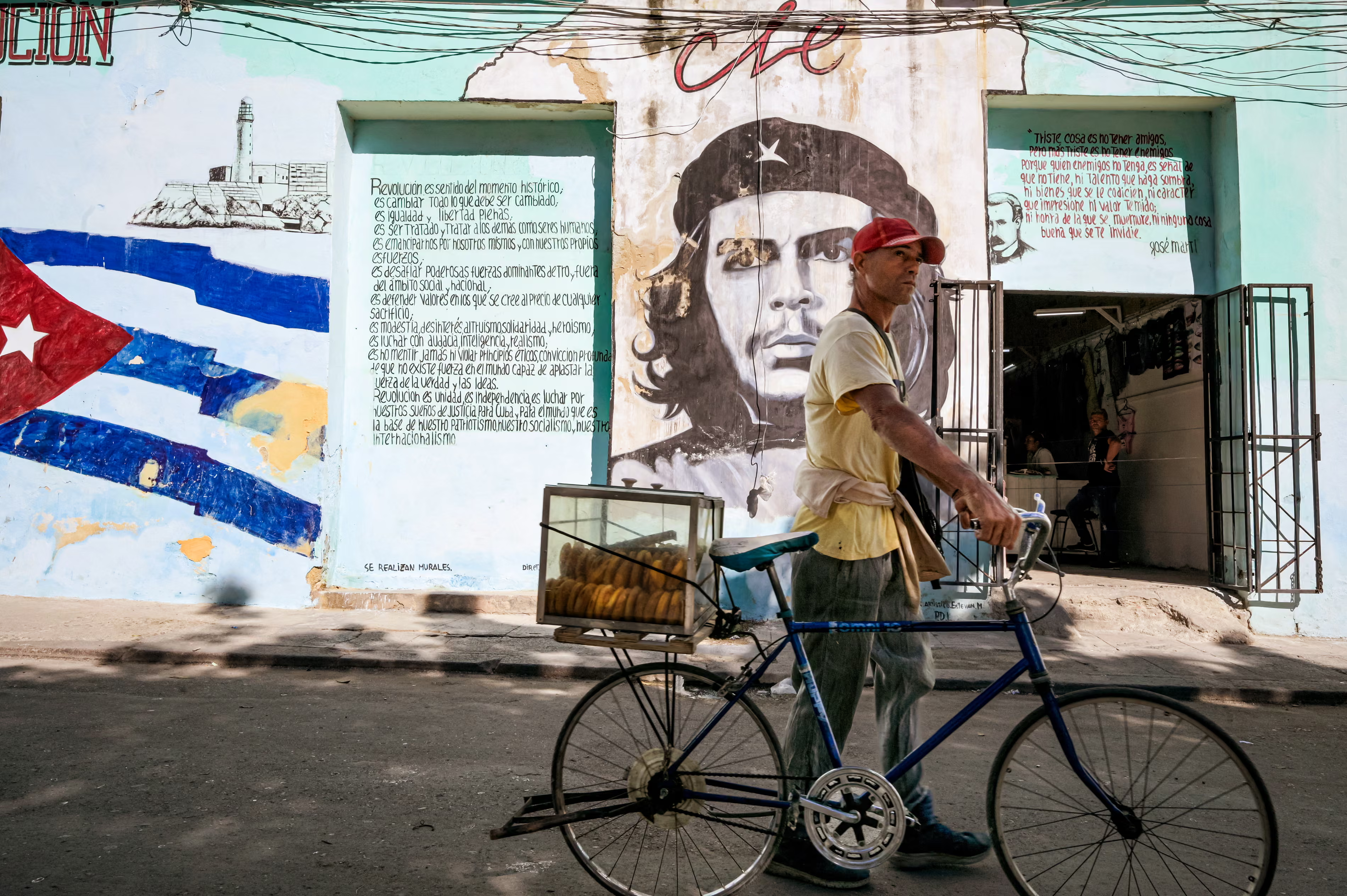
Photo: A man sells pastries in front of a mural of Ernesto ‘Che’ Guevara in Havana. (Adalberto Roque / AFP / Getty Images)
The post U.S. hands off Cuba! first appeared on Workers’ Voice/La Voz de los Trabajadores.
From Workers’ Voice/La Voz de los Trabajadores via This RSS Feed.