

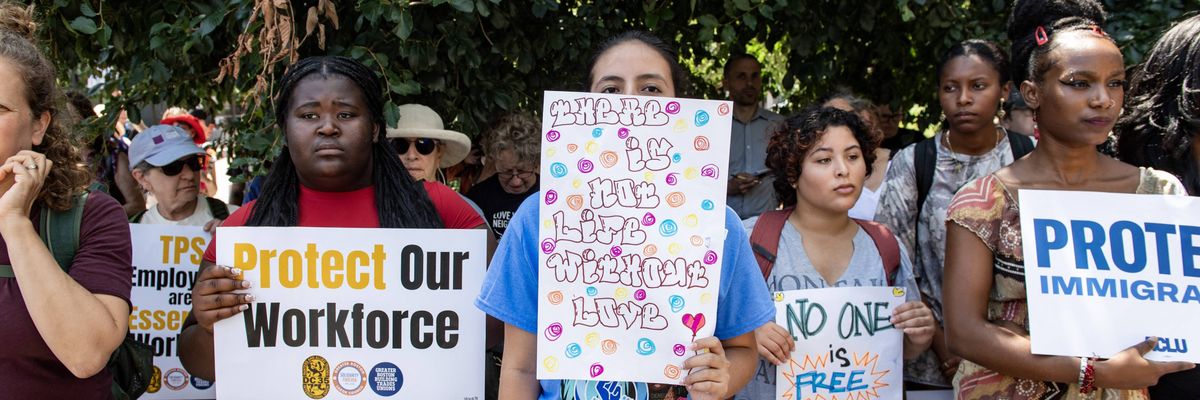
Mass arrests of Haitian immigrants by federal agents could begin as early as this week, according to federal documents regarding President Donald Trump’s new directive to US Immigration and Customs Enforcement following the right-wing majority on the Supreme Court’s ruling that Trump could end deportation protections for the community.
A binding mandate was expected to be sent to lower courts on Monday regarding the high court’s decision last month that held the Department of Homeland Security (DHS) could strip 350,000 Haitians and 6,000 Syrians of their Temporary Protected Status (TPS), which is granted to migrants from certain countries facing disasters, armed conflicts, or other conditions that would put immigrants in danger if they were forced to return there.
After the mandate is transmitted, Haitians across the country will lose their ability to legally live and work in the US, and the administration is reportedly already planning to send ICE agents into states including Ohio—where Haitian communities were targeted by Trump and Vice President JD Vance during the 2024 election—to quickly arrest and deport migrants to their crisis-stricken home country.
Jean Négot Bonheur Delva, director-general of Haiti’s National Office of Migration, told the Haitian Times this month that according to the US embassy in the Caribbean country, about 250 former TPS beneficiaries could be forced back to Haiti on flights each week.
Aaron Reichlin-Melnick, senior fellow at the American Immigration Council, emphasized that the reported operation targeting Haitian communities is just the latest evidence that Trump is rounding up people who have been living and working in the US for years, despite the White House’s claims that it is going after “the worst of the worst.”
“The majority of Haitians with TPS today entered the US lawfully on humanitarian parole during the Biden administration, and then transitioned to TPS before their parole status expired,” said Reichlin-Melnick. “Those people have not spent a single day in violation of immigration law.”
The crisis in Haiti that necessitated TPS for people who arrived in the US from the country, he added, “hasn’t ended.”
Haiti is the poorest country in the Western Hemisphere, with widespread food insecurity, and large swathes of the country as well as transport routes are controlled by armed gangs. Violence intensified toward the end of 2025 “and remains the dominant force shaping the daily life of Haitians,” according to the United Nations, with more than 8,100 killings reported last year, and gangs have increasingly used children in violent attacks.
Many healthcare facilities are “barely functioning,” and extreme weather including hurricanes and droughts have worsened the humanitarian crisis. The country has also struggled to fully recover from the devastating 2010 earthquake that killed hundreds of thousands of Haitians.
Last week, US Rep. Joaquin Castro (D-Texas) spoke out about a Pentagon plan to strengthen coordination between the UN’s Gang Suppression Task Force in Haiti and a private military contractor run by Erik Prince, a close ally of Trump’s. The contractor, Vectus Global, has conducted drone strikes that have killed dozens of Haitian civilians.
Those conditions are what DHS suggested Haitians should voluntarily return to, after having built lives in the US, when the agency told CBS News on Monday that TPS has been used as a “defacto amnesty program” and called on people who are about to lose protections that have been in place for 16 years to “self-deport.”
“What we would say now is it’s closing time which means you don’t have to go home, but you can’t stay here,” DHS told CBS News. “The good news is it’s not too late to get a $2,600 check and a free flight home.”
The Supreme Court’s majority asserted last month that Trump administration officials did not make “overtly racial” comments about Haitians that would suggest the push to end TPS for the population was driven by “racial animus”—but US District Judge Ana Reyes in the District of Columbia came to the opposite conclusion earlier this year, saying then-Homeland Security Secretary Kristi Noem had likely pushed to end TPS "because of hostility to nonwhite immigrants.”
Reyes pointed out that Noem had not acknowledged the $1.3 billion Haitian TPS holders pay each year in taxes, and said Trump’s racist comments about Haitians in the US—including that they “probably have AIDS” and that residents of the community in Springfield, Ohio were eating their white neighbors’ pets—were rooted in “racial animus.”
The ICE directive to ramp up enforcement operations against “an ethnic group the president has repeatedly attacked is bigotry as official government policy,” said Reichlin-Melnick.
Rep. Sylvia Garcia (D-Texas) called on members of Congress to sign on to a discharge petition she put forward for a vote on “the American Dream and Promise Act, to extend protections for TPS holders from Haiti and 16 other countries.”
“In less than four days, House Democrats secured 210 signatures, including two Republicans, we just need eight more members of Congress to force a vote,” said Garcia. “TPS holders, you are not alone, we are with you!”
From Common Dreams via This RSS Feed.