


Bullets:
The world’s central banks are buying gold at the highest levels in decades, and China continues to stockpile gold while dumping US Treasury bonds.
The valuations for gold mining stocks are far below other investment classes, especially compared to tech shares.
Mining companies require high capital expenditures to start operations, and to maintain them. Tech companies, by contrast, can start and grow on small budgets.
But today’s tech companies require hundreds of billions of dollars in new CapEx simply to grow revenues at all, while facing existential challenges from Chinese AI and semiconductor industries.
Inside China / Business is a reader-supported publication. To receive new posts and support my work, consider becoming a free or paid subscriber.
Report:
Good morning.
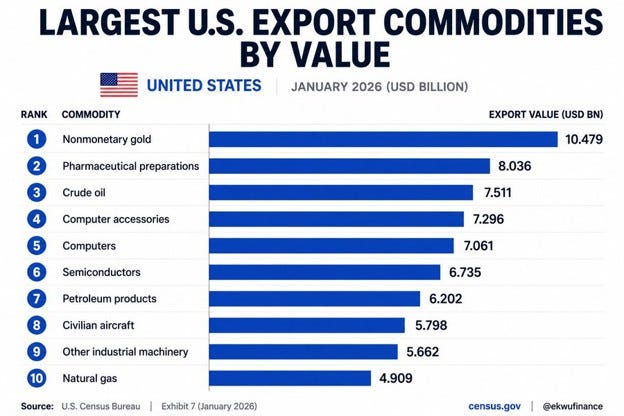
In January, Gold was the number one export from the United States, ahead of drugs, ahead of energy, ahead of semiconductors, ahead of aircraft. We were expecting that to be a one-off, but gold exports from the US continued through all of Quarter One.
Gold topped US exports for the first three months: $45 billion in gold was exported, ahead of civilian aircraft at $39 billion and refined petroleum at $30 billion.
Primary buyers of that gold, globally, are central banks. The institutions that can literally print money, to buy US Treasury bonds or to lend in their own economies, are instead gold at the highest levels in years.
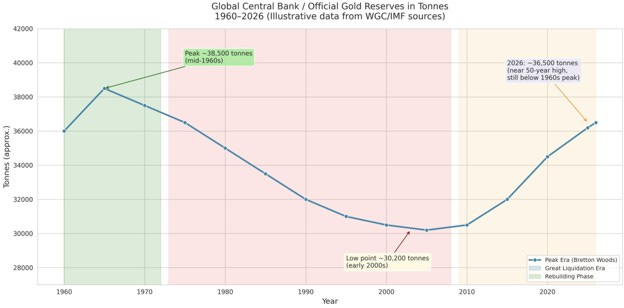
That is a reversal from previous policies of the world’s central banks, who were net sellers of gold from 1965 through 2000. And in the 2020’s, gold buying by central banks outside the G7 went vertical, as China, India, and emerging market economies decided they couldn’t get enough.
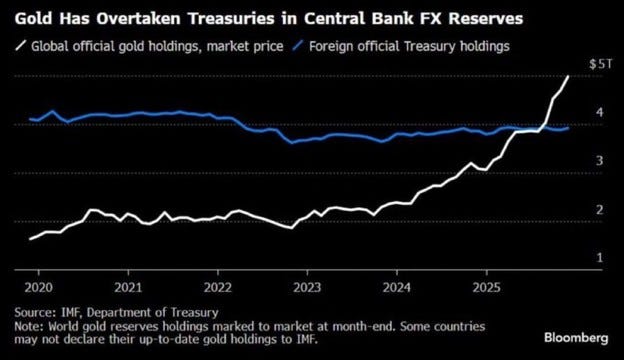
This is a picture of the de-dollarization trade, right there. For years, central banks held more than $2 worth of US Treasury bonds for every $1 dollar in Foreign Exchange gold holdings. The Y-axis is trillions of dollars, and since 2022, central banks sold over $500 billion in US treasury bonds, and bought over $3 trillion in gold.
And it’s not like there were fewer Treasury bonds to buy—trillions of dollars’ worth of new US government debt has been created since then, but central banks on balance are selling Treasury bonds instead of buying, and so interest rates are going up.
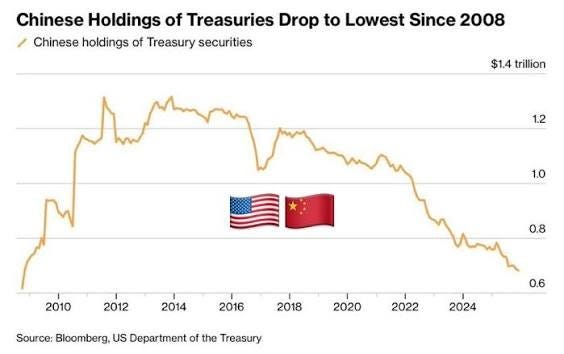
China is the 800-pound gorilla in the room for a lot of these data. They are dumping Treasury debt, while buying gold. That in itself is historically unusual: typically countries who run large trade surpluses, like China does, invest those surpluses into productive assets in the country where the surpluses were generated.
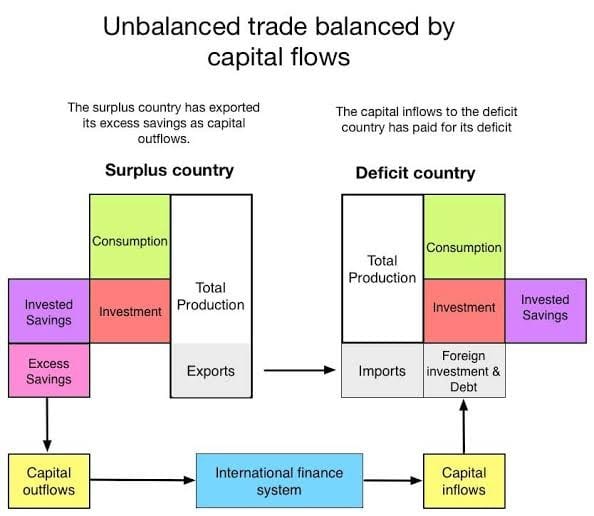
Under classical economic theory, we would have expected them to invest in new factories in the United States, or to buy income-producing debt instruments, like Treasuries. But the Chinese instead are taking the dollars earned in trade, buying gold, and shipping it to vaults back here.
And that was confirmed again in the Q1 export data. Hong Kong is now the second largest buyer of US gold, passing London for the first time ever. Hong Kong is the repository for China’s offshore gold.
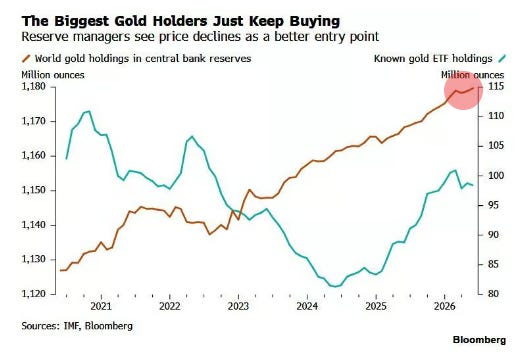
So central banks’ demand for US government debt is going down, while their demand for gold is going up. But the supply of new gold is limited by what comes out of the ground. And it’s here we’ve got a lot of questions.
And I’ll preface everything that’s coming next, with the disclaimer that nothing we do or say here is a recommendation to buy or sell investments. For the record, I don’t buy stocks at all; our investments are in our own companies. There are a lot of stocks and companies we hate, and we make that kind of obvious, but that is still not a recommendation on our part for anyone to sell shares.
Moving on, then, to the valuation problem. Gold miners are selling their production into a market that cannot get enough of it. Even the Chinese want to buy it. And that is very different, already, from these stocks that are sucking all the air out of the room. The Artificial Intelligence investing theme may be falling apart right now, in real time, and in large part because Chinese large language models now deliver the same performance at a fraction of the price. And China’s chip fabs are just a little behind the top chipmaking firms in the West, and may not be behind at all.
So we’re asking the question today, whether gold mining stocks are deeply undervalued, and especially relative to the companies that are grabbing all the headlines.
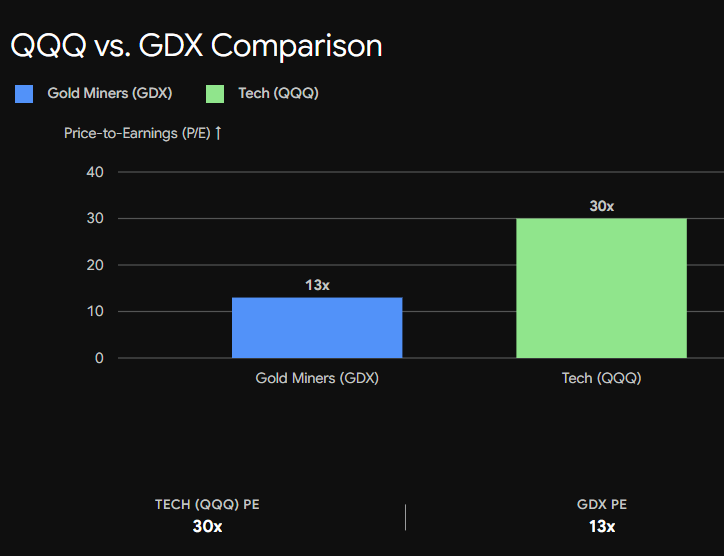
The Price to Earnings ratio is a traditional, old-fashioned way of looking at how much money a company actually makes, compared to the stock price. Simply put, it’s how long it takes an investor to get his money back in companies’ profits. GDX is an index of gold mining stocks traded in the United States, and the average stock price is 13 times today’s earnings. The QQQ is the technology index, and investors there are waiting 30 years. So those tech investors obviously expect earnings to accelerate, to speed up.
But that’s the problem, because big tech now faces the same issue that always faced gold miners. For decades, the advantage for Silicon Valley companies is that they can grow, quickly, without high levels of capital expenditure.
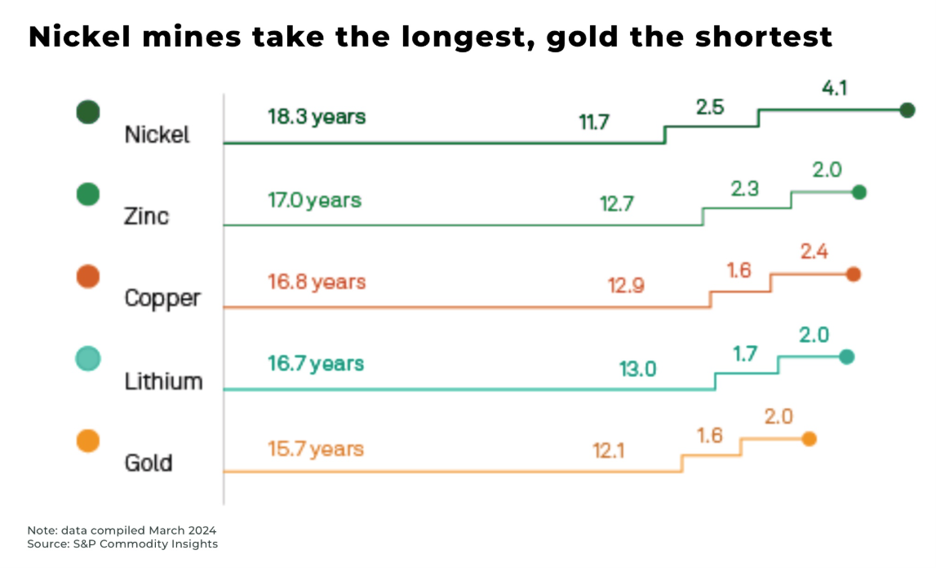
Gold miners, on the other hand, have to spend a lot of money, and time, to get their mines up and running. It takes over a decade just to get a new gold mine surveyed and approved, then huge investments in heavy mining equipment. All those capital commitments are upfront, and involve hiring hundreds of professional mining engineers and specialists.
It’s simply not possible to start a new gold mining venture in a college dorm room, for example, on a shoestring budget. Gold mining is expensive, and it’s capital-intensive to keep the mines going once they’re set up. That’s why investors need look at free cash flow, besides just earnings. Earnings by themselves are deceptive, and especially so in the case of companies with lots of expensive equipment that needs to be depreciated and replaced.
But today it’s the tech companies that are pouring hundreds of billions of dollars into new CAPEX. Price to Future Cash Flows for the tech companies are far higher now, than for gold mining shares:
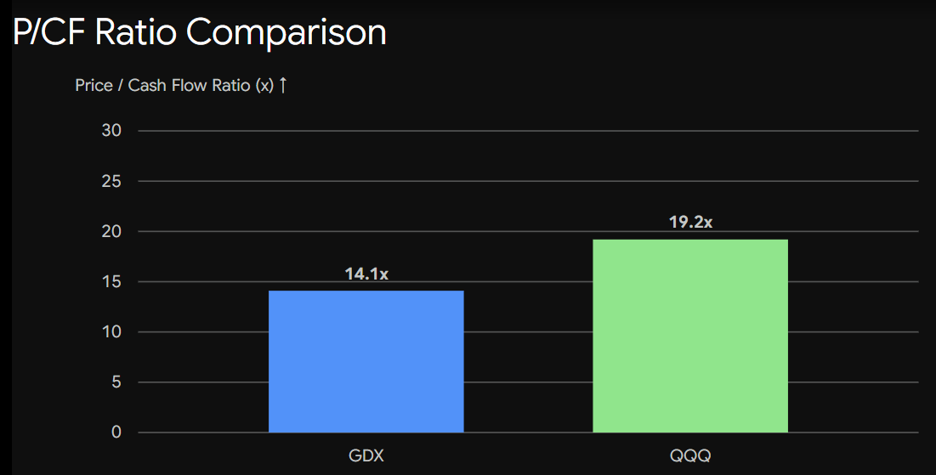
Let’s look at the top three gold mining companies by market cap, Newmont, AEM and Barrick Gold. Newmont Corp has a current Price to Earnings of 11.77, and a forward P/E—price divided by expected earnings next year, of 8.76. Price to Future Cash Flow is 10.76. Again—the lower the number, the more attractive the shares, from the point of view of a traditional investors.
Agnico Eagle Mines, current P/E of 13.6, Future of 11.3, Price to future cash flow of 16.3.
Barrick: P/E of 10.22. Forward of 8.9, P / FCF of 11.5.
Contrast those with the biggest technology names. The difference between big tech now, and before, is how many hundreds of billions of new capital expenditure are required to keep growing. Nvidia’s forward P/E is 16.2. But the Price / FCF is 42.04. Meta is Facebook; Price / FCF is 31. Microsoft, Price / Free Cash Flow is 39.
The biggest tech names are “priced to perfection”; everything has to go perfectly well for those Capital Expenditures to translate into the necessary trillions of dollars in future profits. Meanwhile equity investors also seem to believe that central banks are going to change their minds about gold, and that China will.
The market capitalization for Facebook is $1.3 trillion. All the publicly traded gold miners, combined, are worth just $23 billion. Here’s a data point that shows that a lot of people are very wrong, about something: Estimates for Facebook’s new CAPEX for 2026 are over $125 billion.
For 2027 it will be a lot more than that, perhaps double, over $200 billion. But for just $25 billion Facebook could buy outright most of the gold mines in North America.
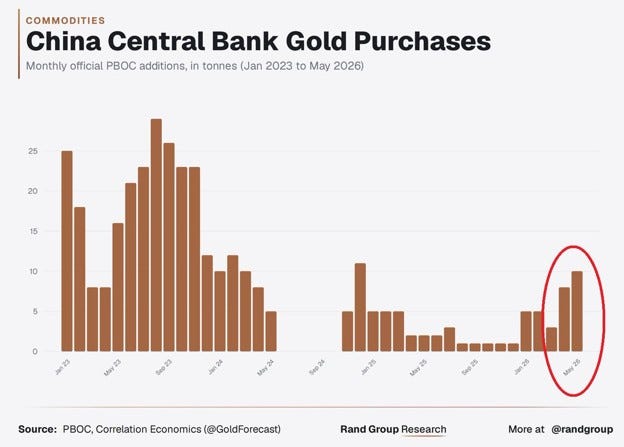
Executives of gold mining companies believe that their CapEx will result in future cash flows, in sales of gold, and believe that buyers in China are waiting for gold to come out of the ground so it can be shipped off to Hong Kong the next day.
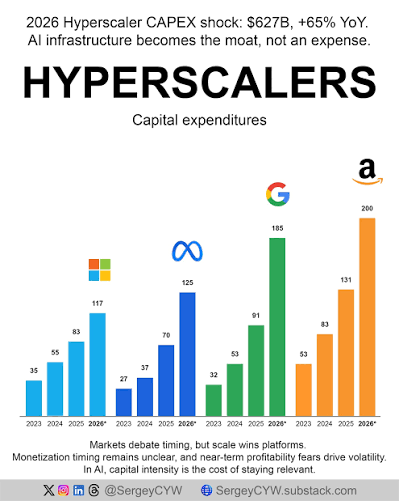
But the people running Facebook and Microsoft believe that their capex will result in far higher future cash flows and AI revenues, and believe that China’s tech industry won’t be around.
Somebody is wrong, and so are their investors.
Be good.
Resources and links:
What are the US top export items in Q1/2026?
https://tradeint.com/insights/us-top-export-items/
Chinese gold imports stay elevated
https://x.com/KobeissiLetter
Buy gold, wear diamonds
Told you—buy gold
Tether is buying more gold than China
Weekend thoughts
[ Gold and Geopolitics
Weekend thoughts
This is a weekly digest of unassociated pictures (graphs mostly) I saw during the week. Not much context is given…
Read more
a day ago · 62 likes · 6 comments · No1](https://no01.substack.com/p/weekend-thoughts-dd2?embedding_publication_id=3320368)
China’s gold buys are accelerating in 2026
New mines take nearly 18 years to build in 2020-23
https://theoregongroup.com/investment-news/new-mines-take-nearly-18-years-to-build-in-2020-23/
How Gold is Mined: The Lifecycle of a Gold Mine
https://www.gold.org/gold-supply/gold-mining-lifecycle
Gold Wars: investors, central banks, and BRICS are dumping dollars for “safe haven” of gold
Stock data from www.finviz.com and Bloomberg
Inside China / Business is a reader-supported publication. To receive new posts and support my work, consider becoming a free or paid subscriber.
From Inside China / Business via This RSS Feed.