

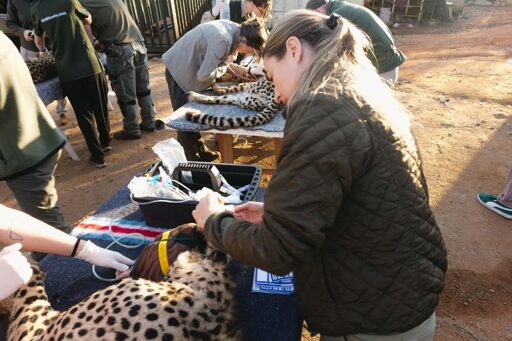
Cheetahs are back in Zambia’s Greater Luangwa Ecosystem, nearly 30 years after the big cats’ last recorded presence in the massive landscape. Six cheetahs (Acinonyx jubatus), three males and three females, were earlier in July moved by Zambia’s Department of National Parks and Wildlife (DNPW) and several conservation groups, including the South Africa-based Endangered Wildlife Trust (EWT), to a remote part of North Luangwa National Park. The cheetahs were translocated from private reserves in South Africa. Another six will be moved in August, while a third batch of six will follow in August 2027, according to a statement by EWT. There haven’t been confirmed sightings of cheetahs in the Greater Luangwa Ecosystem since 1998, according to EWT’s fact sheet, which attributes the cat’s disappearance to successive outbreaks of anthrax disease and habitat disturbance. “Many of the threats that likely contributed to the disappearance of cheetahs from Luangwa in the 1990s have been significantly reduced,” Olivia Sievert, manager for EWT’s Cheetah Metapopulation Project, told Mongabay by email. Sievert said conservation efforts in North Luangwa and South Luangwa national parks, the two major protected areas in the ecosystem, have resulted in healthy prey populations, allowing large carnivores such as lions (Panthera leo) and African wild dogs (Lycaon pictus) to flourish across the ecosystem. “However, cheetahs are unable to naturally recolonise the Luangwa valley because the nearest viable populations are too distant and disconnected for natural dispersal to occur,” Sievert said. “As a result, active reintroduction is the only realistic way to restore…This article was originally published on Mongabay
From Conservation news via This RSS Feed.