

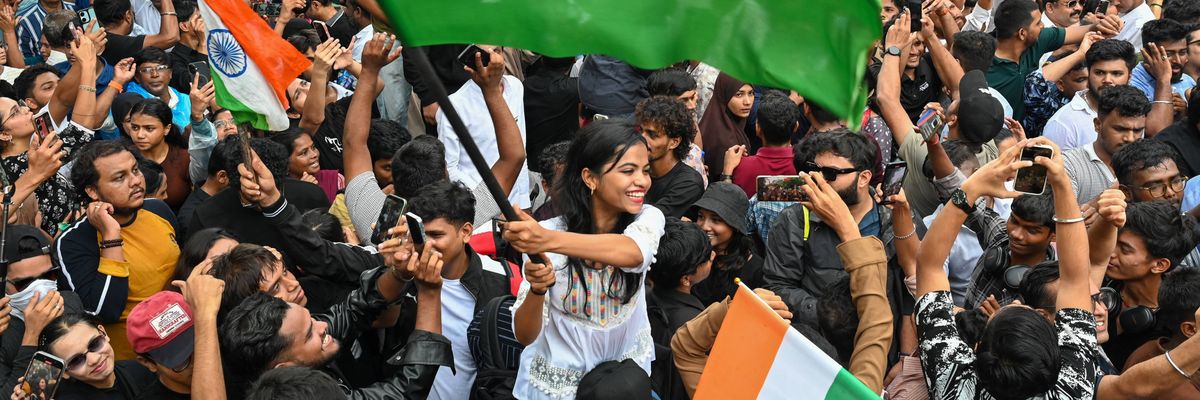
India’s Cockroach Janta Party ended its five-week multi-city protest on Saturday after the youth-led movement’s key demand—the resignation of Education Minister Dharmendra Pradhan—was met.
“We have done it,” CJP spokesperson Saurav Das told a jubilant crowd at New Delhi’s Jantar Mantar. “Pradhan has sent in his resignation, which means that our first demand has been met.”
Das said that the protesters’ second main demand, the withdrawal of criminal investigations targeting CJP members, was also met. However, members and supporters of the movement noted that some cockroach protesters remain in detention and vowed to continue pressing for their release.
Pradhan’s resignation is the first such surrender to public pressure during the 12-year tenure of Hindu nationalist Indian Prime Minister Narendra Modi.
“Considering the situation at Jantar Mantar and elsewhere in the country, and so that anti-national forces do not take advantage of the circumstances, national unity is maintained, no student’s future gets entangled in legal complications, and our children can focus on their studies and building their careers, I have submitted my resignation," Pradhan said in a statement.
Pradhan’s tenure was marred by repeated leaks of National Eligibility Entrance Test (NEET) papers in a scandal that has upended the lives of millions of students by forcing them to retake the grueling exams and delaying their university admissions. CJP organizers said more than 20 students have killed themselves over the matter.
The now-ex education minister had dismissed the protesters as “the B-team of terrorists.”
On Sunday, Modi said he would authorize the creation of an examination reform task force headed by Nandan Nilekani, co-founder of Indian tech giant Infosys.
“The government of India is continuously taking various measures for the future of students," the Bharatiya Janata Party prime minister said in a video posted on social media. “However, we must look to the future. Our examination system needs to be reliable and transparent, and it must make maximum use of technology.”
The protest movement began in May after Chief Justice of India Surya Kant reportedly compared unemployed young people to “cockroaches.” The protesters, led by political strategist Abhijeet Dipke, satirically reclaimed the slur as the symbol of a movement that has grown into a broader challenge to Modi’s increasingly authoritarian rule, which has seen mounting repression of protest and dissent, including restrictions on journalists and activists, and the use of “lawfare” to target critics.
Last week, tens of thousands of youth-led protesters marched in New Delhi, where they were met and attacked by police batons and tear gas. Indian media reported thousands of injuries.
The mood was markedly different following Pradhan’s resignation.
“Cockroaches won!” many CJP members and supporters said.
Others added, “Democracy Won!”
“This is democracy,” said the CJP.
“Now that the cockroaches have won their first battle, may they win many more,” Tavleen Singh, a columnist for The Indian Express, wrote on X. “May they become a real political party in the near future.”
Sonam Wangchuk, an environmentalist whose hunger strike was a focal point of the cockroach protests, was released Sunday from a Gurugram hospital, where he had been recovering from his 26-day fast since Thursday.
Emboldened by the CJP victory, members of the Communist Party of India (CPI)-affiliated All-India Youth Federation and All-India Students’ Federation marched on the Chennai residence of Tamil Nadu Gov. Rajendra Vishwanath Arlekar demanding the abolition of the NEET. According to Indian media reports, police detained more than 200 of the demonstrators.
“The struggle will intensify,” said CPI.
“Don’t mistake the beginning for the end,” echoed CJP.
Asked Sunday what’s next for the cockroach movement, Dipke told an ANI reporter that “we will soon share the next strategy.”
“This has just ended yesterday,” he added, “please give us a little time.”
From Common Dreams via This RSS Feed.