

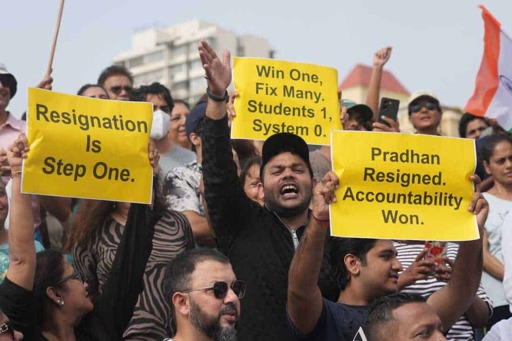
India is being rocked by massive youth-led protests, sparked by an inflammatory statement by the Supreme Court of India’s Chief Justice, Surya Kant. In a May hearing, Kant said, “There are youngsters like cockroaches, who don’t get any employment and don’t have any place in the profession.”
This caused widespread outrage among the youth who have now claimed the “cockroach” label and taken to the streets in unprecedentedly large numbers, showing the way forward in fighting the right-wing administration of Narendra Modi.
Youth Precariousness and an Undemocratic Education System
Not long before Kant’s controversial statements, India’s highly competitive medical entrance exam, the NEET, had been mishandled by the education department led by Dharmendra Pradhan. Over two million students take this examination each year for only about 150,000 spots. For many, it represents a lifeline for a better future. The cancellation of this year’s exam caused intense stress and despair, leading to the suicides of at least 20 students. This scandal, combined with Chief Justice Kant’s controversial statement, has led to months of youth discontent.
Abhijeet Dipke, a recent Boston University graduate and former volunteer for the Aam Aadmi Party (AAP), started the satirical “Cockroach Janta Party (CJP),” a play on the name of the ruling Bharatiya Janata Party (BJP) after Chief Justice Kant’s comments. The CJP quickly accumulated over 25 million followers on Instagram and mobilized hundreds of thousands of protestors across the country, which exploded into mass protests. The CJP organized a march to the parliament in the capital of New Delhi on July 20 which was brutally repressed by the police.
Students were further radicalized by a 26-day hunger strike held in solidarity by activist Sonam Wangchuk during which he was kidnapped and isolated in a hospital where he could only communicate through handwritten notes. Solidarity protests quickly sprung up in cities across the world where international students like Dipke form a large part of the Indian diaspora. Pradhan resigned after another day of large protests on July 24.
![Graffiti art translating to "[We] don't have jobs. If you erase us, we will return tomorrow!"](https://www.leftvoice.org/wp-content/uploads/2026/07/image-1024x909.jpeg)
Graffiti art translating to “[We] don’t have jobs. If you erase us, we will return tomorrow!”
In addition to brutal violence against protestors which left at least one person in intensive care, there have been reports of police officers sexually harassing women, censorship on social media, and the blockade of public transportation in New Delhi. Neha Bora, a PhD scholar at Jawaharlal Nehru University and the president of the All India Students Association, said, “the anger that originated from the violence that was committed on the 20th far exceeded any other emotion that the students are feeling.” Bora was on a 23-day hunger strike but has said that it was “nothing compared to how many people showed up on [the] 20th.”
These protests are happening as youth all over the world are coming of age into a system ravaged by exploitation, increasing cost of living, austerity, wars, and genocide. Gen Z have taken to the streets en masse in places like Bangladesh, Peru, Madagascar, Kenya, Morocco, Italy, and beyond. In India, this crisis of the youth is being intensified under the right-wing Modi administration.
Many students and activists want to abolish NEET and the NTA (the body administering the test) altogether. This opposition to NEET and NTA calls into question an education system that is underfunded, understaffed, and undemocratic, and makes millions of youth compete over crumbs, portraying the process as meritocratic. Some also want the National Education Policy (NEP) of 2020 to be reversed. The NEP was a slew of measures implemented with little parliamentary debate to further precarize the country, introducing more liberalization measures aimed toward increasing public disinvestment and privatization and deregulation.
This education system perpetuates the oppressive caste system and forces students who can afford an education elsewhere to leave the country. This year’s NEET exam was the straw that broke the camel’s back, coming after decades of attacks from the capitalist class. As India’s billionaires have profited immensely from privatization measures in recent years, the working class and youth have become more and more exploited.
The Hindu nationalist BJP took hold of the national government back in 2014. Since then, Modi has not only relentlessly privatized and deregulated the economy but also instilled a social order which furthers the brutal oppression of marginalized communities. The last youth-led movement in India occurred in 2019 against an Islamophobic citizenship law. Alongside the Black Lives Matter movement in the U.S. emerged the Dalit rights movement in India. Soon after came the massive farmers’ movement against three agricultural laws aimed to privatize the sector. The ongoing movement is a sign of the revolutionary spirit that the masses carry.
Pradhan’s Resignation Is Just the Beginning
Pradhan’s resignation is not the end; the movement has outgrown the minimal demands of its leadership. Not just the youth, but Indigenous people and farmers across the country are also fighting privatization and demanding land rights in response to years of privatization which have corrupted many crucial sectors. The farmers protests of 2020 and 2021 are a stark reminder of the connections between these struggles and demonstrate the need for a unification of all movements — students, workers, farmers, Dalit and indigenous communities, and more.
The youth, however, carries an anger and energy so palpable that its leadership is struggling to contain it within the confines of bourgeois electoral politics.
The demands of the CJP included Pradhan’s resignation, as well as reparations for the families of the deceased youth, and an end to the police violence against protestors. All demands have been promised by the government now. In light of this, the CJP has now called off all protests. But the enthusiasm of the youth can achieve so much more than this; it can topple the entire Modi regime. It is especially important to continue this fight now that Pradhan has been replaced by Pralhad Joshi, another far-right BJP politician and a longtime member of the Rashtriya Swayamsevak Sangh, a Hindu nationalist militia notorious for violent lynchings of minorities.
Education does not need these right wing goons and corporate administrators in any capacity; students and workers can run schools and universities themselves. Indian youth are not alone in their struggle against right-wing attacks on the education system, and we extend our full solidarity to them in this fight.
The CJP which kickstarted this massive movement is now walking back on some of its demands regarding police brutality and collaborating with right-wing Hindu nationalist politicians such as Uddhav Thackeray of the Shiv Sena party in the state of Maharashtra. Additionally, there have been reports of the CJP leadership not permitting protestors to chant anti-Modi and pro-Kashmir slogans. It has been blatantly encouraging nationalism among the youth, urging them to bring the national flag and constitution to protests. Even as bourgeois politicians and celebrities insist that the police force is doing its job and to remain peaceful, the youth is having a formative experience with the police, leading to disillusionment with law enforcement and with the prospect of careers in policing and administrative positions.
This reflects the problems of a strategy rooted in electoralism and class collaboration. A Hindu nationalist politician like Thackeray cannot save us from Modi. A movement organized by a handful of nationalist activists will never get to the root cause of the crisis. What we need is democratic organizing from below. This includes democratic assemblies to discuss and debate demands, a unification of the student movement with the workers, farmers, and Indigenous peoples.
If previous capitulations to electoralism have taught us anything (like AAP in New Delhi in 2012, for instance), it is that nobody is going to save the working class except us. Workers need to unite with students to organize strikes and assemblies to take on the Far Right. Unity not only domestically but also internationally is our best bet for winning dignity, full rights, and liberation across all castes, ethnicities, gender identities, and sexual orientations. Our website and our communities are open to all those in South Asia and the world thinking about the youth revolts. In the words of our comrade Anasse Kazib, a militant Marxist in France, if we are not profoundly internationalist today, we will be nationalist tomorrow.
The post India’s Massive Gen Z “Cockroach” Protests Show How to Fight Modi and the Right appeared first on Left Voice.
From Left Voice via This RSS Feed.