

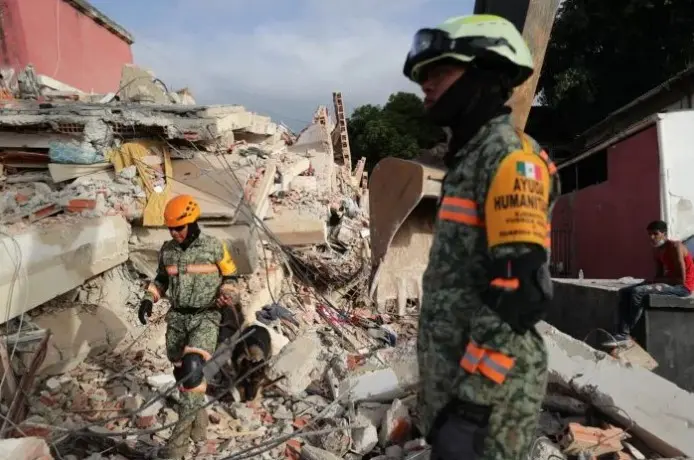
Venezuela Mexico aid delivered after the earthquake brought medical, technical, and humanitarian support, strengthening bilateral ties in a crisis.
Related: Venezuela Military Promotions Mark Bolívar’s 243rd Birth Anniversary and a Strong Call for Unity
Venezuela Mexico aid became a symbol of regional solidarity after the earthquakes that struck the country on June 24, as Caracas formally thanked Mexico for its humanitarian support. The Venezuelan government recognized the assistance as timely, technical, and essential for helping affected communities during the emergency.
Foreign Minister Félix Plasencia delivered the message of gratitude during a phone call with Mexico’s foreign affairs secretary, Roberto Velasco. He conveyed the appreciation sent by Acting President Delcy Rodríguez to President Claudia Sheinbaum, highlighting the speed and sensitivity of Mexico’s response.
Venezuela Mexico aid and humanitarian response
During the conversation, Plasencia said that Venezuela Mexico aid reflected the historic ties between both countries and the willingness of both governments to cooperate in moments of crisis. He noted that the response included not only supplies, but also specialized personnel capable of supporting emergency operations.
Mexico sent several tons of assistance to Venezuela through the Simón Bolívar International Airport in Maiquetía on July 1. The shipment included equipment for the Red Cross, five power generators, and 2,200 kilograms of information and communication technology transmission systems, along with health and telecom personnel.
Authorities also reported the arrival of 341 tons of humanitarian aid, which included four water purification plants, Mexican technical operators for installation, medical supplies, medicines, non-perishable food, and materials for housing reconstruction. That package made Venezuela Mexico aid one of the most significant regional responses to the disaster.
The Venezuelan government stressed that the assistance helped address urgent needs in the hardest-hit areas, where damaged infrastructure and displacement complicated access to basic services. The medical and communications support was especially important in restoring coordination between emergency teams and local authorities.
Bilateral ties and regional solidarity
Beyond the emergency itself, both diplomats used the call to review the state of Venezuela-Mexico relations. According to the official account, both sides agreed on the importance of deepening strategic ties and expanding cooperation in areas of common interest.
That includes diplomatic dialogue, humanitarian coordination, and historical friendship, all of which have long shaped the relationship between the two countries. In this context, Venezuela Mexico aid was presented not as a one-time gesture, but as part of a broader regional logic of mutual support.
The exchange also reinforces a familiar pattern in Latin America, where countries often rely on neighbors during natural disasters when access to external financing or rapid international logistics can be limited. In that sense, Venezuela Mexico aid carries significance beyond the immediate emergency response.
The message from Caracas suggests that the government views Mexico’s support as a demonstration of practical solidarity in a moment of national vulnerability. It also signals that humanitarian cooperation remains one of the most stable areas in bilateral relations, even as political differences exist across the region.
Geopolitical context
Venezuela Mexico aid comes at a time when Latin America is facing repeated climate and disaster-related pressures, making cross-border humanitarian cooperation increasingly important. Earthquakes, floods, and storms have shown how quickly governments can be tested when emergency systems need outside support.
Mexico’s response also highlights the role of regional diplomacy in disaster relief, where governments can act faster than larger multilateral frameworks. For Venezuela, the aid underscores a broader effort to maintain international ties and diversify support networks during a period of economic and social strain.
From teleSUR English via This RSS Feed.