

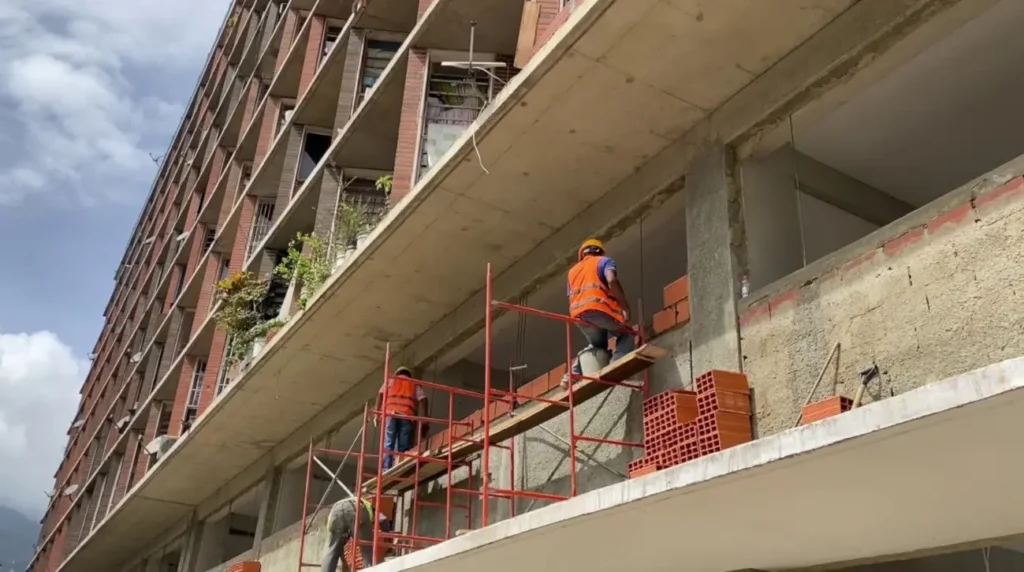
Venezuela earthquake inspections top 8,000 buildings after the twin quake, with most habitable and a major rebuild plan still underway.
Related: Venezuela Military Promotions Mark Bolívar’s 243rd Birth Anniversary and a Strong Call for Unity
Venezuela Earthquake Inspections as Recovery Accelerates
Venezuela earthquake inspections have surpassed 8,000 buildings one month after the twin earthquake that hit the country’s northern region on June 24. The latest assessment by the Venezuelan College of Engineers shows that more than 70% of the evaluated structures are habitable, while about 25% require caution or are not safe for occupancy.
The inspections are part of a broader technical and humanitarian response aimed at determining building safety, identifying structural damage, and giving residents reliable guidance as reconstruction efforts continue.
Venezuela earthquake inspections and building safety
According to the Venezuelan College of Engineers, volunteer engineers have already visited more than 8,000 structures in Caracas and other affected areas. Their work is focused on checking whether buildings can be used safely, spotting critical faults, and issuing technical recommendations to reduce risk.
Rafael Argotti, a member of the group’s national board, said the response has involved around 6,000 professionals working voluntarily and without pay in the disaster zones. He described the effort as a major civic mobilization intended to restore confidence among residents who remain concerned about the safety of their homes and workplaces.
The organization expects to reach 12,000 inspections in total. To get there, the College of Engineers is working alongside local governments, universities, firefighters, and civil protection teams, in what officials describe as an interinstitutional effort to speed up the evaluation process.
Most of the inspected buildings have been classified as habitable, but the remaining cases include properties with restricted use or with damage severe enough to make them unsafe. That distinction is important, since many families are still deciding whether they can return home or need temporary relocation.
Damage toll and reconstruction outlook
The technical update comes as Venezuela marks one month since the earthquake disaster struck the country’s north. Official figures cited by the government put the toll at at least 5,546 deaths, 16,740 injuries, 17,907 displaced people, 856 damaged buildings, and 190 collapsed structures.
The broader economic picture is equally serious. The World Bank estimated on Thursday that direct physical damage from the quakes reached $19.6 billion, warning that a slow reconstruction strategy could hold back Venezuela’s economic recovery for the next decade.
That estimate underscores a major challenge now facing the country: repairing infrastructure fast enough to stabilize daily life without deepening long-term economic weakness. Housing, transportation, public services, and commercial activity all depend on how quickly the assessment and rebuilding process can move.
For many communities, the inspections are more than a technical exercise. They are the first step toward returning to normal life, reopening schools and businesses, and deciding where reconstruction resources should go first.
Geopolitical context
Venezuela earthquake inspections are also taking place in a wider regional setting where disaster recovery is shaped by sanctions, financing limits, and uneven access to international credit. That makes the reconstruction effort not only a domestic emergency response, but also a test of the country’s ability to mobilize institutions under pressure.
Across Latin America and the Caribbean, major natural disasters often expose the gap between technical needs and financial capacity. Venezuela’s case is especially sensitive because the scale of destruction comes on top of economic fragility, making rapid rebuilding central to both social stability and regional humanitarian concern.
Community Response and Technical Monitoring
The Venezuela earthquake inspections have also become a broader test of community organization and technical coordination. In neighborhoods where damage was visible but not always structural, residents have relied on engineer-led assessments to determine whether walls, ceilings, stairwells, and support beams remain safe for daily use. This has helped reduce uncertainty, especially for families unsure whether they should return to damaged homes or remain in temporary shelters.
Local authorities and technical teams have emphasized that the inspection process is not limited to identifying collapsed buildings. It also includes reviewing hidden structural weaknesses, water leaks, fissures, foundation shifts, and deterioration in older construction that may have been made more vulnerable by the tremors. In many cases, buildings that appear intact from the outside still require precautionary restrictions until a full evaluation is completed.
The work has also exposed the importance of preventive engineering in a country where many buildings were not originally designed to withstand repeated seismic stress. Engineers have said that the current inspections could help establish a clearer map of urban risk, especially in densely populated districts of Caracas and in older residential zones where informal modifications may have weakened original structures over time.
Beyond the technical dimension, the inspections have had a social role as well. They have provided residents with official confirmation, helping prevent rumors, panic, and unsafe self-assessments. For many families, the presence of volunteer specialists has been just as important as the eventual reconstruction plans, because it offers a direct and credible answer to the question of whether their homes can still be occupied safely.
This phase of Venezuela earthquake inspections is expected to remain central in the coming weeks, as authorities continue to balance emergency response with longer-term recovery planning. The goal is not only to count affected buildings, but also to define which neighborhoods can be reoccupied quickly, which require urgent reinforcement, and which will need deeper structural intervention before any return is possible.
From teleSUR English via This RSS Feed.