

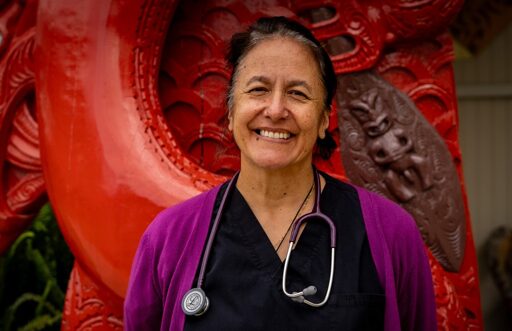

Dr Matire Harwood is a practising GP as well as deputy dean and professor in the Faculty of Medical and Health Sciences at Waipapa Taumata Rau, University of Auckland. (Photo: Francesca Brugnoli)
Professor Matire Harwood (Ngāpuhi) is a leading kaupapa Māori health researcher at the medical school at Waipapa Taumata Rau, University of Auckland. But she still does a GP clinic once a week at Papakura Marae to keep in touch with what’s happening at the flaxroots. Here, she is, sharing some insights from her life with Dale Husband.
Tēnā koe, Matire! I can’t believe we’ve never spoken to you before now, with all the wonderful mahi you’ve done over the years. But let’s resolve that today. And let’s start with your names, please, and how you came to carry them.
My full name is Matire Louise Ngarongoa Harwood. Matire was my grandmother’s name, my mother’s mother. Her name was Matire Ngarongoa Matene from Tautoro, which is south of Kaikohe, in Te Tai Tokerau. Louise comes from my dad, who’s Pākehā. His grandmother’s name was Louise.
My namesake Matire passed away maybe three days after Mum and Dad got married. But because my mum (Haupuru) was the youngest of the 14 children born to Matire, she lived with her right up to the time she married my dad. I think it was a no-brainer for Mum to make sure her name carried through into our whānau.
She was a very strong character, my grandmother. She was well known in Tautoro, and even today, when I see patients who grew up in Tautoro, I can see the fear in their eyes when her name is mentioned. She was very strict, very staunch. Tino rangatiratanga to the max. She would refuse to speak English because she felt there was no reason to. But she also demanded high standards of her children and ensured their education and their very Anglican church upbringing.
I wish I’d met her. But it’s just wonderful that I get to carry her name.
It doesn’t escape me that the name Ngarongoa carries a lot of meaning for someone whose mahi is in health. (Rongoā means remedy or medicine.)
I know. It wasn’t until I got into med school that I reflected on the name Ngarongoa. My grandmother had that name because her uncle had bad asthma and he was on a lot of therapies to help him, so it was to do with kōrero around that.
When I was given her name, I don’t think there was any thought of me going into the health field, so it’s interesting that it happened. Was that destiny? I don’t know.
You’d have to think so. Are you a city kid or were you born in Tautoro?
I was born in Auckland at National Women’s, but we were always back and forth to Tautoro. My dad was a social worker, and our whānau lived in the boys’ homes, first in Mt Albert and then down in Kirikiriroa (Hamilton). Then he got a job as a social worker with the Auckland City Council.
We lived in a Freemans Bay council flat for a long time, while Mum and Dad were saving up for their first whare. They decided to build on the North Shore, so we could be closer to Tautoro. In those days, getting up there was a good five-hour drive because a lot of the road was still gravel.
Mum and Dad made sure we got up to Tautoro regularly. We had the homestead where my great-grandmother had lived. She gifted that land to the whānau so we could build our marae there, right next to the church.
Tautoro is famous for being the place where Hone Heke went to recuperate after he was shot during the Northern War. We grew up with stories about him. And we thought Tautoro was the centre of the universe because that’s where all the amazing, wonderful, talented, but very strong-willed and probably a bit rebellious people whakapapa to.

With whānau in Tautoro. From left: Matire’s Aunty Charlotte, Aunty Sue (holding Matire, aged 3), Aunty Lou, grandfather Ngature Wilcox, and mum Haupuru, holding Aramiha. (Photo supplied)
Tell us about your pāpā.
My dad, Peter Keith Harwood, was born in Whanganui. He had whakapapa from England and Wales. He loved to sing, but he was flat as a pancake, and he was always disappointed that his singing didn’t reflect his Welsh whakapapa.
He lived next door to a Māori family, the Love whānau, and when his father went off to fight in the Second World War, the Loves were the ones who supported him and his mum and younger sister, because they were really struggling.
He went to Wanganui Tech, I think it was called at the time, but he was asked to leave school when he was 15 because his family couldn’t afford for him to stay at school. He started as an apprentice at his father’s butchery, but then he went to night school and got UE. He moved to Wellington and started studying law, but he didn’t enjoy it, so he got into social work.
It was during one of his social work placements in the Far North that he met my mum. He always said that his experience of working in Te Tai Tokerau as a Pākehā had a huge impact on him. I think it built on the short time that he spent studying in the southern states of the US, where he saw racism and the impact of poor government policies on people — but also the power that social services can have to address inequities or eliminate them.
He always had this sense of social or collective responsibility. He believed that people should look after one another, because that was how communities and families were able to flourish. I’d say he was a socialist. He would often talk about the impact that poverty can have on the rest of your life, and how those conditions are set up by leaders who don’t value aroha and community wellbeing.
So Dad was a big influence on our way of thinking, and I think all four of us children reflect that in our mahi today.
My old man was similar. He was a well-read seafarer, but he spent time in the southern states and often talked about the overt racism there. There were good people that he interacted with, but the entrenched racism in those southern states left its mark on him. Can you share a little about your siblings that might illustrate their sense of social justice that was perhaps a legacy of your mum and dad’s ways?
I’m the oldest. When I was six or seven, my grandfather (Ngature Matenga Werekake) told me he wanted me to be a doctor. He also said to my brother, Aramiha, who’s a couple of years younger: “I want you to be an architect.” My brother ended up doing sociology, like my dad. He’s very much like Dad and Mum. Mum was creative — she was an art teacher.
And my brother is a beautiful artist and writer. He did his PhD looking at the experience of international university students living in Australia. We spent some time living there when we were kids. He works in Australia now and brings up his three kids over there.
Naumai is an accountant. She’s always been the brilliant maths person. She’s doing a doctorate, looking at the experiences of professional staff in universities, especially the ethnic and gender inequities in pay and in the opportunities for development and leadership.
Hokimate also has a PhD. She wove together the idea of genetics with mātauranga Māori, in order to find out where the cloaks, the kākahu, in museums, had come from and who those weavers were, and enabled many of them to be returned to iwi.
We were all very close growing up, and we’re still close. We were the sort of kids who would get off the bus from school and go and have a debrief, eating boiled potatoes and having a feed before Mum and Dad got home from work.

In Australia in 1980 with her siblings. From left: Hokimate, Naumai, Aramiha and Matire. (Photo supplied)
I know that you guys lived in Aussie for a while, in rural Victoria. Many of us tried our hand over there, myself included. But it’s a racist place, Australia. Did you find it that way?
Quite a number of Māori whānau moved to Australia in the late ‘70s, and we were one of them. We were surrounded by Māori whānau there. To be honest, I probably had more Māori in my class at kura in Australia than I did at some periods during my primary schooling here in Auckland. With so many whānau there, we came together. Mum and Dad set up a kapa haka. They got a rugby club going. So those were our weekends.
Sometimes I think I wouldn’t have done as well at school if I’d stayed in New Zealand. On the one hand, the racism there was a lot more explicit and in your face. They had no shame in saying: “Oh, we don’t think you’re going to do well.” So you had the opportunity to face that and fight it.
When I returned to New Zealand, it did seem more passive-aggressive here, more implicit, so it was more challenging to fight. You’d think: “Did that actually happen? Am I being gaslit here, or am I imagining things?”
I think that was part of the reason us siblings were so close. We made sure that we had each other’s backs, but so did our parents. Mum would be the one to pick up any signs of racism. She was more vigilant, and she’d make Dad go and take the teachers on. That partnership between those two was really useful for us kids.
So we had lots of opportunities there. We played sports, and we had kapa haka, as I said. Things were more available to us, and it was so cheap to get into all the different clubs.
But we always knew that we would come home. Mum and Dad would say: “The money’s in Australia, but our hearts are back in Aotearoa.” After 10 years there, they were actively looking for jobs back here because they wanted to come home. I’d always dreamed of studying here in Tāmaki Makaurau, so I came back to go to university when I was 17, and they followed six years later.

Matire’s mother, Haupuru, and brother, Aramiha, graduating together with their bachelor’s degrees in Australia, 1991. (Photo supplied)
Our health stats are bloody challenging, aren’t they? There’s a lot of inequity and a lot of injustice in accessing healthcare. Give us some thoughts about why it’s important that we use the best possible approaches to chart a way forward in Māori health, please, Matire.
To me, it’s always been about excellence. To provide excellent care, which means achieving excellent outcomes, you need to achieve equity. So it’s about ensuring that there’s equity in accessing healthcare, as well as equity in the quality of care people receive when they do come into our health system.
Too often, when our people come into the health system, they don’t have a good experience, and they aren’t provided with the best quality of care, and that has an impact on their life for the long term. So our whānau are dying, or they’re becoming more unwell, but they don’t want to come back again because they’ve had a bad experience.
But there’s also inequity before we even get to the health system. If you’re coming from a place where you’re at increased risk of exposure to disease risk factors, whether that be smoking, poverty, or poorer housing, those things are largely out of our control. So excellence is also about addressing each of those determinants that put people at greater risk.
It comes back to Moana Jackson’s point. We get caught up in this narrative of need, but he always argued that we only have these health needs because our rights haven’t been met. We have a right to the best healthcare and the best health outcomes that are available. We have a right to the best life expectancy possible in Aotearoa. We have a right not to live in communities with the most vaping and liquor stores and with the worst housing. We deserve to have the best.
And we have a right to be part of creating the solutions when those rights aren’t being met. So advocacy needs to be part of an excellent health system. Everybody having equal opportunity to have their voices heard and being able to feel safe to speak up about things that are unfair, that are unjust.
Those are all things that, for me, speak to a wonderful and excellent health system.
That’s what I always fall back on. I want to make sure I’m part of the solution and pushing the idea that Indigenous knowledge, mātauranga Māori, has much to offer Aotearoa, if not the world.
I’ve always said that Indigenous-led solutions don’t just benefit Māori — they benefit everybody. Everything that I’ve ever designed in the health system, any intervention which has been with Māori in mind, I’ve always opened it up for everybody. And so everyone has reaped the benefits of these Indigenous-led solutions. That’s always been the sort of work that I strive to do.
Kia ora. You have an impressive body of research work to your name now, including work on heart disease and diabetes, but it all started with your stroke work, didn’t it? I understand that, o****n top of being a stroke doctor, you did a PhD that looked at recovery for Māori after stroke. And out of that came an intervention for stroke rehabilitation designed specifically for Māori and Pasifika — which was so successful it led to changes that benefited everyone.
So, as you said, an intervention you designed with Māori in mind ended up helping everyone. Can you take us back to how you started on that work, please, Matire?
In 1999, I was working in a stroke unit in Wellington with one of the top stroke doctors, Harry McNaughton, when my mum phoned to say that Dad was unwell. I knew immediately he was having a stroke from what she told me, so I asked her to phone the ambulance and ring me when they’d arrived. The paramedics checked Dad over and phoned to tell me he had an inner-ear problem, not a stroke, but I asked them to take him to hospital immediately. There was a bit of moaning about carrying him down the stairs at his whare, but they did.
I flew up from Wellington and went to the emergency department he was at. I arrived just as he came from having a CT of his brain, and so asked the ED doctor what it showed, not mentioning that I was a stroke doctor. She looked me up and down in my tracksuit pants and suggested it would take too long to explain it to me. Well, you should have seen her face when I said I worked in a stroke unit so I had a pretty good understanding.
So, these two interactions with health workers really highlighted for me the issues whānau face when trying to get the best care.
My boss, Harry, was auditing care in the stroke unit, which showed inequities in stroke outcomes. My experience aligned with these findings, so it got me thinking about how I could improve things. In addition to optimising stroke care, I also saw the potential of giving hope to people living with stroke and their whānau. So that was the start of it.
My Pākehā grandmother actually passed away at 60 after she’d had a stroke, and that broke my dad’s heart. And after that he was very much about making sure that, if he and Mum ever became unwell, we would travel home to help and support them, because that lifting of the hearts is very important for recovery.
So that’s what we did. My dad had a stroke at 60 as well, and all four of us made sure that we went home and we were there for him. And I certainly think that helped his recovery. I see that in a lot of health things that I do, the importance of whānau being supported to support their loved ones during illness.

Matire with her parents Peter and Haupuru and her children Te Rangira and Waimarie, graduating with her PhD for her work on Māori and stroke, at Otago University in 2012. (Photo supplied)
Tēnā koe. You should almost be in a circus, with the amount of juggling that you do! You have a full-time job at the Auckland University medical school, and you’re part of research projects and groups advocating for change, as well as being a GP at the Papakura marae. Who are some of the people who’ve helped you along the way, Matire?
I’m very thankful for the people I’ve met along the way. In my third year at medical school, Papaarangi Reidcame to speak to our class. She was working with Eru Pomare at the Wellington School of Medicine and coming into her own as a public health leader in smoking cessation. And she was able to articulate many of the things that I was thinking but didn’t have the words or the framework to put them into.
That was in 1990, which was a big year for us. It was 150 years since the signing of Te Tiriti, and I was becoming pretty active. I was going up north to Waitangi and doing a lot of advocacy and protest work with Ngā Tauira Māori (the Māori Students’ Association).
I was around wonderful, on-to-it young people who were striving to make the world a better place. And not just in the medical school but from the wider student group across the university. People like Linda Te Aho, Wille Te Aho, Chad Brown, Bernard Te Paa, Hare Rua, Dale Sherman, Andrew Tunks, Pierre Pohe. These amazing people went on to major leadership roles and continue to advocate for our people in reo, kapa haka, health, business, and all those sorts of things.
Suzanne Pitama was also part of our rōpū, and she’s now the dean down at Otago Medical School. So I had that alongside me, and then leaders like Papaarangi and David Tipene-Leach. David taught me to question the status quo — not to accept the narrative, and to always unpick it and look behind to see what might be going on. So he was also a really important leader for me.
Elana Curtis and Donna Clark had set up Te Ora, the Māori Doctors’ Association, and we all got to meet other health leaders through that experience. I only got a small opportunity to work with Eru Pomare down in Wellington, and he was very much about the whole idea of clinical excellence, as was Paratene Ngata. Paratene’s last words to me before he passed were: “Matire, you need to make sure we keep up the standards. That’s going to be your role as a clinician, to make sure the standard of care afforded our people is excellent.”
These were people who were always pushing to ensure that we got our rights to the best care, and that we didn’t just settle for good enough.

Matire (centre) at her inaugural professorial lecture in June 2025 with colleagues Professor Susan Wells, Professor Warwick Bagg, Professor Papaarangi Reid and her cousin, Dr Julian Wilcox. (Photo: University of Auckland)
You’ve maintained a role as a GP. When our people, or actually, any of your patients, come into the waiting room, they come with a kōrero and a history and a story, don’t they? How important is it to acknowledge that there’s a richness that everyone carries, a mana, if you will, that needs to be recognised in the way that they’re seen, spoken to, and have their needs addressed?
I love being a GP. When I was a medical student, back in the 1980s and ‘90s, the first three years were mostly lab and lecture-based, and they were pretty challenging, so most people were focused on getting through those years.
But Colin Mantell, who was the lead of the Māori and Pacific Admission Scheme (MAPAS) when I went through, always said to us MAPAS students: “Wait till you hit the wards. That’s when your strengths will really show, where you’ll really fly. Because that’s where your relationships with people will come to the fore.”
I often think about that as a GP. I still have new patients who come into my clinic at Papakura Marae who say, after their first consultation: “You’re the first doctor that’s actually heard me and has listened to me,” and that shocks me.
All it requires is respect. It’s recognising and acknowledging the mana of people and their stories and their context. You’re not going to be able to solve everything at once, but people deserve to feel valued when they come in to see you.
That’s what I expect as well, when I’m the patient. I’ve had both good and bad experiences in the health system. The bad ones have been where you felt not heard. You felt diminished. You felt that that person in front of you didn’t recognise your strengths or your values. So it’s really important that we allow people to feel valued and heard in those spaces.
But you also need to trust your gut instincts, and recognise that sometimes you might not be the best person for that situation, that you might need to bring in an expert, whether that’s cultural or clinical or other whānau who might be able to help. Or you might just need space to reflect on things.
I’m lucky that I get a bit of that space after clinic. It takes me an hour to get home after I leave Papakura, and I really value that time in the car on my own with my Coke Zero and my packet of chips, just to reflect on what I did well in clinic that day and what I could’ve done better. I try to take those lessons into my next clinic.

Professor Matire Harwood at Papakura Marae, where she holds a weekly clinic as a GP. (Photo: Francesca Brugnoli)
It’s a pretty tough time in the health system right now, isn’t it?
It’s certainly challenging at this time with ongoing system changes and a hardworking workforce that’s feeling overwhelmed. We had just come through this huge crisis with Covid, and then we had the reforms and everything else on top of that.
So big ups to all the clinicians out there. We’re all trying our best, and it is challenging, but equally we need to do our best. So please don’t take it out on our people. Please look at how you can change the systems for the better.
Wonderful kōrero, Matire. We all need something to counteract the pressures of our work lives, and reconnecting with the moana for Māori and Pasifika people, has been immense. I know that you’re a waka ama wahine. Let’s talk about that feeling that you get sometimes, when you’re on the water and the water’s glistening, and there’s a sense of calm.
I love waka ama. I was introduced around 1998 in Wellington. And to be honest, the waters aren’t glistening or calm that often on the Wellington harbour. Amster Reedy had a club down there, and he took us all out in a double hull. I was always a ball sports person — I played basketball and touch rugby — and I never considered myself a water person, especially living in Tautoro and then in the country in Australia where we weren’t that close to the ocean.
But we got out on the waka, and there was just something calming about being on the water like that. And I did feel a deep connection.
It’s through waka that I’ve been able to go and, I won’t say compete, but play the sport in various places around the Pacific. So I got a sense of what waka was like for our people as we traversed the Pacific and down to Aotearoa. Just that connection through our ocean, caring for the ocean, being respectful of the ocean. These are all values that are important for us as Māori and Pacific people.
Someone talked about waka ama being the most authentic Indigenous sport that we have in Aotearoa at the moment, and that really resonates with me. It’s the whole team play, the camaraderie, the humour, and that connection with the ocean that connects us as Indigenous peoples across the Pacific. Just knowing that our ancestors, our tūpuna, were doing it well before our time and that we’re continuing that legacy and tradition. What a privilege for us!
And then going to the waka ama sprints each year and just seeing beautiful, healthy, flourishing people of all ages, from our teeny-tiny babies out there paddling with their nannies and parents, right through to our kaumātua who are still paddling into their 80s and loving it.

Matire (second from left) at the Waka Ama Sprint National in 2024. (Photo supplied)

Matire’s mixed team on their way to winning silver at the Long Distance Championships at Waitangi in 2022. (Supplied)
Love it! Can we wrap up by talking about our rangatahi? You know, we do our best, and then we pass the reins on to others. I know you’ve a long way to go in your own career, but when you look and see the calibre of the next generation who will be kauhoe (paddlers) for advances in Māori health, are you confident that we’re going to be in good hands?
Oh, gosh, yes. I’m thankful I get to teach as well, because I see these beautiful young health students coming in and fully acknowledging their space as Tiriti allies and partners. And equally, our own rangatahi too, who are flourishing and thriving in these health spaces. I do have complete faith in them.
I’m thankful that I’ve also got my own two kids at home, Te Rangira and Waimarie*,* who are 20 and 15, and they keep me grounded but also hopeful. You know, I’ve heard people talk about this generation being probably the most self-aware compared to previous generations. They’re able to think about their place in the world, what their contribution is, and where they can make their mark. It’s a beautiful thing to see.
I got to watch the secondary schools kapa haka competition recently. And oh my gosh, what stunning young people they were. They made me laugh, they made me cry, and they were awe-inspiring with their haka, their waiata, and their poi. I was just completely inspired.
So it’s not the young people that I don’t have confidence in. It’s the rest of us. I’m not confident that our current environment is allowing them to flourish and be their best selves. Certainly, as a parent, I’m always looking for places where I can put my kids so they can be their best selves, where they feel happy and safe, and do the things that they want to do for the betterment of not just themselves, but of their own whānau and the people around them.
I think it’s a tricky time for our young people, and I’m not sure we’ve got the answer right. I’d love to see more opportunity for them to lead that for us, rather than us telling them what to do. But we certainly have a responsibility for creating and maintaining those environments to support them.

Matire with her children Te Rangira and Waimarie, after winning a bronze medal at the waka ama nationals. (Photo supplied)
(This interview has been edited for length and clarity.)
The post Matire Harwood: Whānau deserve excellence in health appeared first on E-Tangata.
From E-Tangata via This RSS Feed.