

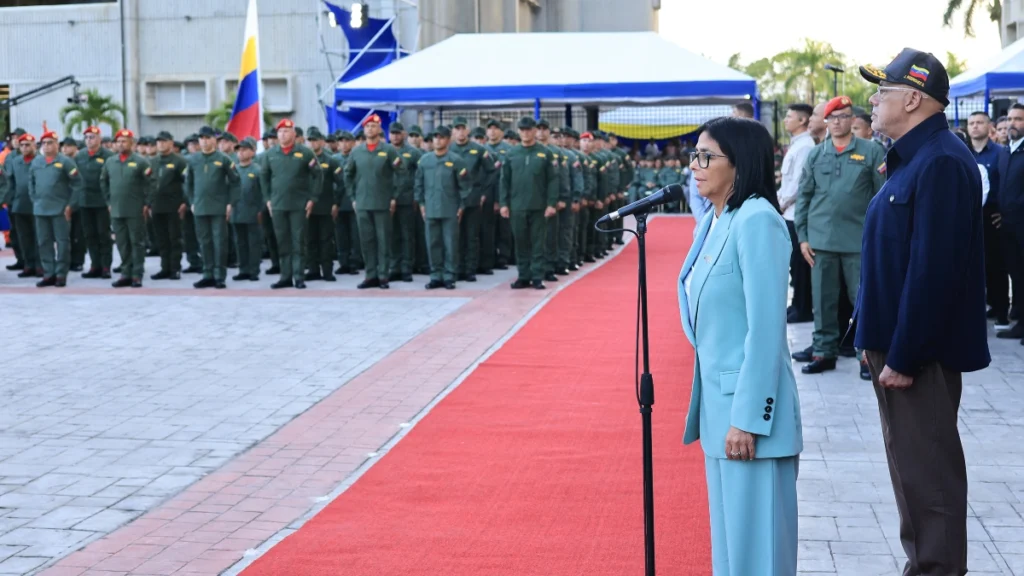
Venezuela military promotions mark Bolívar’s anniversary with more than 19,000 officers promoted and Delcy Rodríguez calling for national unity.
Related: Venezuela’s Acting President Names Top FANB Commanders
Venezuela military promotions took center stage on Friday as Acting President Delcy Rodríguez led the annual ceremony honoring the anniversary of Simón Bolívar’s birth, the Battle of Lake Maracaibo, and Bolivarian Navy Day. The event also served as a political and institutional message, combining military recognition with calls for national unity, recovery, and social cohesion.
Held at the Defense Ministry headquarters in Fuerte Tiuna, Caracas, the ceremony marked the promotion of more than 19,000 officers, generals, and admirals of the Bolivarian National Armed Force, or FANB. The military leadership swore allegiance to the Constitution, the laws, and the regulations governing the armed forces, reaffirming the state’s emphasis on discipline and sovereignty.
Rodríguez said each insignia awarded had been carefully reviewed as a recognition of merit, stressing that the promotions reflected commitment, loyalty, professionalization, and service. She added that the honors were not only institutional recognition but also an acknowledgment from the Venezuelan people.
The ceremony took place on July 24, a date loaded with historical symbolism in Venezuela, where Bolívar is remembered as the central figure of independence and anti-colonial struggle. The combination of military promotion and commemoration was presented as part of a broader narrative of defense of sovereignty and national continuity.
Venezuela military promotions and national unity
During her address, Rodríguez linked the ceremony to the legacy of Simón Bolívar, national independence, and the need for political cohesion. She argued that Venezuela’s historical achievements were made possible through unity, and that the country remains capable of overcoming present challenges when it acts with collective purpose.
She issued a direct call for political and national unity, saying there should be no space for any “anti-national project” that acts against the interests of the people or the republic. Her remarks were framed as a defense of stability, peace, and the continuity of the state amid pressure from internal and external factors.
Rodríguez also highlighted the role of the FANB in La Guaira, El Junquito, Aragua, Falcón, Carabobo, and Caracas, where military personnel were deployed to respond to the emergency caused by the recent double earthquake. She thanked the armed forces for their rapid response and extended condolences to members who lost relatives in the disaster.
A silence was observed in memory of the victims, underscoring the connection between the military ceremony and the country’s ongoing humanitarian recovery. The acting president said the armed forces had demonstrated capacity, discipline, and solidarity during a period of national distress.
The promotion of officers in Venezuela military promotions also included members of the 1993 class, who formally moved into active reserve after 33 years of service. Their transition was presented as part of the institutional continuity of the armed forces.
Recovery, sanctions, and foreign policy
Rodríguez used the event to return to one of the government’s central themes: recovery under sanctions. She said the country needs a master plan to rebuild after more than a decade of economic blockade, arguing that sanctions have severely affected social and productive life.
Her remarks tied Venezuela military promotions to a broader national recovery agenda that includes education, labor, and infrastructure. According to Rodríguez, the executive branch is working on a gradual and comprehensive plan to restore normality and improve conditions across the country.
This recovery narrative has become increasingly prominent in official discourse, especially after the earthquakes that affected several states. The government has sought to frame reconstruction not just as a technical task, but as part of a larger project of national resilience and social rebuilding.
In the same speech, Rodríguez also referred to foreign policy developments announced by the foreign ministry, including the gradual resumption of consular relations with Peru. That step suggests a cautious effort to rebuild limited diplomatic channels while maintaining Venezuela’s broader political positions.
She also addressed Venezuela’s decision to withdraw from the International Criminal Court, arguing that the institution has been politicized against the Venezuelan people. The statement reflects the government’s wider criticism of multilateral mechanisms that it believes have been used selectively against the country.
Human agenda and political meaning
The final part of the ceremony focused on what Rodríguez described as a “human decalogue” for the country’s future. The proposal emphasized respect for diversity, environmental protection, social justice, and the strengthening of the family as pillars of the next phase of what officials call “Venezuela renaces” or Venezuela reborn.
This message placed Venezuela military promotions within a broader moral and political framework. Rather than limiting the event to a military ceremony, the government used it to project an image of institutional order, social commitment, and national renewal.
The presence of high-level officials reinforced that message. Among those attending were Jorge Rodríguez, president of the National Assembly; Minister of Defense General-in-Chief González López; commander Prieto Martínez; Caracas mayor Carmen Meléndez; and senior military command members. Their participation signaled coordination between the political leadership and the armed forces.
The ceremony also served as a reminder of how central the FANB remains to Venezuela’s political system. In official discourse, the armed forces are not only a security institution but also a symbol of sovereignty, social stability, and state continuity.
From an editorial perspective, Venezuela military promotions combined historical commemoration, military discipline, disaster response, and political messaging into a single national event. That mix reflects the current government’s effort to present unity as the main answer to crisis, reconstruction, and external pressure.
Geopolitical context
The ceremony took place at a time when Venezuela remains a key point of tension in Latin America’s political map. Relations with the United States and several regional governments continue to be shaped by sanctions, diplomacy, migration, and debates over democratic institutions.
At the same time, disaster recovery has added urgency to Venezuela’s domestic agenda, increasing the importance of military logistics, civil defense, and state coordination. In that context, Venezuela military promotions carried significance beyond the barracks, projecting institutional strength during a period of humanitarian and political strain.
The government’s emphasis on sovereignty, unity, and reconstruction also reflects a wider regional trend, where countries facing economic stress and social fragmentation increasingly frame national stability as a matter of strategic defense. In Venezuela’s case, the armed forces remain central to that narrative.
Venezuela anuncia retiro definitivo de la CPI. Notificó a la ONU su denuncia del Estatuto de Roma. Canciller Plasencia denunció sesgo geográfico contra el Sur Global y calificó la actuación de la Corte como lawfare. #Venezuela #CPI #SurGlobal #Soberanía #teleSUR #24Jul pic.twitter.com/w86BSflgoS
— teleSUR TV (@teleSURtv) July 24, 2026
From teleSUR English via This RSS Feed.
Read the title, was like Mark Bolivar? Who the fuck?