

Venezuela earthquake recovery advances one month after deadly double quake, with reconstruction plans aiding over 128,000 affected people.
Related: Venezuela’s Acting President Names Top FANB Commanders
Venezuela earthquake recovery marks a critical phase one month after a powerful double seismic event struck the country, leaving widespread destruction and thousands of victims. Authorities have combined commemorative acts with ongoing reconstruction efforts, as the nation continues to respond to one of the most severe natural disasters in its recent history.
On July 24, 2026, Venezuela observed a month since the twin earthquakes that hit on June 24, which resulted in more than 5,000 deaths and over 16,000 injuries, according to official figures. The coastal state of La Guaira emerged as the most affected ಪ್ರದೇಶ, where infrastructure damage and human losses were particularly severe.
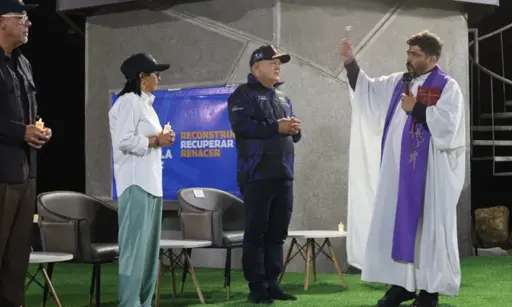
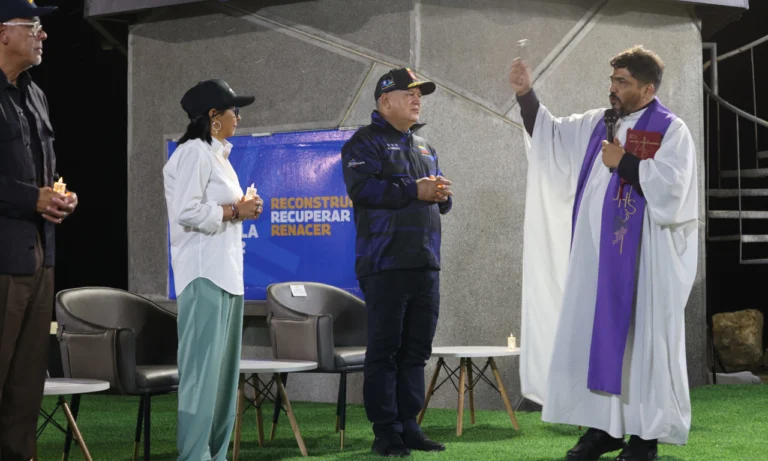
During a multifaith prayer ceremony held near the coastline in La Guaira, Acting President Delcy Rodríguez presented an updated reconstruction strategy, emphasizing a comprehensive and long-term recovery framework.
Venezuela Earthquake Recovery Plan and Humanitarian Response
The government’s Venezuela earthquake recovery strategy is based on what officials describe as a “master plan”, designed to address immediate humanitarian needs while laying the groundwork for sustainable rebuilding.
According to Rodríguez, more than 128,324 people have received assistance so far, including access to food, water, medical care, and temporary shelter. Authorities have prioritized the distribution of essential resources in the hardest-hit areas, ensuring that vulnerable populations are not left behind.
Search and rescue operations played a decisive role in the early response, with the participation of 2,200 international rescuers alongside 31,475 local volunteers. Their efforts, documented in official audiovisual reports, were crucial in locating survivors and recovering victims.
Rodríguez expressed gratitude for the solidarity shown by religious organizations and civil society, noting that faith communities provided emotional and spiritual support from the earliest hours of the crisis.
Despite progress, many families continue searching for missing relatives, underscoring the ongoing human dimension of the disaster.
Reconstruction Advances and Housing Initiatives
As part of the broader Venezuela earthquake recovery, authorities have begun implementing housing and infrastructure reconstruction programs aimed at restoring normal living conditions.
The government recently delivered 200 fully equipped homes to displaced families under the Gran Misión Venezuela Renace initiative. Officials announced plans to allocate an additional 4,000 housing units in the coming months, signaling a масштабный effort to address homelessness caused by the disaster.
Beyond housing, recovery efforts extend to rebuilding schools, healthcare facilities, and employment opportunities, which authorities describe as key pillars for national recovery.
Rodríguez highlighted that coordinated national and international cooperation has been essential, enabling progress in restoring public services and local economies in affected regions.
Ongoing Challenges and Community Recovery
While the Venezuela earthquake recovery process shows tangible progress, significant challenges remain, particularly in remote and heavily damaged المناطق.
Authorities acknowledge that restoring infrastructure such as roads, electricity, and water systems requires sustained investment and logistical coordination. In addition, psychosocial support for survivors has become a priority, given the trauma experienced by affected communities.
Local organizations and community leaders continue to play a vital role in facilitating aid distribution and rebuilding social cohesion, reinforcing resilience at the grassroots level.
Geopolitical Context and Regional Implications
The Venezuela earthquake recovery unfolds within a broader regional and geopolitical landscape marked by economic constraints and international dynamics.
Venezuela has faced longstanding economic sanctions and financial limitations, which complicate access to external funding and reconstruction resources. Despite these challenges, the country has received international humanitarian assistance, including support from multilateral organizations and allied nations.
The disaster has also highlighted the importance of regional cooperation in Latin America, where natural disasters frequently test institutional capacity and solidarity mechanisms. Analysts note that Venezuela’s recovery efforts could influence future disaster response frameworks in the region, particularly in terms of coordination between governments and international agencies.
At the same time, the situation underscores global inequalities in disaster recovery, as developing nations often face greater obstacles in rebuilding after large-scale catastrophes.
Commemoration and National Unity
Commemorative events held across the country reflect a collective effort to honor victims while reinforcing national unity.
During the ceremony in La Guaira, Rodríguez emphasized that the recovery process is not only material but also symbolic, involving remembrance, resilience, and reconstruction of community ties.
The Venezuela earthquake recovery narrative increasingly centers on solidarity, both domestic and international, as a driving force behind ongoing efforts.
Authorities reaffirmed their commitment to continuing multidisciplinary planning, focusing on infrastructure rehabilitation, social programs, and economic revitalization to ensure dignified living conditions for all affected.
From teleSUR English via This RSS Feed.