

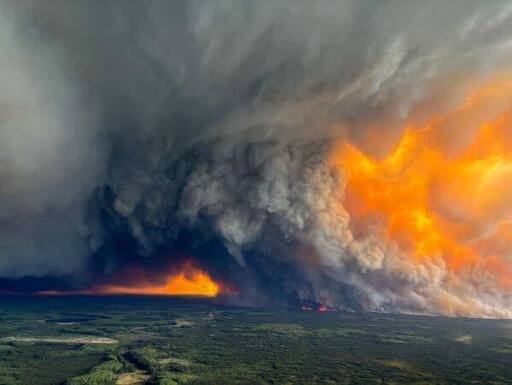
More than 900 wildfires have been raging across Canada, primarily in Alberta, British Columbia, Northwestern Ontario, and Saskatchewan. In Northwestern Ontario, where nearly 200 fires have been burning, community members have reported thick air, the constant smell of a campfire, and ash falling from the sky. Last Monday, July 13, a freight train was engulfed in flames, and workers had to request an emergency rescue.
Smoke from the wildfires has poured over the Canadian border, with dense clouds hanging over cities in the U.S. Midwest and Northeast. There have also been more than a dozen fires in the northern state of Minnesota due to extreme heat, dry conditions, and strong winds.
Indigenous communities, such as the Namaygoosisagagun (Collins) First Nation in Northwestern Ontario, have been hit the hardest by the wildfires. Of the more than 3,000 people who have had to be evacuated and the tens of thousands more on evacuation watch, a disproportionate number are First Nations have been affected by the fires. Although First Nations account for only five percent of Canada’s total population, their evacuation rates were eight times higher than the general population during the 2023 wildfires and 80 percent live in fire-prone regions. Officials estimate that more than 1,600 First Nations residents have been displaced by wildfires this season, and many received no emergency alerts from the government.Moreover, residents were denied assistance because the national government does not recognize it as a First Nation, according to Meaghan Daniel, a lawyer who represents Collins First Nation.
Meanwhile, throughout Canada, the government has passed laws that criminalize cultural burning practices that use controlled fire as a traditional land management practice that reduces the risk of uncontrollable wildfires.
There are innumerable other cases of oppressed and working class communities bearing the brunt of climate disasters. When wildfires spread across parts of Los Angeles last year, incarcerated people from nearby prisons fought the fires with limited protective gear and extremely low pay. At the same time, the LA Fire Department was underprepared for the emergency after the city budget slashed their funding while increasing the police budget by millions.
On top of the devastating effects faced by those on the front lines of the flames, the poor air quality disproportionately impacts working-class and oppressed communities. According to a 2024 study, communities of color “endure nearly 8 times higher rates of pediatric asthma and 1.3 times higher risk of dying prematurely from exposure to pollutants.” This is part of the ongoing legacy of redlining and systemic racism in the country that has pushed working-class communities of color closer to highways, factories, and other polluted areas. And unhoused populations are often left without protection and with nowhere to turn during climate crises.
Capitalism Is Fanning the Flames
These wildfires are part of a broader global climate crisis. In Texas, multiple people have died from record-breaking floods. In Europe, heat waves, wildfires, and storms have resulted in thousands of unnecessary deaths. In the Greater Horn region of Africa, intersecting crises caused by imperialist war and capitalist-driven climate change threaten the populations of multiple countries, including Sudan and Ethiopia, as they already face acute hunger and violent conflict. These fires and extreme weather events show that the climate crisis knows no borders.
While thousands were evacuating from their homes and millions more choking on the smoke, Donald Trump took to Truth Social on July 17 to say he plans to hold Canada responsible for the United States “being unnecessarily invaded by filthy, polluted, and unhealthy air.” He apparently didn’t see the irony in denouncing such an “invasion” while the U.S. has been initiating imperialist interventions from Venezuela to Iran. (Let’s not forget that the U.S. military is one of the largest greenhouse gas emitters and contributors to climate change.) Trump complained about the air quality to Canadian Prime Minister Mark Carney during the World Cup final in New Jersey on Sunday from their FIFA-gifted seats.
Rather than acknowledging that the climate crisis and wildfires are driven by capitalism, right-wing U.S. politicians are claiming they are exclusively a forest-management issue that Canadians should have to pay for in tariffs. On Monday, July 20, as part of a larger trade-war escalation, Trump slapped 50-percent tariffs on Canada that will take effect on August 19.
Trump, who has taken an ax to the already inadequate climate protections, cannot be taken seriously as he blames Canada for the smoke. Since returning to office, he has withdrawn the United States from the Paris Climate Agreement, expanded oil and gas drilling, fast-tracked new fossil fuel infrastructure, weakened environmental regulations, and moved to dismantle the federal government’s authority to regulate greenhouse gas emissions. All the while, he continues to champion an “energy dominance” agenda that puts the profits of oil and gas companies ahead of the future of the planet. Meanwhile, his administration is pulling back from energy efficiency efforts as the war on Iran, data centers, and heat waves are raising energy prices. Trump’s climate denial may be especially brazen, but he is only the most extreme expression of a capitalist system that prioritizes profit over human life and the environment.
Meanwhile, Mark Carney, despite acknowledging that the wildfires are a result of climate change, has green-lighted a new pipeline in Alberta, which would move 1 million barrels of oil daily from landlocked Alberta to the southern coast of British Columbia. The oil and gas sector is Canada’s largest source of greenhouse gas emissions. His rhetoric may differ from Trump’s, but both defend an economic system that subordinates the health of people and the planet to corporate profits.
Capitalism is to blame for the destruction of our planet, and it’s working and oppressed people who pay the price. We may physically live on the same planet as Donald Trump, Elon Musk, and the rest of the ruling class, but we are not all in this together when it comes to climate change.
Under capitalism, the ruling class is not only destroying the planet, but also using its nearly unlimited resources to ensure that they don’t have to face the consequences of the climate catastrophes they’ve created.
If their homes burn down, they can buy more. If the planet becomes unlivable, they’ll try to colonize a different one. It is the working class and poor of the world who are being forced to face these consequences instead.
Workers Need an Emergency Plan
Workers have the necessary tools and technology to address climate disasters at our fingertips: at factories that build weapons and warplanes, we could instead be producing aircraft and equipment for fighting fires. Oil and energy production that fuels private jets, billionaires’ estates, and the advertisements that shine 24/7 in Times Square could be under the control of the workers in those sectors, who could ensure that energy is allocated by need, not for profit.
The same workers whose labor keeps society running have the knowledge, technology, and power to confront the climate crisis at its source. Instead of allowing corporations and politicians to organize production around profit, workers could fight to redirect industry toward human need — converting factories that produce weapons into equipment for disaster response, placing the energy sector under democratic workers’ control, and expanding the resources needed to prevent and respond to climate disasters.
But no such plan will be implemented by the politicians who defend the fossil fuel industry or the corporations that profit from environmental destruction; it will have to be fought for. There is a burning need to reignite a mass climate movement that unites with the workers’ movement, the environmental movement that has been protagonized by the youth, and beyond.
Unions have a crucial role to play by taking up the fight for climate justice as a working-class issue — organizing workers to demand the resources needed to protect communities, defend workers facing increasingly dangerous conditions, and challenge production organized for profit instead of human need. By linking workplace struggles with the fight against climate change — alongside fighting imperialism and deportations — the labor movement can confront the climate crisis at its root.
The climate crisis cannot be solved by the same capitalist system that created it. It requires a working-class emergency plan that puts people and the planet before profit.
The post Capitalism Fans the Flames of the Climate Crisis appeared first on Left Voice.
From Left Voice via This RSS Feed.