

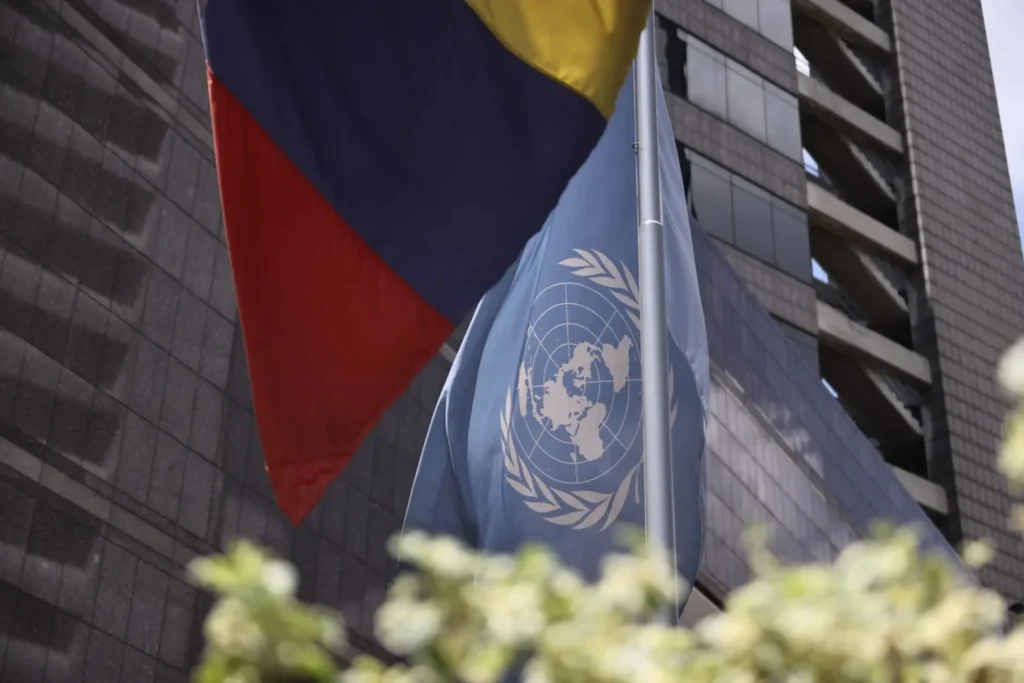
Venezuela formalizes this Friday its irrevocable withdrawal from the International Criminal Court, denouncing structural bias against the Global South and the weaponization of international justice through lawfare.
The withdrawal, processed under Article 127 of the Rome Statute -the clause reserved for states wishing to leave the Court’s jurisdiction- was announced by Foreign Minister Félix Plasencia González following direct instructions from the Acting President Delcy Rodríguez.
The diplomatic move formalizes a longstanding critique of the ICC’s operational record.
RELATED: Venezuelan Acting President Delcy Rodriguez Meets IDB to Plan Multilateral Roadmap
The Venezuelan Foreign Ministry argues that the Court’s activity reveals a demonstrated geographical bias, disproportionately concentrating its investigations on African and Latin American nations. This pattern, according to Caracas, undermines the promise of equality before the law upon which the institution was founded.
“The imbalance reveals an international justice system that has lost equity as its compass,” the Bolivarian Government stated. Plasencia warned that the Court’s mechanisms have been instrumentalized to deepen inequalities among nations and to disregard the right of peoples to self-determination and sovereignty.
Caracas categorically rejects that this pattern results from procedural coincidence. The Foreign Minister described it as the reflection of an institution that placed its tools at the service of interests far removed from justice and the very peoples it claims to protect.
Por instrucciones de la presidenta encargada @delcyrodriguezv, Venezuela comunicó al secretario general de la ONU,@antonioguterres, su decisión firme e irrevocable de denunciar el Estatuto de Roma e iniciar su retiro definitivo de la CPI, conforme al Artículo 127.
Venezuela…
— Félix Plasencia González (@plasenciafelixr) July 24, 2026
Lawfare as Central Charge
The document delivered to UN Secretary Antonio Guterres contains a second fundamental argument that anchors Venezuela’s position. The Venezuelan Government denounces what it identifies as a systematic practice of lawfare, a phenomenon whereby judicial instruments are deployed for political persecution.
“The dimension of lawfare perpetuates the persecution against the Venezuelan people and aggravates the inequalities that international justice should correct,” the Foreign Minister stated. The official indictment adds that a body created to repair asymmetries between nations ended up amplifying them, with proceedings that repeatedly target the same regions of the planet.
According to figures compiled by legal analysts, more than 60% of the ICC’s formal investigations since its inception in 2002 have focused on African states, while cases involving Western powers remain marginal or are dismissed during preliminary examinations. The Philippines, Burundi, and now Venezuela represent a growing wave of withdrawals from the Rome Statute, each citing selective application of the Court’s jurisdiction.
Commitment to Equitable Justice
In its formal announcement, Venezuela accompanied the denunciation with an express commitment to pursue a genuinely equitable justice system, one that respects sovereignty and the self-determination of peoples, according to the wording delivered to the UN.
The declaration sets the framework under which Caracas wants its multilateral stance to be understood. The objection targets the concrete functioning of the Court and the inequality that, in the Government’s assessment, its case selection reproduces on a global scale.
Acting Delcy Rodríguez, who has led Venezuela’s foreign policy during a period of intense multilateral challenges, previously addressed with the UN coordinator a recovery and assistance plan for the country, signaling a dual strategy: confrontation with what Caracas considers an instrument of geopolitical pressure, and cooperation with the broader United Nations system in humanitarian areas.
The Venezuelan move adds momentum to a broader debate on the reform of international justice mechanisms, with several nations of the Global South demanding structural changes to ensure that the ICC fulfills its original mandate without reproducing the historical hierarchies of power that shaped the international order.
From teleSUR English via This RSS Feed.