


By Nikos Mottas
Andy Burnham’s arrival at 10 Downing Street has, once again, been accompanied by the familiar chorus of illusions. Britain, we are told, has entered a “new era.” A new Labour prime minister promises hope, fairness and renewal.
Yet beneath the new rhetoric lies the same old reality. The faces change. The managers change. The class character of the British state does not.
For more than a century, the Labour Party has fulfilled a specific and indispensable role for British capitalism. The Conservatives have traditionally defended the interests of monopoly capital openly and unapologetically. Labour has defended precisely those same interests under the banner of “progress,” “fairness” and the “national interest.” Whenever British capitalism has entered a period of political instability or social discontent, Labour has stepped forward as the “acceptable alternative,” promising change while ensuring the uninterrupted continuity of bourgeois rule.
This is no historical accident. It is the very political function social democracy has performed throughout its existence. The Labour Party was born out of the trade union movement, yet it never embraced the historic mission of the working class: the overthrow of capitalism and the construction of socialism. From its very foundation, Labour sought not to abolish exploitation but to reconcile labour with capital. It preached class collaboration instead of class struggle, class peace instead of class conflict. It accepted the capitalist ownership of the means of production, the institutions of the bourgeois state, the monarchy, Britain’s imperialist alliances and, ultimately, the dictatorship of capital itself. Labour has never sought to dismantle the existing order. Its historic mission has been to preserve it, to shield it from working-class resistance and to give capitalism a more “humane” face whenever the system required political stabilization.
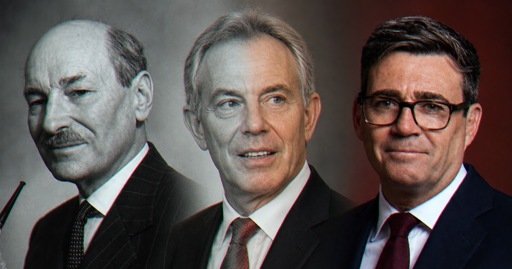
This is the thread that runs uninterrupted through Labour’s entire history. Much has been written about Clement Attlee’s post-war government and its social reforms, above all the establishment of the National Health Service and the nationalization of key industries. Yet these measures did not constitute a transition toward socialism. They were reforms carried out within the framework of capitalism, designed to stabilize British capitalism after the devastation of the Second World War, rebuild an exhausted economy and safeguard the long-term interests of British monopoly capital. State ownership under capitalism is not socialism; it merely transfers ownership from individual capitalists to the bourgeois state while leaving the capitalist mode of production intact. The exploitation of wage labour continued. The capitalist relations of production remained untouched.
Harold Wilson adapted British capitalism to the changing conditions of the post-war era without ever questioning its economic foundations or the class character of the British state. James Callaghan, faced with deepening capitalist crisis, imposed austerity under the dictates of the International Monetary Fund, demonstrating once again that when the interests of labour collide with the interests of capital, social democracy invariably sides with the latter.
Tony Blair completed Labour’s full embrace of neoliberalism. Under the banner of the so-called “Third Way,” his governments accelerated privatizations, deepened financialization, strengthened the dominance of the City of London and integrated Britain even more tightly into the strategy of U.S.-led imperialism. Blair’s government also bears direct political responsibility for the criminal invasion of Iraq—one of the greatest crimes of twenty-first century imperialism—which claimed hundreds of thousands of lives and left an entire country in ruins. It was no coincidence that Margaret Thatcher, a sworn enemy of the working class, reportedly described “Tony Blair and New Labour” as her greatest political achievement, adding: “We forced our opponents to change their minds.” Few verdicts better capture Labour’s historic evolution into a fully reliable party of British monopoly capital.
Keir Starmer stripped away even the last vestiges of Labour’s traditional social-democratic rhetoric. By purging left-wing members, criminalizing internal dissent, openly courting big business, reaffirming unconditional loyalty to NATO and presenting Labour as the safest guarantor of “stability” for British capitalism, he merely brought to completion a process that had been unfolding for decades.
Andy Burnham does not represent a break with that legacy. He is its political heir. Whatever differences of style or tone may exist, the fundamentals remain untouched: unwavering commitment to capitalism, loyalty to the British bourgeois state, fidelity to Britain’s imperialist alliances and the perpetual illusion that the interests of labour and capital can somehow be reconciled.
Burnham’s first speeches are filled with familiar promises: helping working families, rebuilding Britain and restoring hope. Yet behind the carefully crafted rhetoric lies the same old political programme. “Fiscal responsibility” remains the guiding principle. The sanctity of capitalist profitability remains unquestioned. Britain’s military commitments and strategic interests remain inseparable from those of NATO and Anglo-American imperialism. The profits of monopoly capital remain untouchable. The domination of finance capital remains beyond challenge.
There is no contradiction here. This is social democracy functioning exactly as history has shown it always does: offering the language of reform while safeguarding the foundations of capitalist exploitation.
Whenever workers begin to reject openly conservative governments, social democracy emerges to absorb popular discontent before it develops into a conscious challenge to capitalist power. It redirects class anger into parliamentary alternation. It transforms demands for social change into expectations of better management. In doing so, it disarms the workers’ movement while renewing confidence in the very system responsible for exploitation.
Labour has performed this role no differently from other major parties of European social democracy—from Germany’s SPD and France’s Socialist Party to Spain’s PSOE, Italy’s Democratic Party, Greece’s PASOK and, more recently, SYRIZA. Despite their different histories and political vocabularies, they have repeatedly demonstrated the same fundamental characteristic: administering capitalism in periods of crisis while preventing working-class discontent from developing into a revolutionary challenge to bourgeois power. This has always been Labour’s greatest service—not to the working class, but to the British bourgeoisie.
Lenin long ago exposed the historic role of opportunism as the principal obstacle to the revolutionary movement of the working class. The most effective defenders of capitalism are not always those who openly proclaim their allegiance to the bourgeoisie. More often, they are those who speak in the name of labour while confining the workers’ movement within the limits acceptable to capital. This has been the historic function of social democracy: to subordinate class struggle to the preservation of the capitalist order, preventing working-class militancy from developing into revolutionary consciousness and revolutionary organization.
The Labour Party has embodied precisely that role throughout its history. Its leaders speak endlessly of fairness, opportunity and compassion, yet remain conspicuously silent on the question that lies at the heart of every capitalist society: class power. They promise to reduce inequality while leaving untouched the system that inevitably reproduces it. They speak of higher wages while defending the private ownership of the wealth created by labour. They praise public services but never challenge the domination of monopoly capital over the commanding heights of the economy. They promise prosperity without asking the decisive question: who owns the factories, the banks, the energy sector, the transport system, the media and, ultimately, political power itself?
This is not simply hypocrisy. It reflects the objective limits of every party that accepts capitalism as the permanent framework of society. A party that refuses to challenge capitalist property relations can only promise a more efficient management of exploitation—not its abolition.
Capitalism is not a system that can be humanized through better management. It rests upon exploitation, the extraction of surplus value and the concentration of wealth and power in the hands of monopoly capital. No government that accepts these foundations can ever govern in the interests of the working class, regardless of its slogans or electoral promises.
Labour has endured not because it offers socialism, but because it persistently presents the management of capitalism as an alternative to capitalism itself. Every generation is told that this Labour leader will be different, that this government will finally put working people before profits. History has delivered the same verdict every time.
Again and again, Labour has entered office promising change and left office having strengthened the very system it claimed it would reform. Again and again, it has restored political legitimacy to British capitalism at moments of crisis and discontent. Again and again, it has confirmed a fundamental truth: social democracy is not the road to socialism but one of capitalism’s most effective instruments of survival.
That is the essence of the Labour Party. Not an alternative to bourgeois rule, but one of its most dependable political pillars.
Andy Burnham may govern with a different tone and style than his predecessors. He may introduce limited reforms or temporary concessions where the balance of class forces makes them necessary. But no concession alters the class character of state power. Such measures are intended to preserve social stability, contain working-class resistance and secure the continued reproduction of capitalist relations—not to abolish exploitation.
The decisive questions have never changed. Who owns the means of production? Which class holds political power? In whose interests does the state ultimately function? As long as those questions receive the same capitalist answers, no alternation between Conservatives and Labour can represent genuine change for Britain’s working class.
The real choice is not between two parties that administer capitalism in different ways. It is between the continued rule of capital and the struggle for its overthrow.
For more than a century, the Labour Party has fulfilled a historic mission: not to challenge British capitalism, but to rescue it whenever its rule has been threatened. That was true under Attlee. It was true under Wilson, Callaghan, Blair and Starmer. It remains true under Burnham.
* Nikos Mottas is the Editor-in-Chief of In Defense of Communism.
From In Defense of Communism via This RSS Feed.