

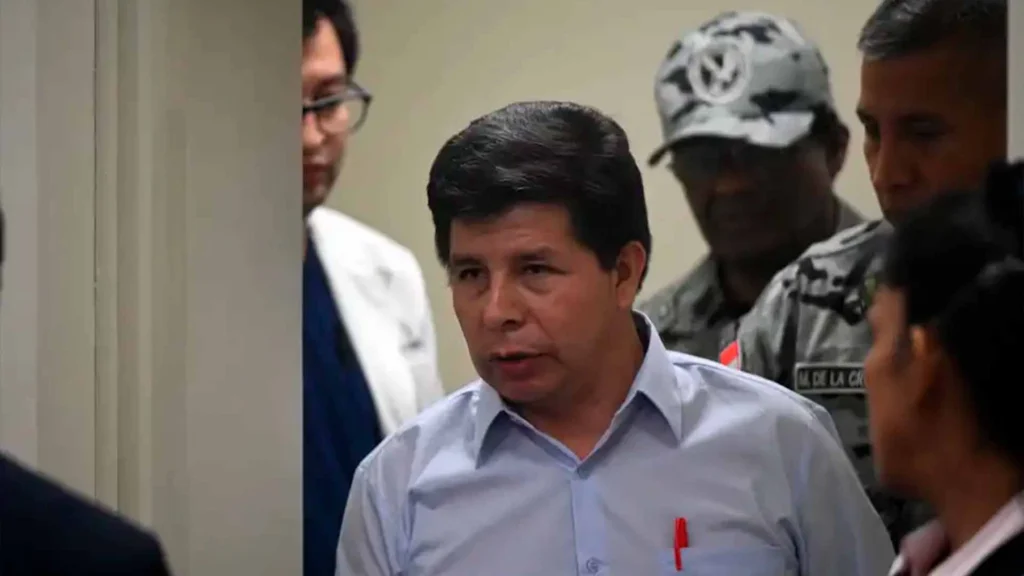
The government of Peru’s interim president, José María Balcázar, will not release former president Pedro Castillo after the administration declared his latest request for a presidential pardon inadmissible this Friday. Castillo is serving a sentence for an alleged coup attempt and faces another legal process for corruption.
RELATED:
Peru Court Reviews Pedro Castillo Habeas Corpus Case
The Minister of Justice and Human Rights, Luis Enrique Jiménez, confirmed that Castillo has been notified and that the process is now complete. “This has been the last session of this government; the matter is closed. It has been analyzed, the substantive reasons why the pardon is not warranted have been given, and the inmate in prison has been notified of the grounds for the decision,” the minister stated.
The Minister of Justice recalled that, according to the regulations of this body, all requests for presidential pardons must include the necessary documentation for admissibility and initiate the corresponding process, and the approval of a recommendation requires the unanimous vote of its members.
Regarding the figures for the process, the commission has reviewed a total of 17 requests for a pardon or presidential clemency for Castillo, who is serving an 11-year, 5-month, and 15-day prison sentence for conspiracy.
Comisión de Gracias Presidenciales declara improcedente y archiva pedido de gracia de Pedro Castillo: Ministerio de Justicia publica las razones del rechazo
Mantente informado en la WEB ► https://t.co/WAgcNzGC9I pic.twitter.com/K0jnwp5ftT
— Canal N (@canalN_) July 24, 2026
The text reads, ” Presidential Pardon Commission declares inadmissible and files away Pedro Castillo’s pardon request: Ministry of Justice publishes the reasons for the rejection”
Of these, 14 were submitted by third parties and were not admitted. Of the remaining three, two were declared inadmissible for failing to meet the deadline, and the one that was pending was the one evaluated this Friday.
Consequently, Castillo’s release will no longer occur during Balcázar’s transitional term, who had promised the former president’s freedom upon being chosen as interim president in February. Any new requests in this regard will be evaluated by the administration of the new president, Keiko Fujimori, who will assume office on July 28.
The decision comes weeks after the release of a non-binding opinion from the United Nations Working Group on Arbitrary Detention, which recommended Castillo’s release, considering him a victim of arbitrary detention—a report that had revived the possibility of a pardon.
From teleSUR English via This RSS Feed.