


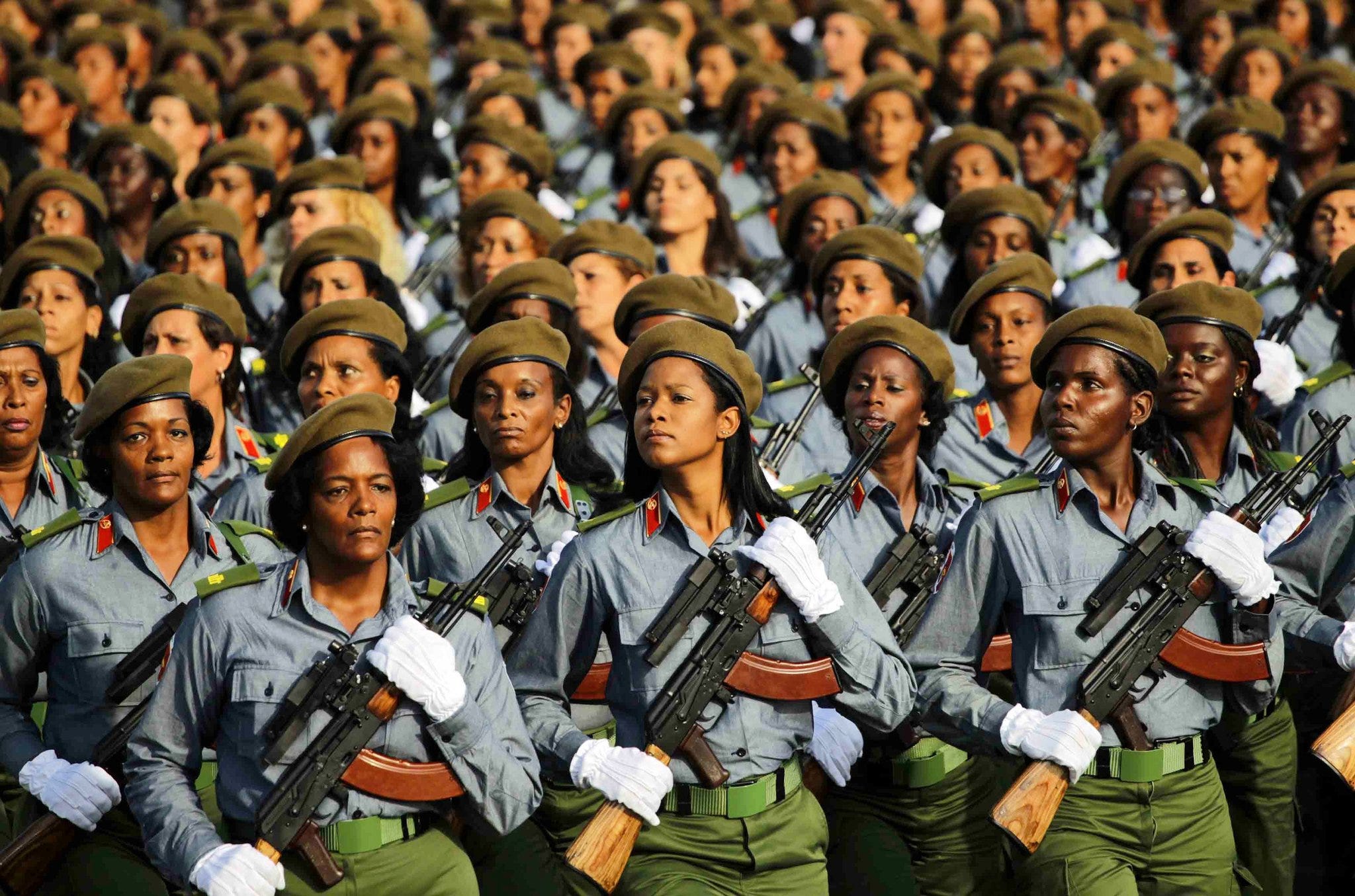
Women of the Cuban military
What do the Vietnam War, the Korean War, the assassination of Fred Hampton, and the bipartisan support for jihadists in Afghanistan during the 1980s have in common? These are some of the countless instances of the United States government attempting to destroy socialism, both domestically and abroad. When it is not engaging in invasion, murder, or proxy wars, the U.S. will employ a “peaceful option” — economic sanctions — to punish disobedient nations, including those with a socialist orientation. Sometimes called “unilateral coercive measures,” this devastating economic warfare is in fact not peaceful, but quite deadly. In Venezuela for instance, U.S. sanctions resulted in an estimated 40,000 deaths in just one year. In total, sanctions imposed by Western nations have killed an estimated 38 millionpeople since 1970.
Speaking of the Vietnam War, this brutal military aggression against Southeast Asia inspired Dr. Martin Luther King, Jr. to refer to his government as “the greatest purveyor of violence in the world today.” This statement is just as true now as it was when King uttered those controversial words some six decades ago. It was true before that as well. Indeed, the U.S. empire — an entity founded on genocide, slavery, and settler colonialism — has butchered and starved its way to the top of the geopolitical food chain, leaving a mountain of 300 million corpses in its wake (an estimate three times higher than the sensationalized “victims of communism,” which we will explore later). However, most Americans are oblivious to the true scope of this disturbing history — a sentiment expressed by Assata Shakur in her autobiography:
Too many people in the [U.S.] support death and destruction without being aware of it. They indirectly support the killing of people without ever having to look at the corpses. But in Cuba [I] could see the results of [U.S.] foreign policy: torture victims on crutches who came from other countries to Cuba for treatment, including Namibian children who had survived massacres, and evidence of the vicious aggression the [U.S.] government had committed against Cuba, including sabotage, and numerous assassination attempts against Fidel. I wondered how all those people in the states who tried to sound tough, saying that the [U.S.] should go in here, bomb there, take over this, attack that, would feel if they knew that they were indirectly responsible for babies being burned to death. I wondered how they would feel if they were forced to take moral responsibility for that. (Shakur, 268–269)
Although socialism is not the only target of U.S. imperialism, this implacable global violence is unequivocally committed in the name of capitalism — often to secure access to natural resources, labor, and other avenues of profit at the barrel of a gun. However, despite the best efforts of U.S. foreign policy (including the decades of global, anti-communist mass murder chronicled by Vincent Bevins in The Jakarta Method), socialism remains resilient today. As one might expect, the consistently anti-socialist and anti-communist nature of U.S. foreign policy complements the domestic political situation.
In every era during the last century, contempt for socialists and communists has animated the U.S. government and ruling class — from the imprisonment of socialist presidential candidate Eugene Debs in 1919, to McCarthyism and COINTELPRO, all the way through President Trump’s national security memo classifying anti-capitalists (among others) as potential domestic terrorists. Leading members of the two mainstream political parties fall over themselves to dramatically and pejoratively refer to the other side as “socialists” and “communists” — apparently the greatest insults they can possibly muster (1) (2) (3). The Republicans have made no secret of the fact they are the party of big business, but even prominent Democrats like Nancy Pelosi and Elizabeth Warren have stated outright that they are “capitalists” (1) (2). In 2026, 86 congressional Democrats voted to formally “condemn socialism” (two voted “present” and no one voted against the resolution).
Yet the appeal of socialism continues to grow, especially among young folks. For instance, a 2025 YouGov poll found that 62 percent of Americans under age 30 have a favorable view of socialism and 34 percent of that same demographic have a favorable view of communism. Polling conducted by Harvard University that same year also found that young Americans report “deep economic insecurity” and “eroding trust in democratic institutions.” As the standard of living continues to deteriorate while the rich keep getting richer, both aforementioned polling trends are likely to continue. As our government spends trillions of dollars on war while the cost of housing, education, and healthcare skyrocket, interest in the concept of socialism will only become more and more prevalent. The book you are now reading should simply be considered a modest contribution to this important and ongoing discourse.
That being said, this book is intended to be a primer — not an exhaustive, authoritative, definitive masterpiece on the subjects discussed herein. Without clarifying this, some readers might think to themselves, “Why didn’t he mention ‘X’ or ‘Y’? Why didn’t he go into more detail about ‘Z’? Does he not care about ‘A,’ ‘B,’ and ‘C’?!?” With this text, I simply seek to concisely introduce readers to a perspective on socialism that is rarely encountered in the United States, including refutations of some popular capitalist narratives. After devouring this relatively brief volume, I hope readers will continue to pursue this subject matter, including a further examination of the source material. I hope this book will be enjoyable and informative, but most of all I hope it can serve as a springboard for continued revolutionary political education. For many, the first step in this process is acknowledging you have been lied to by your government. Regardless of political disposition, most of us have taken this cathartic step at least once or twice (Iraqi WMDs, anyone?). But the second step can be a little more difficult: Realizing that your government (and media) has lied to you about socialism and communism specifically.
If more Americans become aware of this particular realm of misinformation, they can become more open to socialism. Yes, socialism as a vague concept has been gaining more traction lately, in large part thanks to one Senator Bernard Sanders (and, more recently, New York City mayor Zohran Mamdani), but this newfound consciousness is in its infancy. We are still at the naive juncture of believing we can reform this neoliberal nightmare; this juggernaut of voracious imperialism and exploitation. Reformism has a consistent track record of failure, and we must reject it. We therefore need to embrace revolutionary politics, but a prerequisite to this serious pursuit is the recognition that socialism has indeed succeeded before and it can succeed again. After all, who’s going to study Marxist theory and help chart a path forward when they believe socialist revolution “always results in tyranny”?
Ah yes, the classic “socialism works on paper, but in reality it always leads to totalitarian regimes who murder 100 million people for no reason and steal everyone’s toothbrush.” We’ve all heard this kind of conventional wisdom before. This ubiquitous narrative is extremely problematic, to use a term that’s popular with the kids these days. It is a narrative that leads only to political nihilism and despair after seemingly endless cycles of failed reforms. It reinforces capitalist domination in the bleakest of ways. It kills hope and entrenches the status quo — a status quo that is so profoundly dangerous and destructive that it could lead to the end of humanity as we know it. If we are ever going to save ourselves — if we are ever going to liberate ourselves — we will need a grounded historical perspective. If we are ever going to achieve socialism in the United States, the people need to know that it’s worth fighting for. And that requires a deep appreciation for socialist and communist history and a strong refutation of capitalist propaganda.
As you have likely observed, dear reader, this book is not neutral, impartial, or “fair and balanced.” This author unequivocally and unreservedly stands with the project of revolutionary socialism and commends its historical and ongoing accomplishments. For me, this position is as simple as viewing human needs as human rights. As the late political scientist Michael Parenti once said, “The revolution that feeds the children gets my support.” If you want to hear cartoonish horror stories about evil communists eating barbecued Christian babies for breakfast every morning, you can find that kind of content literally anywhere else in the Western world. Objectivity, which itself is virtually impossible, is not the objective here. To reiterate, the purpose of this book is, first of all, to introduce readers to a perspective on socialism that is almost entirely absent from mainstream discourse, and secondly, to promote revolutionary politics in the United States. This discussion is long overdue.
Socialism should be the natural inclination — the default goal — of the working class in any country. As Fred Hampton said, “Socialism is the people. If you’re afraid of socialism, you’re afraid of yourself.” But in the United States, which happens to be the headquarters of global capitalism, we have been subjected to a pervasive, century-long program of misinformation that has led us astray. This relentless capitalist indoctrination campaign includes an elaborate combination of logical fallacies, double standards, omissions, distortions, exaggerations, and outright fabrications, with the purpose of keeping the masses fighting each other instead of fighting our exploiters and oppressors.
After being bombarded with this dogmatic, cultish perspective for a lifetime — from Hollywood movies, TV shows, corporate news media, universities, and politicians from both parties — the average American cannot escape the depressing conclusion that “socialism might look good on paper, but it never works in practice.” Well, I’m here to tell you that socialism has worked in the past, continues to work in our modern era, and will work in the future as well. It is part of a historical process in humankind’s advancement beyond a barbaric and parasitic economic system that, to quote Dr. King again, “has outlived its usefulness.” Out of the ashes of capitalism emerges a superior economic arrangement: socialism.
But what exactly do I mean by “socialism”? Basically, when I say “socialism,” I am talking about what is often referred to as “Actually Existing Socialism” (AES). This term sounds somewhat redundant when you really think about it. After all, what version of something is there besides the version that actually exists? But this is a very important distinction within Western discourse surrounding socialism. As I explained in my first book, Millennial Marxist, there is a “false notion of socialism that has found its way into U.S. political consciousness (which is essentially just social democracy accompanied by vaguely socialist rhetoric).” So, no — by “socialism” I do not mean capitalist countries that have a stronger social safety net. I mean nations that have been transformed by tumultuous class struggle. I mean societies that have been uprooted by popular working-class revolutions, have resoundingly defeated their former oppressors, and have established new governments that serve the interests of the common citizen.
Allow me to explain this further. At the heart of capitalism is a profound contradiction: One group of people sells its labor for a wage (whether hourly or salaried) and another group siphons off the “surplus value” generated by this labor in order to enrich itself. You see, if we were paid based on our productivity, there would be no “profit” leftover (profit being revenue minus expenses). This is where exploitation comes in: there is a significant discrepancy between the value you create with your labor and what you are actually paid. That difference is pocketed by the “owners.” Over time, this economic practice leads to obscene, oligarchic levels of wealth concentration. Some modern examples include the Walton family (owners of Walmart) amassing more wealth than 40 percent of the U.S. population combined, six men owning more than half the global population combined, and Elon Musk becoming the world’s first trillionaire.
Put simply, one group (the majority) works for a living and the other (the minority) doesn’t. Yet this small group that doesn’t work for a living has been allowed to accumulate more wealth than any of us can possibly imagine while the group that works for a living barely scrapes by. This is not only a contradiction, but an antagonism — the interests of the workers are directly at odds with the interests of the capitalists. Needless to say, this kind of arrangement has been perceived as unfair and unjust by many. The main solution proposed has been called socialism, which is a transitional stage during which society is transformed toward the ultimate, long-term goal of communism: a classless society in which the state “withers away” and economic exploitation becomes a thing of the past.
These two aforementioned groups are referred to as the working class (or “proletariat”) and the capitalist class (or “bourgeoisie”). In order to abolish the exploitative capitalist economic arrangement, working class movements have sought to reorganize the economy with the interests of the workers as the greatest priority (basic necessities like healthcare, education, and housing are de-commodified and made free or easily accessible). To accomplish this, the working class must gain control of the “means of production” — factories, machinery, farm land, transportation, technology — essentially anything that is used in large-scale industry. Under capitalism, these things are privately owned, meaning the group mentioned earlier — the one that doesn’t work for a living — controls vast segments of the economy and the society more broadly while millions suffer needlessly due to lack of resources. The goal of socialism is to make these things collectively owned so workers can finally enjoy the fruits of their labor (instead of some elusive rich guy you’ve never met using the revenue generated by your productivity to buy another five million dollar beachfront home while you barely make your rent payments). In an era of economic strife and heightened class consciousness, this transformation of society in a more equitable direction is surely appealing. But how do we get there?
In the West particularly, idealistic notions about workers themselves directly owning and controlling the means of production in some kind of utopian, horizontalist, decentralized, “non-hierarchical” fashion — where ostensibly every decision made by every institution must be reached by popular vote — are quite prevalent. This concept is certainly compelling, but it’s just not practical on a large scale. A model that has worked during the last century or so is a planned and centralized socialist economy; a political party representing the working class seizes state power and directs economic activity with input from the workers using complex and unique forms of grassroots democracy. This is how socialist countries like Cuba, China, and the former Soviet Union were able to make such significant standard of living improvements and undertake such vast industrialization efforts after starting from destitute poverty. The governments in such societies are usually led by self-described communist parties, and this makes sense when we understand that socialism is a process. For instance, the Communist Party of China (CPC) is implementing Socialism with Chinese Characteristics. Likewise, the Communist Party of the Soviet Union (CPSU) governed in the Union of Soviet Socialist Republics (USSR). Communism is the goal; socialism is the path.
I am aware that the perspective I have outlined thus far is considered controversial by many, and there is a sociological reason for that. When you think about all the news stories you’ve heard about specific socialist countries, what kinds of stories are they? The headlines are usually something like, “Sources say Cuba’s authoritarian government is cracking down on political dissent,” or, “China has made technological advances, but at what cost?” or “North Korean defector tells chilling tale of dystopian society.” They are almost never something like, “Cuba becomes first country to end mother-to-child HIV transmissions,” or “China lifts 850 million people out of extreme poverty,” or “Cuba and China have recently surpassed the United States in life expectancy,” or “78 percent of citizens vote to preserve Soviet Union.” I don’t need to spell out what kind of effect this consistently negative framing has had on millions of Americans over time.
This is why a smaller proportion of the book is dedicated to subject matter directly related to the title; it turns out it is somewhat simple to demonstrate how well socialism has worked (even despite the disproportionate challenges it has faced when compared to capitalism). The problem is that knowledge of the accomplishments of socialist countries has been smothered and suffocated by the weight of a relentless vilification campaign that paints every leftist government in history as a heartless, totalitarian murder machine. It takes a lot more effort (and pages) to correct the record on specific anti-communist narratives and to subsequently reorient the reader away from the fallacious impression they have developed regarding various socialist and communist movements. In short, the challenges I faced when embarking on this project can be encapsulated by Brandolini’s law: “The amount of energy needed to refute bullshit is an order of magnitude bigger than that needed to produce it.” (I promise this is the only time I will cite Wikipedia.)
Zooming out, it seems one of the main tangible reasons most Americans are likely unaware of much of the information I discuss in this book is because it is simply not readily available. This is by design. To quote Assata again, “Nobody is going to give you the education you need to overthrow them” (Shakur, 181). The sources I have utilized include independent investigative news outlets, Italian think tanks, forgotten academic studies from the 1980s, obscure out-of-print books from decades ago, declassified CIA documents, and many other hidden gems. The odds that most Americans would randomly come across these unconventional sources in daily life is near zero, unless you’re a chronically online elder millennial combing through exotic leftist subreddit threads. You shouldn’t have to spend years as a nerdy online political detective to have access to a balanced perspective on socialism — to hear “the other side.”
The message of that “other side” sounds something like this: Capitalism, just like feudalism and monarchy before it, is not just “the way things are.” It is not natural or inevitable. Things have not always been like this. Capitalism had a beginning and it will have an end. It is up to us to move past this profoundly violent and exploitative mode of production and advance to the next stage: socialism. But it is difficult — especially for us here in the belly of the beast — to imagine a reality in which the economy functions for the benefit of the average person, and this lack of imagination can cause a vicious cycle of nihilism and failed attempts at reform. That is why I encourage everyone to study the history of socialism and the successful proletarian revolutions that have served as catalysts. We can learn many lessons from this history and the theory that motivated these instances of monumental human progress. And most of all, educating ourselves and those around us can serve as the inspiration necessary to forge our own path forward. I sincerely hope this book can play some small role in that process.
-Matthew
From This American Left via This RSS Feed.