

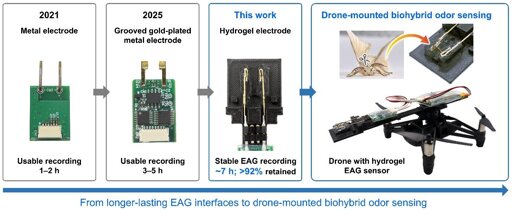
Drones are increasingly being used for disaster response, infrastructure inspection and environmental monitoring. However, most drone systems rely primarily on cameras and other visual sensors, which can become ineffective in smoke, dust, darkness or collapsed structures. Odor sensing could provide a valuable complementary capability by enabling drones to detect gas leaks and chemical emissions that cannot be identified through visual sensing alone. Yet a major challenge has limited the practical use of such biohybrid sensors: Excised insect antennae gradually lose signal quality as they dry out, and the electrical interface becomes unstable.
From Biology News - Evolution, Cell theory, Gene theory, Microbiology, Biotechnology via This RSS Feed.