

The United States is mired in a constitutional crisis. Not only are the ruling-class political parties facing a total loss of popular legitimacy, but the state itself is increasingly dysfunctional. While a shockingly corrupt administration is trying to make it illegal to even observe its “absolutely immune” secret police, the Supreme Court has endorsed a gerrymandering arms race that can only end in the death of competitive House elections in the U.S. Meanwhile, a paralyzed Congress has kept the government shut down for longer than all previous Congresses combined, even with a Republican trifecta. All political norms have collapsed. Yet Trump’s alternative—Hail Caesar and his Unitary Executive!—has yet to decisively assert itself.
Amidst this crisis, the socialist Left has gone on the offensive. After a historic streak of electoral victories propelled DSA past 120,000 members, millions are now looking to democratic socialists for leadership despite hysterical fearmongering from the protectors of the status quo. Whether DSA can step into the breach and lead the way out of the crisis remains to be seen, but the stakes of this confrontation could not possibly be higher. Climate change and world war threaten extinction for the vast majority of people who cannot afford to retreat to the walled gardens of the ultra-wealthy. Only a fighting working class can do anything about it, but the U.S. workers’ movement is only just beginning to stir in a fitful and disunited way.
The task before us is not just to organize workers, but in a very real sense, to rebuild a working class that exists at all as a historical actor. Our class exists empirically as an object of capitalism, but in order to act as a subject in history, it must be composed through conscious collective action. Historically, that collective action has taken the form of epochal struggles for democracy where working and oppressed people discovered that only they had the will or the power to fight to the end for universal, equal political rights.
In the shadow of the unfinished democratic revolution in this country, the working class has decomposed and needs to be recomposed. To rediscover ourselves as a class, we must once again rally around the vision of a society where working people are free to rule ourselves as equals.
Class Formation in America
In the 19th and 20th centuries, working-class movements around the world formed through the struggle for political democracy, first as the shock troops in cross-class coalitions and then, always, as the column willing to take the fight further than the progressive leadership of other classes could tolerate. In Europe, revolutionary social democracy emerged out of the movement for the democratic republic against feudal absolutism and restricted suffrage. In the imperial periphery, communism built a mass base through the struggle for equal rights and national sovereignty against colonialism.
In each case, society’s exploited underbelly forged a common identity, and a capacity to act as a class with shared political institutions, around the mission of winning a democratic form of government on the road to social emancipation. Across the world, the working class painfully realized that it was the sole part of society with nothing to lose by sweeping away the old order, and everything to gain by constructing a new one in its place. And through this process of self-discovery, it also learned how to struggle by creating a whole parallel society of organizations for working people—trade unions, poor farmers’ associations, tenants’ and debtors’ leagues, cooperatives, and the great Labor and Socialist parties that united them.
This history played out similarly in the United States, but as Mike Davis illuminates in Prisoners of the American Dream, its growth was stunted. Working-class unity was strangled by racial, ethnic, gender, and occupational divisions, compounded by the origins of the U.S. as a settler-plantation colony and its emergent status as a world superpower. Promises of upward mobility, sometimes real and sometimes illusory, encouraged sections of the class to trade away their democratic ambitions to serve as junior partners to the capitalists, slamming the door to political power behind them.
The American working class was molded by two great democratic upheavals: the movement for the abolition of slavery in the 19th century that led to the Civil War and Reconstruction, and the double movement for industrial freedoms and equal citizenship in the 20th that gave birth to modern organized labor and smashed Jim Crow. Both struggles created new mass constituencies in American politics that made a democratic restructuring of society the order of the day. Yet in each case, the legacy of past defeats undermined working-class unity and independence. Deep divisions left its organizations vulnerable to being divided and conquered, like when the post-World War II Congress of Industrial Organizations (CIO) hollowed itself out through McCarthyist purges in exchange for what Davis called a “barren marriage” with the Democratic Party.
Likewise, the reactionary countermeasures imposed by the ruling class in the wake of both great upheavals confronted workers with new challenges to overcome if they hoped to stand strong again as a class. The defeat of the First Reconstruction gave way to Jim Crow and a resurgent nativism. The demise of the New Deal/Civil Rights era—the Second Reconstruction—left workers with decimated labor unions, a runaway police-prison complex, and the cannibalization of civil society that helped clear the way for Trumpism.
To recompose a fighting working class in the US, socialists must take a leading role in the next great uprising for political democracy. By organizing masses of ordinary people around the idea that this country is not a democracy and only they possess the power to make it one, we can bring our class back to life as history’s revolutionary protagonist.
The Democratic Struggle Today
In 2026, we can see the outlines of an incipient mass movement for democracy, but one that lacks strategic clarity or unity, sustainable structure, or real political leadership. There is not yet an equivalent to the People’s Charter that unified the early democratic movement in the United Kingdom, nor the focus on dismantling slavery that united American radicals before the Civil War. What we have instead is a disarticulated movement-of-movements with three faces: general opposition to the Trump administration, resurgent left-populism, and popular mobilizations against ICE and the Border Patrol.
The anti-Trump protest culture characterized by the massive “No Kings” demonstrations has no clear positive program, and no force so far appears able or willing to impose one. Though its millions of participants are deeply politically diverse, liberal headliners like Indivisible promote an answer to the democratic question that we can describe as “restorationist:” the belief that the United States was founded as a democracy, that Trump is diverting it down an undemocratic road by tearing up the Constitution, and that checks and balances must be restored to get America back on track.
At the same time, left-populism has experienced a resurgence since the Sanders-AOC “fighting oligarchy” tour in early 2025. It has continued its march back into the political limelight through Zohran Mamdani’s mayoral campaign, and now a slate of left-wing insurgents contesting this year’s midterms—some of whom are socialists (Claire Valdez, Melat Kiros) and many of whom are not (Abdul El-Sayed, Brad Lander). If Indivisible and mainstream Democrats are “restorers” on the democratic question, these left-populists are “renewers.” To this current, the threat to American democracy runs deeper than Trump; it has been corrupted by a corporate oligarchy. They propose a “political revolution” to renew democracy by running the lobbyists out of DC on a tidal wave of grassroots support, disbanding the Super PACs, and creating a new social contract rooted in meeting people’s basic needs so the public has reason to put faith in the political system again.
Neither the “restorers” nor the “renewers” offer a real way out of the current crisis or a vision of democracy that can sustain a working-class movement in the long term. The “restorers” merely want to turn back the clock by ten years. But the Pax Obama has been smashed to pieces; Trumpism, having slithered out of the wreckage, will not be contained by vain efforts to piece it back together. Fighting to restore a status quo that already failed working people a decade ago can only further decompose the class as workers gravitate towards reactionary or altogether depoliticizing answers to explain their total exclusion from the political process.
The “renewers,” meanwhile, have something worth fighting for, but they have no plan to win it that accounts for the ways the state is designed to prevent popular sovereignty. They are at best agnostic on the core questions of how political power is structured in this country, and on some issues (like the power of the police) their leading lights have actively tacked to the right to avoid politically costly confrontations. The fate of early “Bidenism” at the hands of the Senate and Supreme Court is proof enough of the fatal flaw in this strategy. The oligarchs are not going to surrender an inch of ground while their constitutional veto on democracy is intact. It would be profoundly disorganizing for the “renewer” agenda to die a painful death trapped in the constitutional bind.
If the battle for democracy in the modern United States is to be the furnace that forges the working class into an independent political force, a new camp within the democratic movement must first unite around an alternative to the “restorer” and “renewer” visions.
The closest thing to that kind of class regroupment in our lifetimes was the titanic George Floyd Uprising against racist police brutality in the summer of 2020. With the organizational and political foundations laid over the preceding decade through periodic Black revolts against police killings, tens of millions of all races spilled into the streets after another act of police murder. The rebellion forced a popular reckoning with the power of the police and enabled workers to seriously imagine political strike action as protest walkouts and work stoppages began to proliferate amidst the larger pandemic-driven loss of cohesion in the capitalist economy.
But the uprising lacked the organization to transform the crisis into a moment of revolutionary rupture. The moment passed, condemned to live on in the fever dreams of Cop City investors and anti-“Critical Race Theory” crusaders, long after anything like a mass constituency still fought to win its demands.
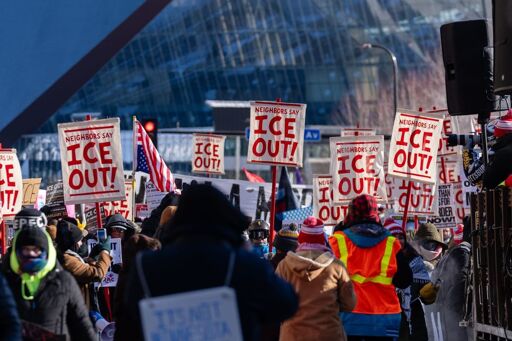
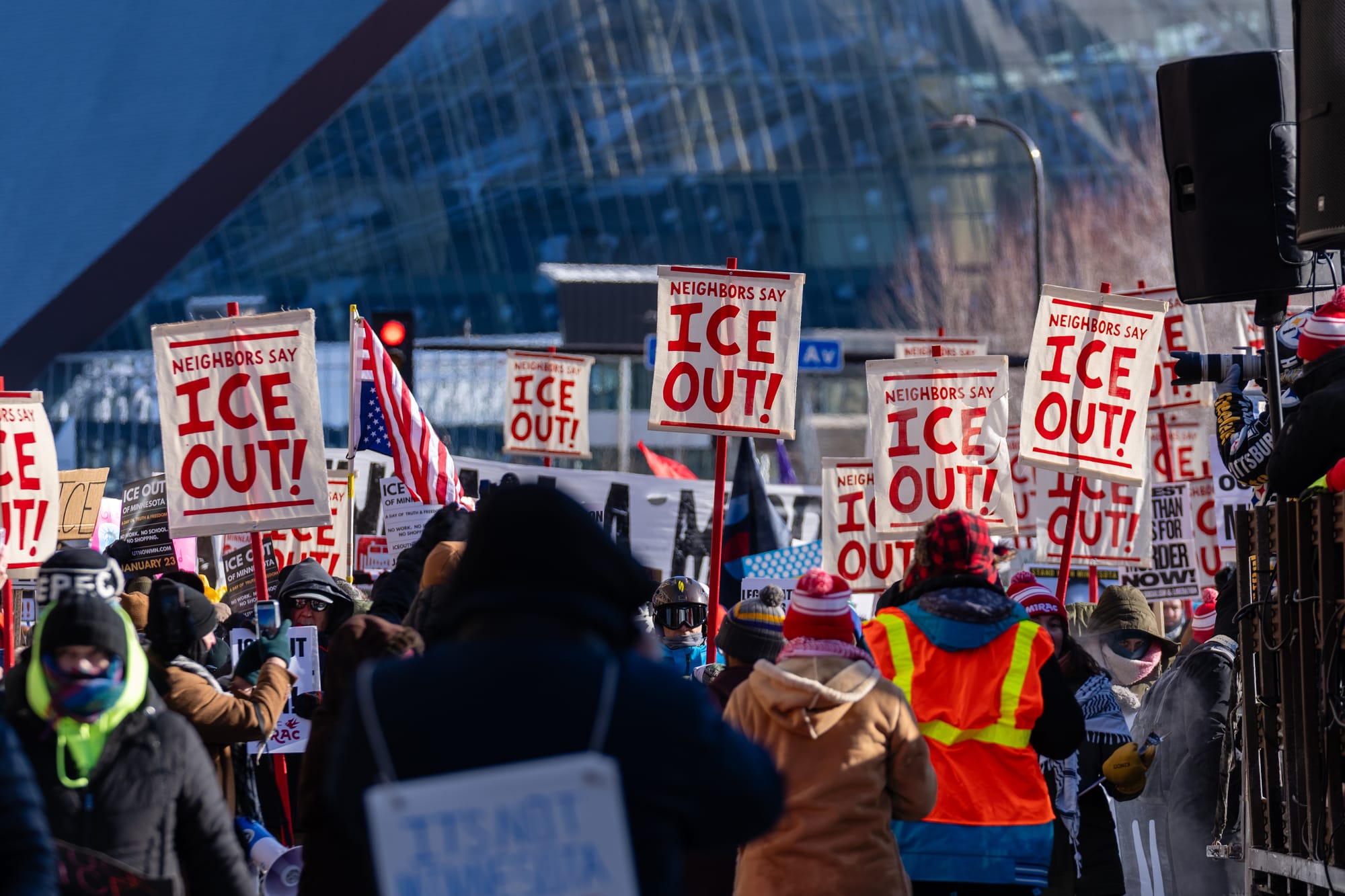
Of the active currents within today’s democratic upsurge, the “ICE OUT” movement harbors the greatest promise for a project of working-class recomposition. With episodes of popular resistance to occupations breaking out in places like Los Angeles, Chicago, and Minneapolis, the movement has raised the specter, if not yet the concrete form, of the citywide general strike. These pitched, spectacle-laden urban battles have polarized society around the question of the arbitrary power of the police state. The demand for “ICE OUT,” an implicit challenge to the authority of the federal government defined in the Constitution, arguably comes closer to expressing the lines of battle of a new democratic revolution than any other demand to emerge from the democratic movement-of-movements so far.
But “ICE OUT” holds only a part of the answer to the problem of class recomposition. A future administration, faced with enough pressure, could conceivably end the occupations and dissolve ICE without wholly uprooting the undemocratic system that keeps the ruling class in power. This would be a tremendous victory for working and oppressed people, but without a shared awareness of the border regime’s place in our larger undemocratic political order, that victory could demobilize rather than embolden the movement.
Every union organizer knows a well-timed concession from the boss can disorganize a campaign without conscious effort to inoculate workers by situating wins in a counter-narrative which identifies where the power to change the workplace actually lies. Ephemeral concessions from the state played a similar role in 2020, when cities promised police reforms only to renege after the streets emptied. To turn victories into building blocks rather than stumbling blocks, we need a foundational narrative that demystifies the nature of class power in this country. Neither the “restorers” nor the “renewers” can offer one.
The Third Reconstruction
Our task as socialists is to articulate a third path: the working class can reemerge as a historical actor by fighting for a democratic revolution to the end. From that task flows our strategy of forging DSA into a mass party rooted in working people’s struggles for freedom and survival, democratically controlled by its membership, and united by a program to fight for a Third Reconstruction.
The content of our program is not an abstract question. To face our tasks we must be able to articulate a vision of what the working class is and can be that millions of people will find compelling. The answer to “who’s in the working class?” is the same as it ever was: the disfranchised many who are exploited and abused because of the arbitrary power of the privileged few.
Though we are wildly diverse, we share a fate as people trapped in a society made by us but not for us. Fighting to take back everything stolen from us under capitalism—healthcare, housing, education, and more—is necessary but insufficient. We must have an answer for how we are robbed of these things and how justice can be done. To convince people that to be a part of the working class is something worth embracing, we need clarity that it will take a completely new political order to set the world to rights, and that those of us who constitute the working majority have the unique power to win one.
To do so we must bury the old Constitution with a new democratic order based on the principle of majority rule. That means replacing minoritarian institutions like the Presidency, Senate, and Supreme Court with a single popular assembly elected by free, equal, and proportional suffrage for all who live here. It would also mean abolishing capitalist tools of coercion like the police, ending all forms of second-class citizenship, and enshrining our rights to organize and seize capitalist property for the common good.
Without that basic foundation, it is impossible to think seriously about what it will take to solve the other great crises of the twenty-first century—ecological collapse, genocidal imperialism, and the unsustainable cost of living. During the First and Second Reconstruction, the movements struggling to solve the great crises of their time failed to secure a democratic constitutional order, leaving a divided working to fight with bound hands. The rollback of the gains these movements bled for continues today, with terrifying consequences and no plausible constitutional path to stop it.
Nor is it possible, without a commitment to the entire program of a Third Reconstruction, to unite the historically fractured working class in this country. Take, for example, unequal citizenship: we must fight for open borders, the abolition of ICE, and universal residency citizenship because working-class freedom is an all-or-nothing proposition. Citizens and noncitizens are disfranchised by different means, but the disfranchisement of any part of the class undermines the ability of the whole to take advantage of its majority and seize power. The same can be said for the struggle against the police state, which uniquely oppresses parts of the class but arms the ruling class with the power to dominate all of society. To compromise on one freedom struggle with the expectation of advancing another is suicidally shortsighted.
The horizon of a new constitution embodied in a clarifying political program is the key to rebuilding a working-class political subject. Meekly accepting the existence of pillars of our constitutional order like the Senate or the border regime legitimizes the idea that citizenship is contingent—to be qualified by some higher authority—an idea that undermines everything we fight for as socialists. Instead, we must draw a clear line: everyone who lives and breathes is a free and equal citizen, and we assert the absolute right to decide the kind of society we are to live in. Because our political system denies that right, we reject the legitimacy of that system and commit ourselves to building a new one.
DSA’s Battle to Win or Lose
What tactical interventions does such a strategy demand of us, in light of the composition of the existing democratic movement? The content of our program matters, but the decisive question is how we use it. The internal unity it represents must be realized externally, when we integrate it into our public identity through rhetoric, literature, and the campaigns we run. We must waste no opportunity to advance our program as an alternative to the insufficient horizons of the “restorers” and the “renewers.”
DSA is still in the process of uniting around a program that qualitatively breaks with both camps. The updated “Workers Deserve More” program recently adopted by the National Political Committee improves on our old platform by incorporating revolutionary democratic demands like the abolition of the Presidency, Senate, and independent judiciary in favor of an all-powerful and proportionally-elected House of Representatives. But there is still a ways to go, and building membership-wide buy-in for a program ratified in an NPC meeting will be difficult, especially considering a significant faction of DSA sees no daylight between our horizons and those of the “renewers.”
It has been widely speculated that AOC will carry the left-populist resurgence to new heights by running for President in 2028. The reality of our non-relationship with AOC means that DSA will have no control over whether she runs, and would have no means of compelling her campaign to give voice to the demands of a Third Reconstruction. But if her campaign is confronted with a working class increasingly united around the democratic ambitions spelled out in DSA’s program, the larger current of left-populism she represents will be forced to reckon with it or lose.
To realize that future, we need to transform the program of a Third Reconstruction into a concrete political force by fighting for its hegemony within the existing democratic movement. We can and should exploit the porous nature of the anti-Trump protest movement and treat events like No Kings as contested terrain. Marching with our own unified chants and signs, crowd-canvassing with or without the permission of liberal organizers, fielding speakers where possible, and stretching the limits of liberal protest tactics by being the first to step off the sidewalk and the last to leave when permits expire will all create opportunities to present our program—and meaningful opportunities to fight for it—to masses of people not yet activated by the socialist movement.
ICE OUT has so far been the most tactically advanced face of the embryonic mass movement for democracy. As the practice of street militancy evolves, DSA is not going to win the arms race for street-level leadership. That is not to say that members cannot participate in important ways on the front lines of mass unrest against ICE, but we as an organization are not built to coordinate illegal kinetic resistance to the state at scale. By its necessarily anonymous and decentralized character, it defies coordinated control, which is both a strength and a limitation.
What DSA can do for the ICE OUT movement is provide a permanent vehicle for more patient mass struggle during the inevitable ebbs in the street protest cycle. Chapters can run pressure campaigns, ballot issues, and tribune-candidates for local office around an agenda of zero tolerance for local collaboration with ICE. Chapter labor committees can get DSA members organizing where they work, either building towards a mandate for strike action with anti-ICE resolutions in their unions, or fighting to bring new workers into the labor movement by organizing in nonunion shops around related common-good demands. By building a mass constituency in opposition to ICE and the police state, alongside the democratic organizations to house it, DSA can begin to erect the scaffolding of an organized working class with the means to elevate its struggle for democracy beyond cyclical street battles with the police.
Realistically, a Third Reconstruction is unlikely to unfold between now and 2029. The present constitutional crisis will reach a different resolution, on terms decided by different class forces. But the urgency facing us is this: wherever the cards fall in the coming years, the new order will either be worse than the present disorder, or it will be an illusory “return to normalcy” waiting to collapse into another, more severe crisis. The liberal reformers and left-populists do not have what it takes to lead us out of these days of catastrophe to a rational and humane world. The question of democracy will confront us, again and again, for as long as the class struggle persists. It is vital to humanity’s survival that the working class learns how to answer it.
Light & Air / Marxist Unity Group
Liked what you read? Subscribe to stay plugged in.
From Marxist Unity Group via This RSS Feed.