

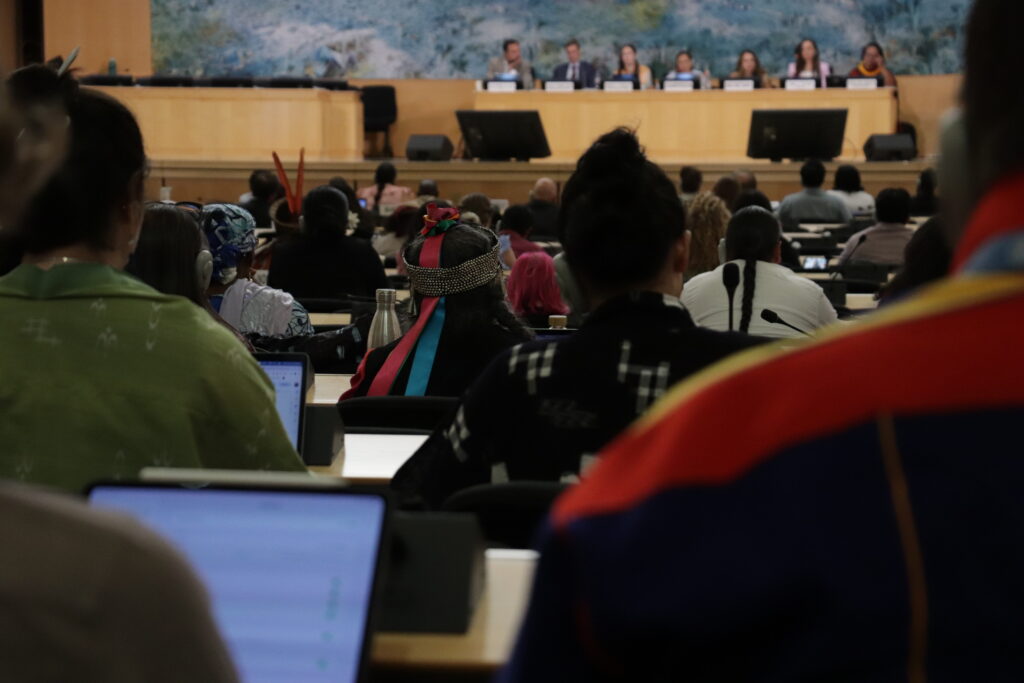
Indigenous delegates from every continent listen during a session of the UN Expert Mechanism on the Rights of Indigenous Peoples (EMRIP) in Geneva last week. Photo by Dionne Phillips
This story is published through the Indigenous News Alliance.
Indigenous communities around the world face mounting — and colliding — impacts from climate change, violence, resource extraction, artificial intelligence, and many other crises.
And at the United Nations in Geneva last week, their leaders united in demanding that the international community take action.
They’ve given the UN a 12-point plan for what they say it must do.
Simply put, their proposal calls on the UN and governments around the world to take sweeping and rapid action to protect Indigenous land, rights, and lives.
At the United Nations’ headquarters in Geneva, hundreds of delegates wrapped up this year’s Expert Mechanism on the Rights of Indigenous Peoples (EMRIP) meetings last week.
The UN body’s seven expert panelists, representing every region of the world, considered a week of Indigenous testimony before issuing recommendations for the UN Human Rights Council.
But amidst hope for change, the massive financial crisis engulfing the UN overshadowed the proceedings.
Numerous delegates expressed concerns about the very future of EMRIP itself, and other hard-won international platforms for Indigenous voices.
Many EMRIP delegates noted significant work is urgently needed to uphold, protect and expand Indigenous rights across the globe.
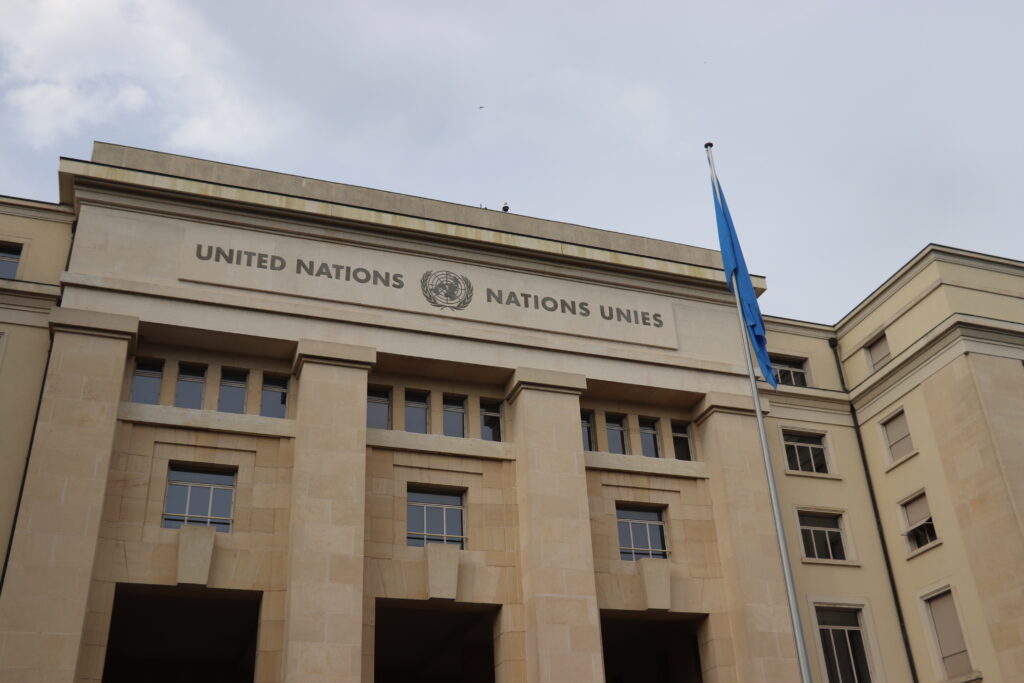
Photo by Dionne Phillips
‘We’re looking for action’
Given the scale of threats Indigenous peoples face, these forums are more important than ever, said Sheryl Lightfoot, an Anishinaabe expert on international law and EMRIP’s North America region expert.
Despite “the progress we’ve made,” she said in an interview, “sometimes we see some regression.
“There’s clearly no shortage of work.”
The breadth of the 12 recommendations reflects that urgency, in their call to protectthe culture and rights of Indigenous peoples and give them a greater voice in global affairs impacting them.
McGuire-Cyrette also feared cuts to Indigenous programs as a result of the UN’s US$1.6-billion (C$2.3-billion) financial shortfall — exacerbated by the United States’ refusal to pay the nearly US$4 billion it owes in dues (C$5.6 billion).
The crisis is engulfing all UN agencies, especially funds specifically earmarked for Indigenous Peoples, which were already stretched.
Cora McGuire-Cyrette, member of the Bingwi Neyaashi Anishinaabek, spoke in Geneva on behalf of the Ontario Native Women’s Association (ONWA) about the importance of involving Indigenous women and girls — and “not simply be consulted” — in decisions that affect them.
“We’re looking for action,” she said in an interview.
“Our communities — our women, our children, our families — they have a right to action and that’s what we’re not seeing globally.”
She and others also reminded delegates about the importance of greater autonomy for Indigenous women and girls.
“We recommend the inclusion of Indigenous women in all decisions that impact our lives, our families, and our nations,” McGuire-Cyrette told the assembly.
Those calls echo what delegates from every continent demanded throughout the week of meetings: governments must do more than simply consult Indigenous peoples on matters affecting their territories and communities.
“The liquidity crisis must not be used as an excuse to limit the mandate of EMRIP and to reduce the frequency or depth of country engagements or follow up,” McGuire-Cyrette said in one of her EMRIP interventions.
The forum is important for Indigenous women’s safety, participation and leadership around the world, and called on UN member states to “take seriously” their commitment and obligation towards human rights and fully pay their contributions to the UN system.
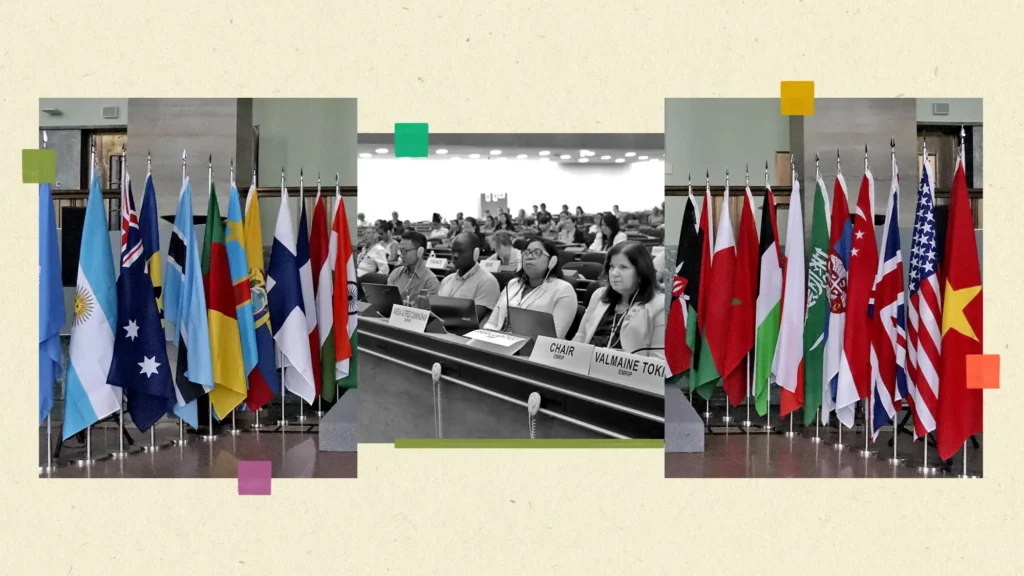
Illustration by Grist, photos by Dionne Phillips
‘Unanswered questions’ over future
Marjolaine Étienne, who is Innu from the Pekuakamiulnuatsh community of Mashteuiatsh in Quebec, told delegates the UN Voluntary Fund for Indigenous Peoples needs greater support.
The program helps Indigenous representatives cover the costs of attending international meetings.
The number of representatives the fund supports is already perilously low, she said. Without greater state contributions, fewer delegates will be able to attend those forums, sidelining them from the international stage.
Currently, she said, the number of people the fund supports is a mere three to five per cent of participants.
Just eight countries contribute to the Voluntary Fund for Indigenous Peoples, with a budget of less than US$2 million (C$2.5 million), and only three countries contributed to the UN Trust Fund for Indigenous Peoples. The “US” contributes to neither fund, while the Government of Canada gave to both.
Without adequate state contributions, fewer and fewer delegates are able to benefit, and therefore their voices are effectively sidelined and silenced on the international stage.
Lightfoot acknowledged there is widespread uncertainty within EMRIP, and all UN bodies, amidst an agency-wide reform effort, known as “UN80.”
But she said EMRIP is preparing for whatever happens.
“There are a lot of unanswered questions right now” about the reforms, she said, “and what the impacts of that might be for Indigenous-specific mechanisms.
“I don’t know where we’re going. I don’t know what kind of efficiencies the UN will ask of us. But I know we are thinking it through because we want to be ready to respond.”
Pacific region EMRIP expert Valmaine Toki chaired the final meeting, and spoke about the panel’s 12 proposals — including one addressing the UN’s dire fiscal situation, titled “The implementation of EMRIP’s mandate in the context of the liquidity and financial crisis.”
EMRIP is one of the three UN bodies focused on Indigenous issues — along with the Permanent Forum on Indigenous Issues, and the Special Rapporteur on the Rights of Indigenous Peoples.
All three agencies face an uncertain future due to dwindling financial support.
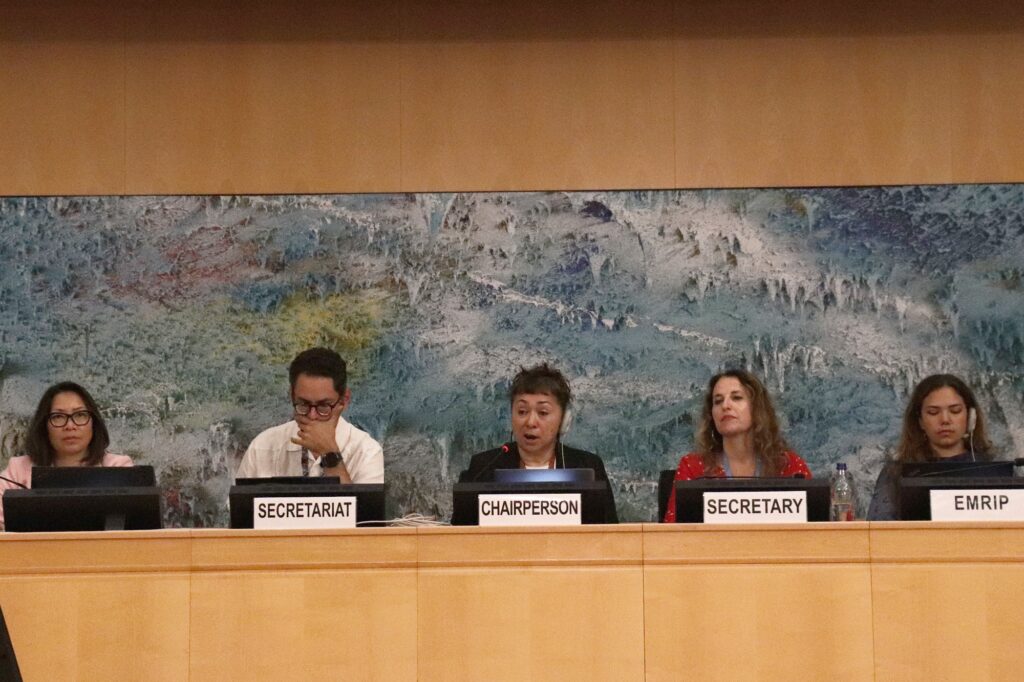
Pacific region EMRIP expert Valmaine Toki, from Aoteoroa (New Zealand), speaks during a session she chaired. Photo by Dionne Phillips
Challenges and opportunities
With 2027 marking 20 years of the UN Nations Declaration on the Rights of Indigenous Peoples (UNDRIP), there were mixed emotions in Geneva about its success so far — and about the very future of the agreement.
Albert Barume — the UN Special Rapporteur on the rights of Indigenous Peoples, and EMRIP’s former chairperson — spoke to delegates about what he called a widespread trend of “stagnation and regression” for human rights.
Instead, the veteran international law expert warned, powerful political and economic interests have too often taken priority over Indigenous rights.
“In the last years … almost no single states have taken a new measure protecting Indigenous peoples’ rights,” said Barume, from the Democratic Republic of the Congo. “And states that had legal and policy frameworks are actively dismantling and regressing.”
Macy Duxfield — who is Māori from the Ngaa Rauru, Te Ātihaunui-a-Papārangi, and Ngāi Tahu nations — spoke in an interview on regressive policies in her home of Aotearoa (New Zealand).
Frustrated by what she called “really regressive” legislative and policy changes at home, she said, she is “upset about what’s going on right in front of us.”
But she reminds herself of the continual work that’s still needed to overcome the challenges her people face.
“We exist in this moment,” she said. “We’ve inherited the work from our ancestors, and we pass it on to our descendants.”
McGuire-Cyrette recognized there may be opportunities that could arise from UNDRIP’s 20th anniversary — especially as anti-Indigenous rhetoric increases in many countries, including Canada.
“I think there’s an opportunity for prioritizing Indigenous women,” she said, “prioritizing Indigenous women’s safety, prioritizing Indigenous women’s rights.”
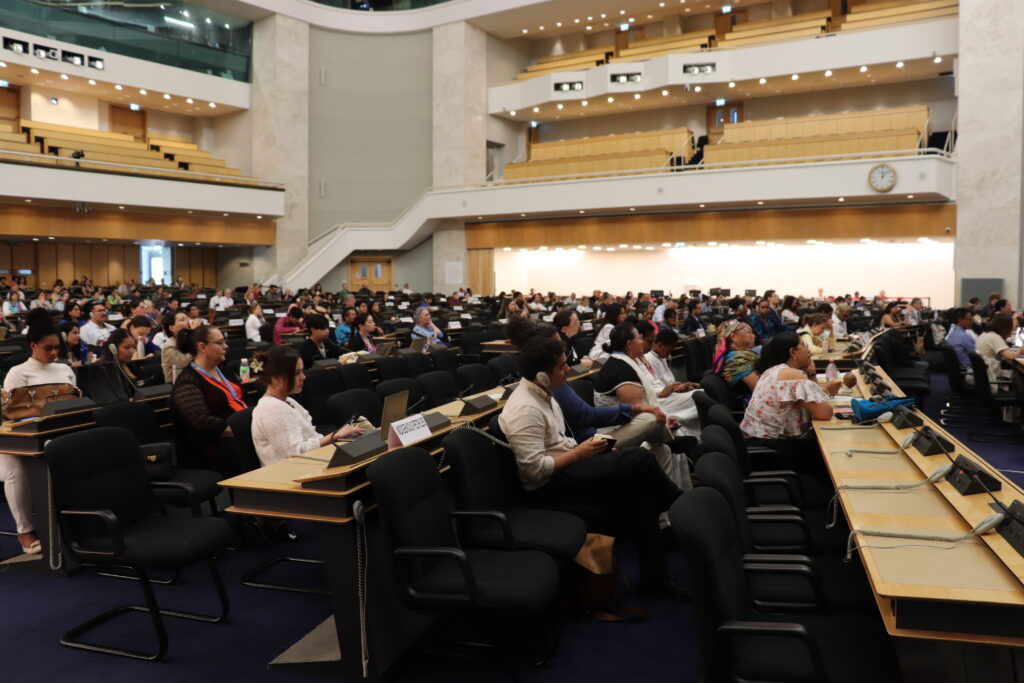
Hundreds of participants attend EMRIP meetings in Geneva. Photo by Dionne Phillips
Calls for consent, not just consultation
As EMRIP came to a close after five days last week, Indigenous experts from the body’s seven regions put forward 12 proposals for the UN Human Rights Council.
The recommendations emerged from the previous four days of testimony from Indigenous delegates and governments — on a broad agenda that included studying impacts on Indigenous commuinities in conflict and post-conflict areas, AI, and the International Decade of Indigenous languages.
Also discussed was how to mark two decades since the creation of UNDRIP — and what EMPRIP’s own future holds.
Toki read out the experts’ 12 proposals for the upcoming year.
One proposal was to convene a panel about UNDRIP’s 20th anniversary, which will address achievements and emerging challenges to “enhance its future work.”
Another proposal addressed EMRIP’s mandate amidst the financial crisis.
The experts also called for increased protection of Indigenous leaders and human rights defenders from persecution.
And they urged the UN Human Rights Council to encourage member states to accept the findings of EMRIP’s study on conflict and post-conflict situations.
One proposal urged greater protections for remote Indigenous peoples, who live in voluntary isolation or initial contact.
Subsequent recommendations tackled concerns about AI; preserving Indigenous languages; Indigenous rights in non-self-governing territories; enshrining Indigenous rights as distinct from other types of human rights; fully implementing UNDRIP; boosting participation within the Human Rights Council; and calling on member states to more fully engage with EMRIP.
Free, prior and informed consent was a widely discussed demand woven throughout the week’s agenda.
Lightfoot expressed concern about businesses, governments and other agencies claiming to uphold free, prior and informed consent without actually following through.
“Indigenous peoples have the right to provide consent or withhold consent on matters that affect their rights — to varying degrees depending on the impact on them,” Lightfoot said.
“When you look deeper, it isn’t really consent-based — it’s merely an expanded or enhanced consultation.”
And even if obtaining Indigenous consent may require a new way of thinking for some governments and companies, she said, “That is the human rights standard.”
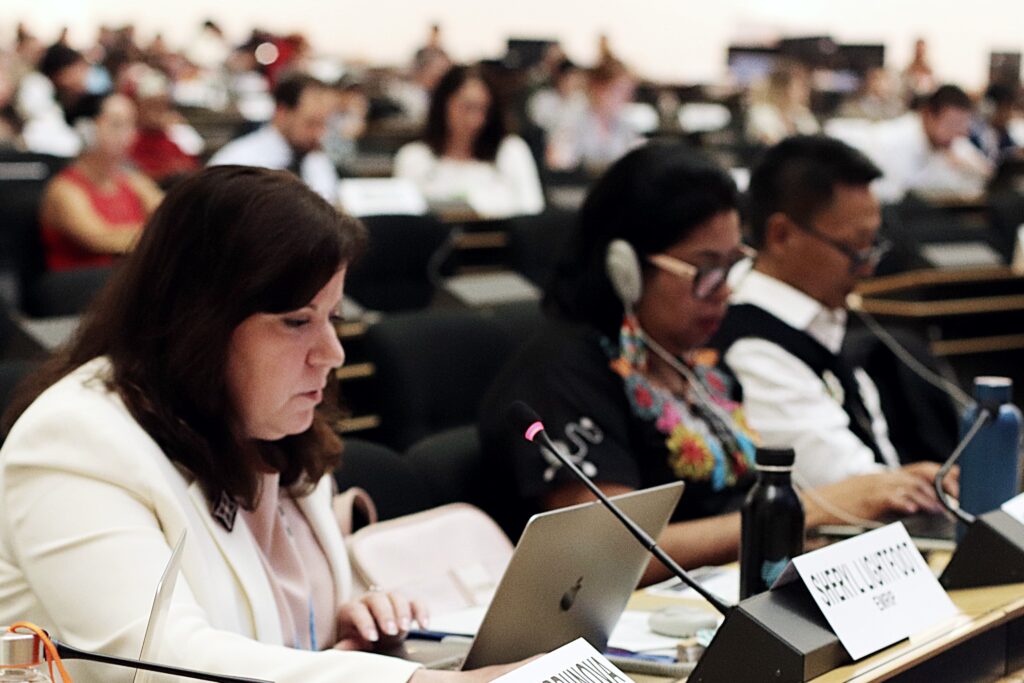
This year’s EMRIP meeting is expert member Sheryl Lightfoot’s last in her role representing ‘North America’ at the global body, after completing two consecutive terms of three years. Photo by Dionne Phillips
Future depends on ‘critically important’ Youth voices
While the future of Indigenous-centred spaces at the global level remains uncertain, there was a common acknowledgement as this year’s EMRIP meetings ended: listening and uplifting the voices of Youth is essential.
“It’s critically important … as we press for the implementation of the declaration, that the Youth become centred,” Barume said.
“Their parents, their grandparents spent tens of years negotiating those standards. It’s time that those standards are implemented.”
Recounting his experiences listening to Youth, he praised “their determination, their creativity, and their embedding into their community culture.”
One of the Indigenous Youth who spent the week in Geneva was Sophia Carnovale, who is Mohawk from Six Nations of the Grand River.
She is ONWA’s vice-president, and a Youth Council board member.
She told IndigiNews that she descends from a long line of Matriarchs, and as a young Indigenous person feels a “responsibility to continue their efforts.”
“I never thought I’d be here,” she said. “But I feel like there’s a legacy that the Matriarchs before me left.”
The meetings ended Friday with a closing ceremony, a Mapuche song, and a Māori haka dance.
Lightfoot offered Anishinaabemowin words of gratitude on her final EMRIP assembly as EMRIP’s “North America” representative, after serving two three-year terms.
“I send you a chi-miigwech, thank you my colleagues,” she said, emotionally. “It has been such an honour.”
The entire audience rose in a standing ovation after she spoke. Fellow EMRIP expert representative Anexa Alfred Cunningham — of the Miskitu people of Nicaragua, who was barred from returning home in alleged retaliation for her UN advocacy — wished delegates safe travels to their homelands.
“May the spirit of co-operation and our ancestors, who are with us today and this week, continue to be with us until we achieve the goals,” she said.
The post Indigenous leaders give the UN a roadmap for protecting their peoples appeared first on Indiginews.
From Indiginews via This RSS Feed.