

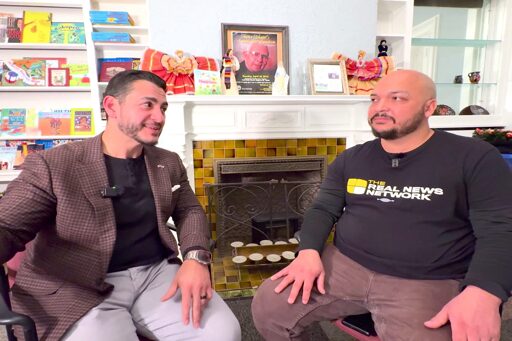
The outcome of Michigan’s Senate race will have major implications for the balance of power in Washington, DC, and for the future of the Democratic Party itself. With primaries taking place on August 4, all eyes are on the battle between progressive candidate Dr. Abdul El-Sayed and establishment candidate Haley Stephens to see who will represent Democrats in the general election. TRNN Editor-in-Chief Maximillian Alvarez sits down with El-Sayed to talk about his campaign, the civil war within the Democratic party, and about fighting corporate oligarchy and MAGA fascism at the same time.
Credits:
- Videography: Maximillian Alvarez
- Post-Production: Maximillian Alvarez, David Hebden
Transcript
The following is a rushed transcript and may contain errors. It will be updated.
Speaker 1:
Michigan is shaping up to be one of the most closely watched Senate races of this entire cycle.
Speaker 2:
Democrats will choose between Congresswoman Haley Stevens and former director of the Department of Health, Human and Veterans Services, Wayne County, Dr. Abdul El-Sayed.
Dr. Abdul El-Sayed:
We pay more for the stuff we got to buy, get paid less for the work that we do and watch as our tax dollars get misappropriated abroad to drop bombs on other people’s kids instead of to invest in our own kids and their schools and their healthcare.
Speaker 4:
We’re done. Business as usual politics is over.
Dr. Abdul El-Sayed:
Most people don’t walk around thinking, where do I stand on the left right spectrum? Most people walk around thinking, how am I going to afford my groceries? How am I going to pay for my rent? Can I ever afford a home? What am I going to do if I get sick? The majority of Democrats out there, when I talk to them, they are so far away from the party elders who hold all the power. And I think we have an opportunity as a party to molt out with the old, in with what the people underneath the party really want.
Speaker 5:
Obviously politics are a very tumultuous time right now and the Democratic Party’s kind of in disarray. So I’m coming out to support Abdul.
Maximillian Alvarez:
He really knew and understood the people, that he was for the people.
Dr. Abdul El-Sayed:
So we’re running a campaign to do three very simple things. Number one, we’ve got to get money out of politics. We’ve got to take on the system that tells us that corporations are people and that their money is speech. So we’ve got to get money out of politics. Number two, we’ve got to put money back in people’s pockets. So what does that mean? It means empowering people to join or form a union in every sector of our lives. It means standing with small businesses like this one that really do create the backbone of our economy. And it means finally taxing billionaires some wealth.
Speaker 7:
And that is precisely why we need people like Abdul in the US Senate.
Speaker 8:
I worked third shift and I made sure to get my butt out here in support before I have to go into work because the message has always been amazing. Watch out. There’s a car right there. But yeah, the way he just speaks to the working class I feel like is really what we need. And also when I shook his hand, he dabbed me up like a homie.He felt like somebody I knew already and that’s somebody I want fighting for us in the Senate. So I’m really glad I came tonight.
Dr. Abdul El-Sayed:
The question for us is bigger than this seat. It is about what we want out of our democracy in the first place. So if everything is working just fine for you, I’m not your guy. Do not vote for me. But if you believe that you deserve healthcare, if you believe that your tax dollars ought to be spent on you, if you believe that corporations should not have a bigger say in our politics than you do, then maybe I am.
Maximillian Alvarez:
We first met when you were running for governor here in Michigan in 2018. The question was how are Democrats going to respond to Trump? But also who’s going to inherit the Bernie Sanders mantle? AOC just won. And so you were part of that progressive cohort. And now we kind of have a similar situation. How are Democrats going to respond to Trump winning again? Zorn Mamdani just won in New York. Who’s going to inherit the progressive movement? But these are two very different moments and you’re a very different person than you were back then. I wanted to ask to start how you would characterize the differences between that campaign and this one.
Dr. Abdul El-Sayed:
Let me break it down two ways. There’s where we are as a country and then there’s the growth that you do as a person. I think where we are as a country, this is a moment where I think to be honest, we had failed to learn the central lesson of Trumpism. I think a lot of folks felt like the record had skipped, that there was this mistake and they didn’t see the fact that Donald Trump was exploiting a foundational pain in people. And I said this thing at the time, I think that was just, it was premature. Most folks didn’t see it. Donald Trump himself is not the disease of our politics. He’s just the worst symptom of the disease of our politics. And the disease is the system that allows corporations and billionaires and would be oligarchs to buy and sell politicians to do their bidding.
You watch as they use their power to suppress our wages for the work that we have to do and to raise our prices for the things we have to buy. And I think this time around people are recognizing that actually we dealt with the symptom, but we didn’t deal with the disease. And as a doctor, I’ll tell you, if you only deal with the symptom and you don’t deal with the disease, it comes back roaring worse. And that’s exactly what’s happened now. So I think folks are a lot more interested in authentic engagement with the structures of our system. Even now though, you got a lot of corporate folks out there who just want to deal with the symptoms. They’re like, “Oh, affordability? Okay, I’ll make one thing more affordable for you. It’d be great.” And they’re like, “No, there’s a structure underneath affordability. There’s a reason why everything accelerates in the wrong direction always.
And if you don’t deal with the foundational infrastructure, you’re not going to deal with the outcome.” One of the frustrations I think I have with some folks in our movement sometimes is that we want people to agree on the critique and we always break apart on the critique. It’s not about the critique, it’s about the outcome.
And I think the more you could focus on how you want the world to be like and get people to agree to that, even if they come at it with different perspectives, I think the better off we are. And I think that’s probably what I’ve learned over time.
Speaker 4:
There’s a big battle brewing. A battle brewing against not only the corrupt fascist forces of the Republican Party, but also against do – nothing Democrats that would rather sit there and collect paycheck after paycheck and fundraise from corporate donors that put your interests second to the interests of those very same corporations.
Maximillian Alvarez:
The 2024 election was less of a referendum on how much people love Donald Trump than it was a referendum on how much people hate the Democrats.
Speaker 2:
Agree.
Maximillian Alvarez:
People’s faith in the Democratic Party is in the basement right now, especially on top of a year of doing what feels like virtually nothing to stop Trump, caving on the longest government shutdown in our history while people are watching their SNAP benefits, their healthcare disappear before their eyes. So the question there is like, is why run as a Democrat? And how are you going to address that lack of faith and prove that this isn’t just the right message that you’re going to meet people’s needs?
Dr. Abdul El-Sayed:
Yeah. I know what I’m about. And Democratic Party hasn’t always met my needs. I think a lot of people out there feel like they’re Democrats by hostage situation. You look at the other guys and you’re like, “That’s crazy.” And then you look at the Democrats and you’re like, “I don’t know what’s worse.” Being cruel and crazy or being feckless in the face of being cruel and crazy. Now the party is so far away from its voters. The majority of Democrats out there, when I talk to them out at Democratic clubs or indivisible or you name the organization that I’m out, they are so far away from the party elders who hold all the power. And I think we have an opportunity as a party to molt. Out with the old, in with what the people underneath the party really want. And I’ve said this for a very long time.
The problem with Democrats is too often they’re taking money from the very same people who created the problem. So now you’re in this weird position of trying to articulate a solution to the problem that includes the people who created the problem. That makes sense. I don’t take over money. I never have. I never will. And I understood from the day I started in politics that that wasn’t the big issue. And so when folks look at me, they say like, “At least I know what he believes because he’s not bought. And I think the party could do the same thing. Say what you will about Donald Trump. He’s got a coherent narrative. You out of a job. Immigrant took your job. Out of a home. Immigrant took your home. Out of healthcare. Immigrant took your healthcare. That’s his narrative. Simple, easy to understand, dead wrong. We could have a narrative too.
Out of a job, corporation offshore automated your job. Out of healthcare, corporation squeezed you out of healthcare. Out of a home, corporation speculated that you can’t afford a home. But when you’re taking money from corporations, guess what you’re not going to
Speaker 2:
Say?
Dr. Abdul El-Sayed:
So you come with your little list of 10 point policy plans that’s going to deliver something for maybe somebody 10 years from now. It’s bullshit. So I think the party could be better and I’m ready to make it better. So I’m a Democrat with lowercase D, and I hope someday we can win the fight for what the Democratic Party can be. And I’m not willing to let go of all that infrastructure because a few folks who can’t let go of power say that it’s theirs.
Speaker 7:
So what the hell is going on? Why are we living in a society where workers are producing more and more and virtually all of that income and wealth is going to the top 1%?
Dr. Abdul El-Sayed:
It’s the system that allows the richest, most powerful people, corporations, billionaires to buy and sell politicians in ways that leave them rigging the system against us. Corporations get bigger, more powerful. Our lives get harder.
Speaker 2:
I feel like I don’t ever see hardly any campaigning politicians come to Saginaw and it’s so underrepresented given how much we’ve been through. I mean, we’re very similar to Flint in a lot of ways and how we had a booming industry and then laws were passed that just discriminated against every single person one way or another that pushed us out of different areas for companies and contractors to come in and exploit us. And I think he touched on that in a way I haven’t seen a lot of politicians really focus on, at least for again, Saginaw.
Speaker 1:
I absolutely think Abdul is right on track of having the billionaires stop having power in politics and allowing us to have a voice and making sure that everybody is treated fairly. I do a lot of the organizing of the Latino community here in Saginaw, Michigan. So I’m trying to get them a voice because for too long there are too many Republicans and Democrats that have been voting to cause harm to the Latino population.
Speaker 5:
I think an unapologetic progressive populism that’s centered on delivering for working class people is how we win in the future. And that’s exactly what Abdul’s message is.
Dr. Abdul El-Sayed:
I mean, democracy was broken the day corporations started to buy elections. That didn’t just happen. We’re at death’s door now, but we’ve been here. We’ve been sick. And so why don’t you talk about it in ways that are actually fully complete? Hey, every time a corporation comes in and buys off a politician, that kills your democracy a little bit. But most of these folks who want us to talk about democracy now didn’t feel it when that happened. And I think we got to talk about it completely. I
Maximillian Alvarez:
Want to talk about what that means for where we are sitting right now in Saginaw, Michigan. And I have a special attachment to this place. My wife grew up here. I have a lot of in – laws who live around here. My wife’s family had generations of men work in the old GM plant up the road. It is a cold, hard, but beautiful place with a lot of families with a lot of deep roots. A lot of igrant families going from back to Poland, Germany, Mexican and other Latino immigrants, a lot of black folks who came up during the Great Depression. People don’t give towns like Saginaw credit for how complex and beautiful they actually are. But in many ways, this is the archetypal rust belt
Speaker 2:
Town.
Maximillian Alvarez:
I mean there is a lot of pride. There’s a lot of joy. There’s a lot of family here. There’s also a lot of boarded up windows. There’s a lot of blight. There’s a lot of pain. There’s a lot of poverty and economic devastation. So why is it important for you to come to a place like Saginaw? And again, moving past the sort of democratic messaging, I guess my question is not how do you hope to reach people who live in places like Saginaw, but what can you and other politicians do for places like Saginaw?
Dr. Abdul El-Sayed:
Yeah. The simple question, how do you reach? You come. We’re here. You know what I mean? This is not my first time in Saginaw. It’s not going to be my last time in Saginaw. For me, I’ve trained as a doctor and that training’s been really useful for me because both doctors and politicians have to be really good at being able to sit with other people’s pain and to speak truth to pain. It’s truth to power, but also truth to pain. And then I think the way you reach folks is to be vulnerable with them. I can’t solve all the problems, but I can’t tell you why the problems exist. And I can tell you I’m going to try like hell to take it on. And then I think you need to go back to that point that I was making to be a really good listener to people’s pain and to try to forge that pain into purpose.
I can’t solve it. Anybody walks in here is like, “I’m going to fix your problems.” No, you’re not. We can solve it. And if I can be a vessel that helps to create something that can organize us and can impose what it is that we’ve been asking for, for a very long time into power, then I think we can solve it. We can’t solve it tomorrow, but we can solve it in due time. And I’ll tell you that the analogy here to medicine is clear. Somebody gets a cancer diagnosis. You want to tell them you’re going to be fine. It’s bullshit. And if I tell you you’re going to be fine, it’s a lie. But what I can tell you is I’m really sorry that this happened to you. And I can tell you what we know and I can tell you what we can do.
And I can tell you I’m going to sit here and listen for as long as you need me to listen to you and that I’m going to be your advocate for helping get the best outcome you want. In this case, it’s not terminal. Places like Saginaw can heal, but not doing the same shit that we’ve been doing. And so in some respects there is an honesty that you have to tell people. It’s not just always going to be okay or I’m going to solve all your problems. I’m not. I’m going to do my best to help you, to be honest with you about what the problem is, to sit down and think about what our approach moving forward can be and to fight like hell for you against people who’ve created this problem. And if we can do that and you can trust me to do that, we can build things over time, but it starts there.
From The Real News Network via This RSS Feed.