

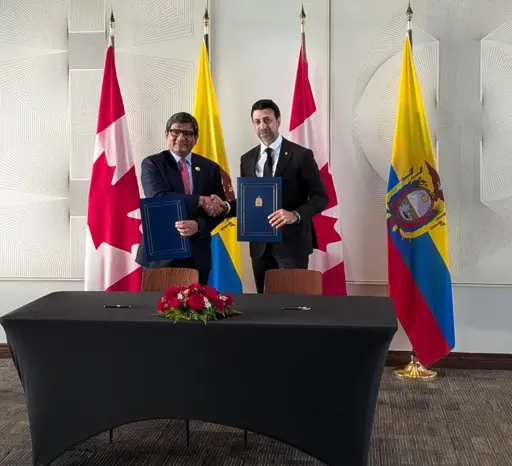
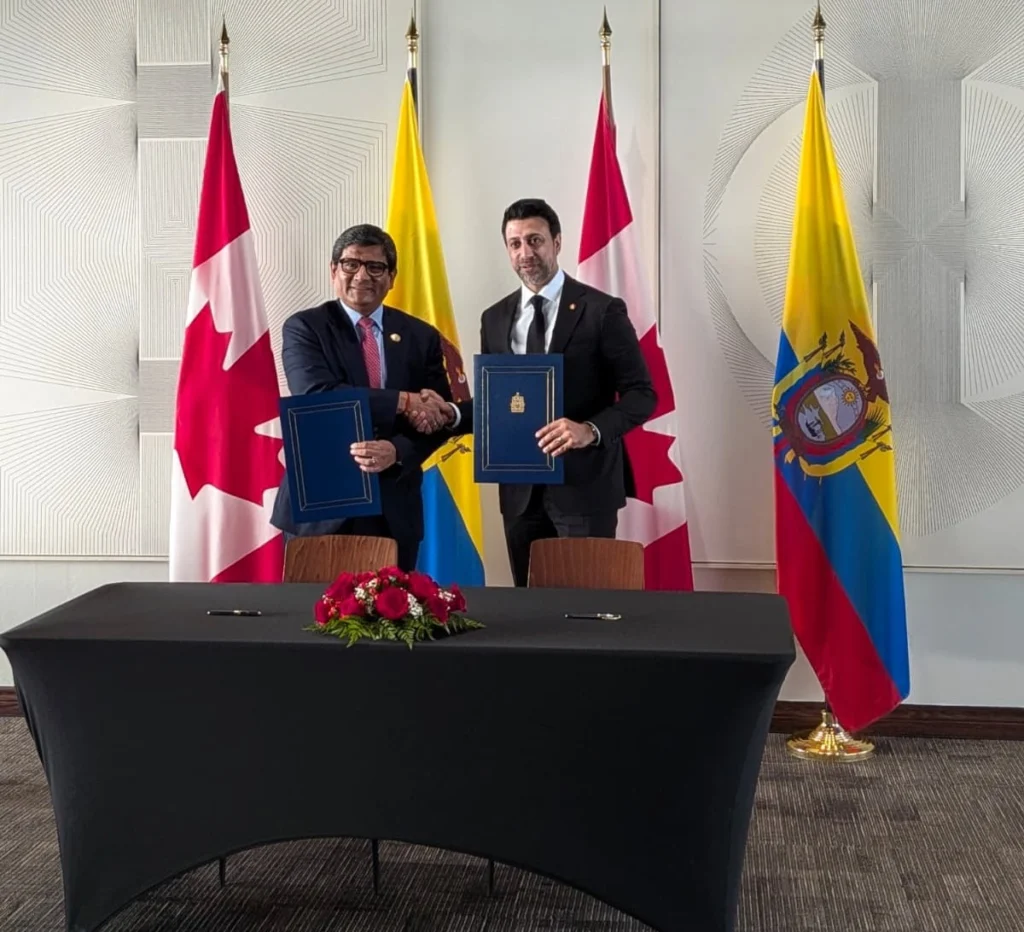
Ecuador and Canada signed a Free Trade Agreement (FTA) on Friday in Ottawa, expanding market access by eliminating tariffs on 99.6% of Ecuador’s exportable goods and establishing new mechanisms for the exchange of goods and inputs.
RELATED:
Ecuador’s Carapaz Wins 18th Stage of the Tour de France
The trade agreement was signed by Ecuador’s Minister of Production, Foreign Trade and Investment, Luis Alberto Jaramillo, and Canada’s Minister of International Trade, Maninder Sidhu.
The treaty comprises 29 chapters covering areas such as trade in goods and services, investment, e-commerce, transparency, labor and environmental issues, gender, micro, small and medium-sized enterprises (MSMEs), indigenous peoples, and dispute resolution.
Once the agreement enters into force, more than 600 Ecuadorian products will have tariff-free access to the Canadian market, allowing the country to match the preferential conditions already enjoyed by regional competitors such as Colombia and Peru. Among the flagship products are bananas, cocoa and its derivatives, shrimp, tropical fruits, broccoli, asparagus, hearts of palm, quinoa, and frozen vegetables.
EXCLUSIVE: Colombia accelerates Latin America’s reactionary revival of Chicago Boys economics today
Colombia is the latest and perhaps most consequential piece of Latin America’s rightward realignment. The preliminary count places Trump-backed nationalist Abelardo de la… pic.twitter.com/lghi7EmLoF
— DannyKPolitics (@DannyKPolitics) June 22, 2026
Additionally, new opportunities are opening up for sectors that previously faced tariffs, such as flowers, chocolates, confectionery, tuna preparations, juices, palm oil, textiles, clothing, ceramics, furniture, auto parts, tires, footwear, and cosmetics.
“Canada, with nearly 40 million consumers and a per capita Gross Domestic Product (GDP) of approximately $53,000, is a strategic partner for diversifying national exports and strengthening Ecuador’s presence in North America,” stated the Ministry of Production.
The government indicated that the treaty protects national production through special treatment for the most sensitive sectors, as it excludes or establishes protection mechanisms for 227 strategic agricultural products, safeguarding activities related to rice, corn, milk, meat, and sugar.
The ministry also noted that Ecuador fully preserved its sovereign right to establish regulations aimed at protecting public health, the environment, product quality, and animal and plant health, and maintains the ban on importing used clothing.
Finally, the agreement will facilitate access to raw materials and capital goods. In 2025, non-oil trade resulted in a trade surplus of $85 million for Ecuador, with exports reaching $563 million, representing a 91% increase compared to 2024, according to the Ecuadorian Federation of Exporters (Fedexpor).
#Ecuador | Gen. Francis L. Donovan, chief of U.S. Southern Command (SouthCom), visited Ecuador to review joint security operations with Ecuadorian forces in Esmeraldas, near the Colombian border.
The visit included operational briefings and an assessment of border surveillance… pic.twitter.com/bELvuTyeK2— teleSUR English (@telesurenglish) July 16, 2026
From teleSUR English via This RSS Feed.