

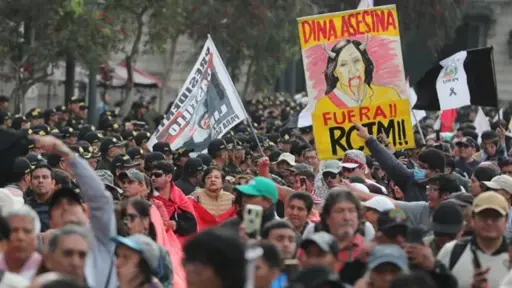
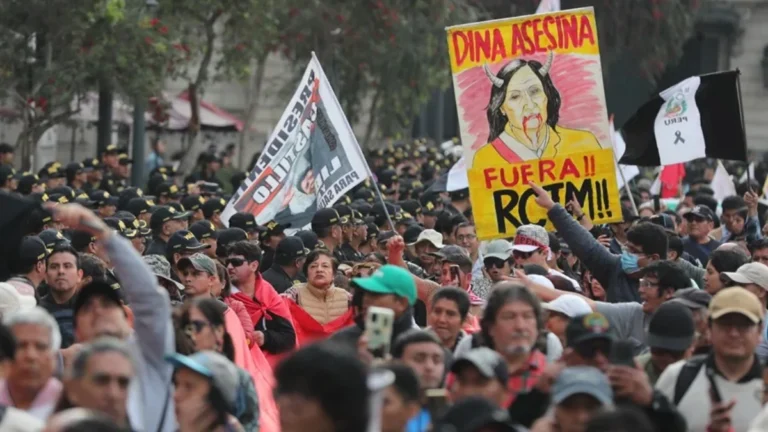
The ruling invalidates provisions that penalized logistical and financial support for peaceful demonstrations and nullifies related criminal cases.
Peru’s Constitutional Court ruled on Thursday that legal provisions criminalizing logistical and financial support for social protests are unconstitutional, striking down measures enacted during the government of Dina Boluarte and dismissing cases brought under those provisions.
RELATED: Peru Renovates National Stadium for Lima 2027 Pan American Games
The court found that the law violated the principles of legality and legal certainty by criminalizing preparatory acts, logistical assistance and expressions of solidarity associated with the constitutional right to peaceful protest.
“The classification of acts of collaboration (…) is unconstitutional because it violates the principle of legality and specificity, insofar as it criminalizes preparatory acts, logistical support or solidarity that form part of the free exercise of the fundamental right to peaceful protest.”
The Constitutional Court also upheld tougher penalties for the crimes of public disorder and obstruction of public services, while reaffirming that peaceful protest is fully protected under the Constitution. It stressed that acts involving violence, damage to public or private infrastructure, or serious violations of the rights of others fall outside that constitutional protection.
“The right to protest protects only peaceful and unarmed demonstrations. Acts involving violence, destruction of public or private infrastructure and the serious violation of the rights of others are not protected by the Constitution.”
The ruling struck down Articles 283-A and 315-B of the Penal Code, which imposed criminal penalties for so-called “acts of collaboration,” including providing money, food, transportation or supplies for demonstrations. As a result, investigations, complaints and legal proceedings initiated under those provisions will be archived and rendered without legal effect.
Protests After Pedro Castillo’s Removal
The decision follows years of controversy surrounding legislation introduced after the parliamentary removal of former President Pedro Castillo. Thousands of Peruvians mobilized in defense of democracy and against Dina Boluarte’s assumption of the presidency.
National and international organizations documented the killing of civilians by the armed forces and police during the protests. Demonstrators also demanded Castillo’s release, the resignation of Congress and the convening of a constituent assembly to draft a new Constitution.
According to the information provided, at least 49 people were killed and multiple arrests were reported during the crackdown on the protests, as demonstrators called for the detention and imprisonment of former President Dina Boluarte.
The decree had also drawn criticism from social organizations and human rights defenders, who argued that it undermined fundamental freedoms, including freedom of expression, peaceful assembly and collective expression, while conflicting with international legal standards.
From teleSUR English via This RSS Feed.