

President Donald Trump on Thursday unveiled a new package of tariffs targeting 60 countries that account for over 99% of US imports, a move that—if upheld in court—would cost Americans an estimated $100 billion per year in the form of higher costs.
The duties, ranging from 10% to 12.5%, were announced as part of the president’s effort to maneuver around repeated court rulings against his sweeping tariffs, including by the conservative-dominated US Supreme Court. Jamieson Greer, the Trump administration’s top trade official, pointed to Section 301 of the Trade Act of 1974 to justify the new tariffs, introduced with the purported goal of penalizing countries “for their failure to impose and effectively enforce a prohibition on the importation of goods produced with forced labor.”
Observers questioned the administration’s pretext. “Magically, the US tariff probe on forced labor practices is done perfectly in time to replace the generalized but expiring Section 122 tariffs,” noted Bloomberg’s Josh Wingrove, referring to the legal authority Trump cited for earlier tariffs.
Rep. Mike Levin (D-Calif.) acknowledged that “Section 301 is a law Congress passed,” but added, “What was passed in 1974 was authority to respond to specific unfair trade practices after investigation.”
“What is being done with it now is a tariff on 99% of American trade, set by Trump, with no expiration, no vote, and no ceiling,” said Levin. “If a delegation that broad is lawful, then the tariff power in Article I means very little. The Supreme Court struck down the last version of this policy in February. The response was to avoid Congress and find a different statute and rebuild substantially the same tariffs, effective the same minute the old ones lapsed.”
The list of countries targeted by the Section 301 tariffs includes Canada, Australia, Brazil, China, Mexico, Russia, Norway, the United Kingdom, and Vietnam.
Between the start of his second administration and January 2026, Trump’s tariffs cost American families $1,700 each on average as importers passed burdens onto consumers in the form of higher prices. The tariffs have also hammered small businesses, increased hardship for farmers, and failed to arrest the decline of American manufacturing jobs.
The Progressive Policy Institute said Thursday that the new tariffs would “likely cost Americans $100 billion a year” collectively—though the group’s trade director, Ed Gresser, said the administration’s order “looks vulnerable to challenge, and courts would have good reason to strike it down.”
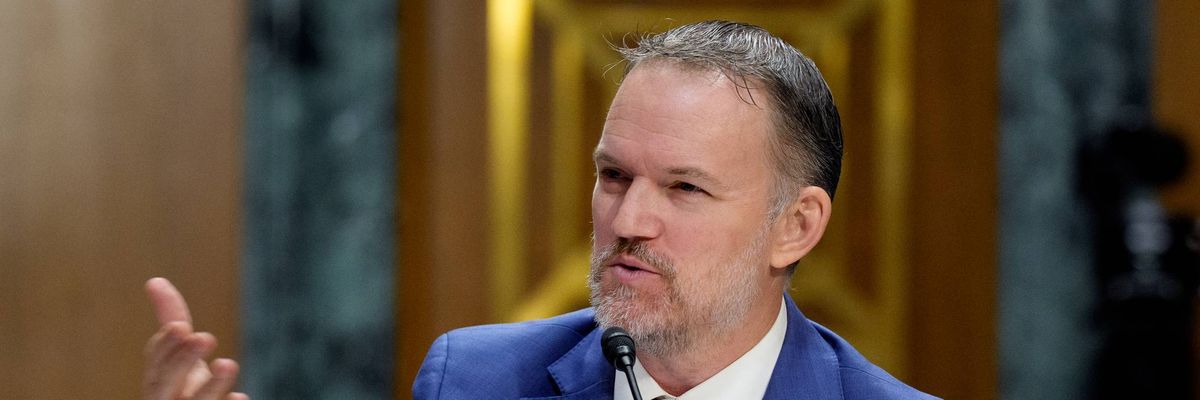
“Its vague claims about forced labor abroad do not hold up,” said Gresser. “Constitutionally, it is likely impermissible as an attempt to use a law designed for problem-solving abroad to impose a general tariff increase. And legally, Section 301 requires administrations to demonstrate ‘unreasonable acts, policies, or practices’ which impose a burden on US commerce, which this executive order fails to do. While making emotive claims about forced labor, it neither presents evidence that the listed countries are buying goods made with the use of forced labor, nor demonstrates that if they were, this would impose the statutorily required ‘burden on US commerce.’”
Rep. Brendan Boyle (D-Pa.), the top Democrat on the House Budget Committee, said in a statement that “these new tariffs are more of the same: a nationwide sales tax that will make life even harder for families already struggling under the costs of Trump’s reckless war in Iran.”
From Common Dreams via This RSS Feed.