

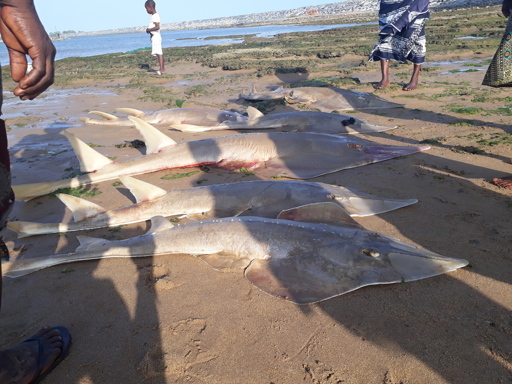
Fishers from western and central Ghana are renowned in the region, traveling the length of the West African coastline to cast their nets in the richest fishing grounds. These migrant fishers, relying on beach and purse seining, dry their catch to preserve them for transport to distant markets. Fish is an important dietary component for West Africans, according to Ghanaian marine biologist Issah Seidu, but its availability is under threat. “There has been a tremendous decline in fish like the tunas, anchovies, mackerel,” he told Mongabay. “And in response, the fishermen have switched gears from the traditional fishing tools to now using gillnet to target these species as their last safety net to support their livelihood.” Issah Seidu with two colleagues from his NGO, Aqualife. Image courtesy of Issah Seidu. As well as bony fish, elasmobranches — like sharks and rays, whose skeletons are made of cartilage — are much sought after. Fifty years ago, sawfish and wedgefish were widely found in shallow water along Ghana’s coast; today, both groups of elasmobranches have been fished to local extinction. Seidu, the founder of a marine conservation NGO called AquaLife, said fishers he’s interviewed for his research say sawfish haven’t been seen in Ghanaian waters since the 1980s, and it’s now been more than eight years since wedgefish were last caught. He said guitarfish, a group of rays, could be next. “Guitarfish are at a tipping point,” Seidu told Mongabay in an interview in March, “owing to their lucrative and high-value white…This article was originally published on Mongabay
From Conservation news via This RSS Feed.