

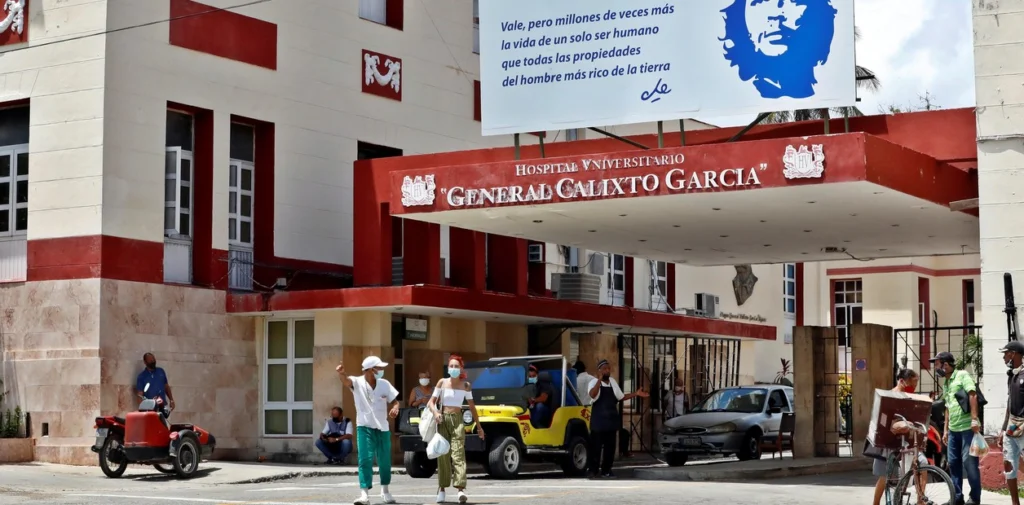
The U.S. government imposed new unilateral sanctions on July 23, targeting Cuba’s public healthcare, energy, remittances, and port sectors to completely suffocate the island’s economic revenues.
The Office of Foreign Assets Control (OFAC), under the United States Department of the Treasury, released an aggressive sanction package designed to cut off Cuba’s main sources of international income and exacerbate the ongoing domestic energy crisis.
This new round of unilateral coercive measures directly targets the country’s public health system.
RELATED: Washington Blames Cuban Socialism for U.S. Blockade Damage
The United States’ government blacklisted Cuba’s Minister of Public Health, José Angel Portal Miranda, alongside Gretza Sánchez Padrón, director of the Central Unit of Medical Cooperation (UCCM).
Additionally, Washington sanctioned the UCCM as an entity and the Cuban Medical Services Trading Company (CSMC). This state enterprise coordinates international medical collaboration, and its entire revenue is legally destined to finance free public healthcare inside the Caribbean nation.
Every act of aggression by the #US government, such as the measures announced this July 23 by the Secretary of State, shows that its purpose is to impose a collective punishment on the entire people of Cuba.
Despite the fact that the US government continues to deny the existence… pic.twitter.com/8KdBibgMxp
— Bruno Rodríguez P (@BrunoRguezP) July 23, 2026
Vital Economic Sectors Targeted
The sanctions hit Orbit SA, the main company managing family remittances, and the Mariel Container Terminal (TCVAL), which operates Cuba’s principal deep-water commercial port.
Furthermore, the Trump administration blocked Coral Marítima SA, a maritime shipping company, and Einarbo SA, an essential domestic fuel supplier. The measures also target a specialized investment fund and the Oil Research Center (Ceinpet), directly crippling the island’s efforts to achieve energy stability.
These actions reinforce the economic blockade that Cuba has endured for over six decades. This hostile policy includes the Torricelli Act and the Helms-Burton Act, passed by the United States Congress in the 1990s to internationalize the economic siege.
Fuel and Supplies Blocked
The current situation worsened in January 2025 when President Donald Trump returned Cuba to the arbitrary list of State Sponsors of Terrorism. This political designation has no factual basis but imposes severe financial restrictions, limiting international banking relations and foreign development aid.
By January 2026, the White House intensified its energy siege through an executive order imposing heavy tariffs on countries supplying oil to Cuba. Consequently, the Caribbean country received only one oil tanker, the Russian vessel Anatoly Kolodkin, in March 2026, as shipping companies routinely divert their routes to avoid US sanctions.
This systemic blockade has caused a severe energy collapse on the island. Due to constant power outages, humanitarian groups like the non-governmental organization Open Arms recently donated solar panels to the Juan Manuel Márquez Pediatric Hospital in Havana to keep intensive care units operational.
Meanwhile, vital medical imports remain stranded in Colombia and Jamaica. International shipping lines, including CMA CGM and Hapag Lloyd, have suspended all freight services to Cuba out of fear of U.S. Treasury retaliation, leaving patients without essential treatments for hemodialysis and epilepsy.
From teleSUR English via This RSS Feed.