


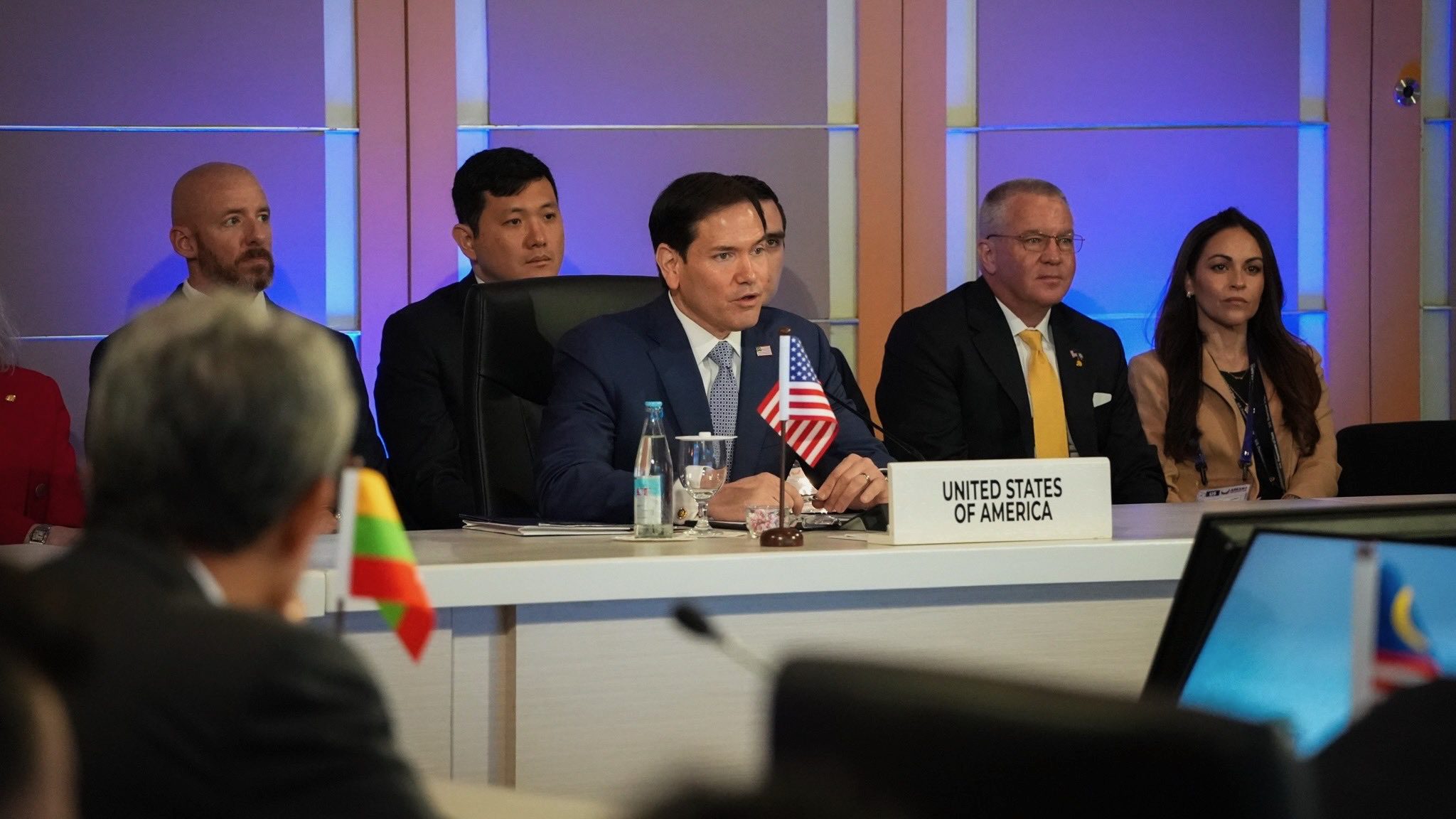
A day after foreign ministers of Association of South East Asian Nations (ASEAN) issued a joint statement demanding immediate end of war in the Middle East and opening of the Strait of Hormuz, US Secretary of State Marco Rubio claimed his country “would love to see a diplomatic settlement.”
Rubio claimed that though Iran is “begging the US for a peace deal” it is also reluctant to make the deal and cannot be trusted even if a deal is signed.
He was in Manila, Philippines, to attend an annual meeting with ASEAN foreign ministers.
His contradictory claims explains US’ failure to appreciate Iran’s apprehensions about the Strait of Hormuz which is at the center of the present round of hostilities.
Iran has accused that the US has failed to respect last month’s peace deal and sabotaged it by trying to bypass its authority over the strait. On the contrary, the US has claimed the present round of attacks on Iran were a result of its repeated attacks on ships passing through the region.
“The US would love to reach a diplomatic settlement,” however, we are “not going to sit by and let the ships be blown up or Americans be attacked,” AP reported Rubio saying, with claims that Iran’s control of the strait will lead to the end of freedom of navigation.
Rubio’s statement came hours after President Donald Trump issued fresh threats of attacking Iran’s infrastructure on Wednesday. “One bridge or power plant, including those located next to, or in, the capital city of Tehran” each time Iran “shoots at a ship” in the strait, Trump wrote on his social media post.
Meanwhile, the announcement of Ansar Allahin Yemen to impose a sea blockade on Saudi Arabia over its failure to lift a decade-long blockade on the country has further increased the concerns of the ASEAN members.
As per the reports on Wednesday, at least two ships carrying Saudi oil were attacked in the Red Sea. The attacks were claimed by Ansar Allahforces.
The ASEAN ministers expressed their deep concerns over the situation in the region saying the recent hostilities and threats of escalation “severely undermine the ongoing efforts of key mediators and diminish the prospects for a peaceful resolution through dialogue and diplomacy.”
They demanded “complete and immediate” cessation of all hostilities in the region and free and secure navigation through the Strait of Hormuz as per the international law.
Rubio faced strong popular protest during his visit to Manila. The protesters called both Trump and Rubio war criminals and claimed Rubio’s visit threatens the peace and instability in the region.
Iran warns against Trump’s threats
If the US attempts to carry out threats issued by Trump “Iran’s armed forces will not allow even a single drop of oil to be exported from the region, and that oil, gas, electricity, and economic infrastructure across the region could become targets,” IRNA reported quoting country’s central military headquarters (Khatam al-Anbiya) on Thursday.
Replying to Trump’s threats, Iran’s Foreign Minister Abbas Araghchi also said in a post on X on Thursday that his country’s “defense doctrine is clear: eye for an eye.”
Any aggression against it, including attacks on its infrastructure “will compel a powerful and decisive response” including on the countries who “contribute to such aggression, whatever the kind of support.”
Meanwhile, at least two more Iranians were killed and almost a dozen others were wounded in a fresh US strike on its border crossing with Iraq on Thursday, July 23, with its Central Command announcing the completion of 12th consecutive nights of strikes.
The killings on Thursday take the total number of Iranians killed in the latest round of US strikes to 55, with over 600 more wounded, according to an announcement made by Iran’s Ministry of Health on Wednesday.
The US attacks have so far largely remained focused on southern parts of Iran with a stated objective of destroying its capacity to control the navigation through the strait.
Iran has retaliated to the US strikes by carrying out attacks on its various military bases in Jordan, Kuwait, Bahrain, and Qatar. Its retaliation has killed at least four US servicemen in Jordan and Iraq and caused massive damage to its bases.
From BT News via This RSS Feed.