

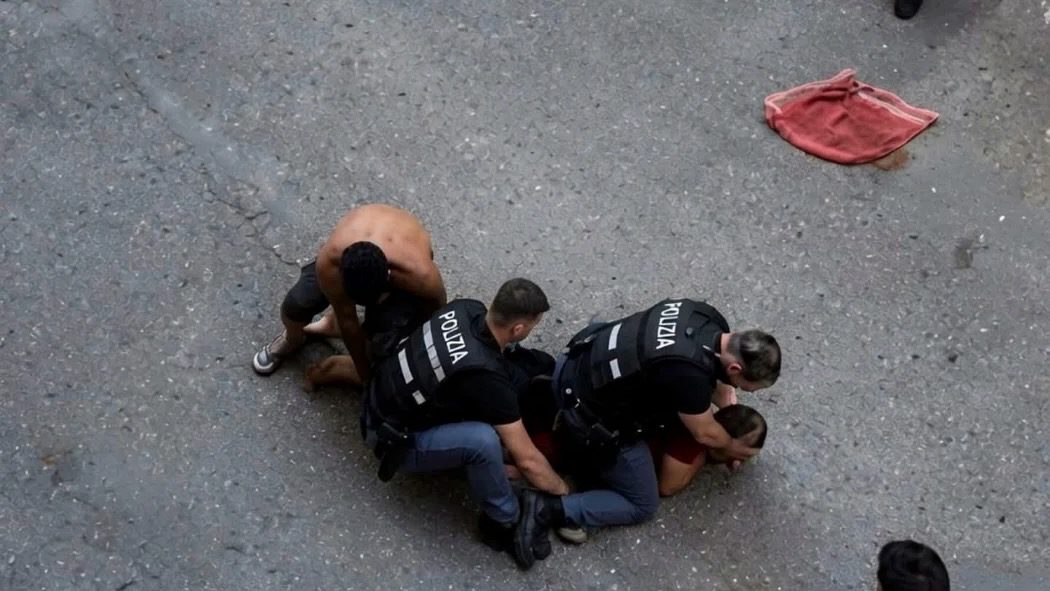
On Sunday, July 19, Abderrahim Fakir, a 43-year-old member of the Moroccan community in Italy, died after being violently restrained by police officers in the Pilastro neighborhood of Bologna. The incident has sparked protests across Italy, with thousands demanding justice for Fakir. It has also drawn reactions from Moroccan authorities.
Video recordings show Fakir – apparently suffering a health crisis and in need of help – calling out “help” and “enough” while officers pinned him to the ground. Medics were present at the scene but did not intervene.
Fakir’s death has caused outrage in Pilastro, with progressive networks describing it as state-sanctioned murder, and brought his friends and family to publicly appeal for accountability.
Read more: Outrage in Ireland after Congolese man Yves Sakila killed as guards kneel on his neck
National and local authorities expressed regret but delayed pursuing thorough investigations into the event. While Prime Minister Giorgia Meloni backed a potential investigation on social media, she did so while accusing demonstrators of instigating clashes with the police.
Instead of triggering an immediate investigation into the officers’ accountability, the official response stretched out the process by implementing new regulations shaped by Meloni’s far-right administration, the so-called “criminal shield” – an add-on to the controversial “red zones” policy and the overwhelming securitization of working-class neighborhoods analyzed in this context by Progetto Me-Ti.
Similarly, left party Potere al Popolo contextualized Fakir’s killing as part of a series of law enforcement-related deaths across Italy, from Milan to Bologna. “It is also the result of the ongoing attack on working-class neighborhoods, carried out through cuts to services, militarization by law enforcement, and a war on the poorest,” stated Potere al Popolo Bologna.
“This tragedy could and should have been avoided: it is the result of the Meloni government’s security- and repression-oriented policies, the security decrees, and the militarization of local communities – presented as the only responses to the needs of citizens and workers, as has been the case in recent months toward those who opposed the destruction of a park in Pilastro,” the local chapter of grassroots union Unione Sindacale di Base (USB) emphasized.
Read more: Militarization in Italy: from the war economy to the battle of ideas
Some USB branches and other workers’ organizations launched sectoral strikes in reaction to Fakir’s death, amplifying the impact of the protests. Trade unions and progressive groups highlighted the harm inflicted on working-class communities by Meloni’s securitization agenda, which has been piloted specifically in areas like Pilastro. A related set of new regulations were used in this neighborhood to stifle community organizing against redevelopment projects that ignored the interests of its residents.
“They left the neighborhoods in a state of neglect, only to then cite that very neglect as a justification for ‘redeveloping’ them, transforming them into a playground for speculation and a form of ‘security’ based on police and handcuffs,” the collective Donne Contro Guerra e Genocidio (Women Against War and Genocide) stated.
Reactions also warned against the systemic racism driving police actions in Italy and Europe. Potere al Popolo noted that in Italy “there are ‘first-class’ and ‘second-class’ deaths, like Abderrahim, a resident of a working-class neighborhood whose only ‘crime’ was being a working-class person and having skin that was too dark.”
This was mirrored by some police organizations and mainstream media, who, following Fakir’s death, attempted to portray him as having a violent record. “The political and media strategy is the same: to retroactively construct the image of a person who is irredeemably violent and dangerous so that the public stops wondering how they died and begins to think that, in some way, they brought it on themselves,” Potere al Popolo warned.
Read more: Four migrant farmworkers burned alive in Italy for demanding labor rights
Fakir’s death occurred less than two months after the brutal killing of four migrant workers in southern Italy and amid a constant stream of reports about workplace violence, experienced in particular by migrant and precarious workers. Potere al Popolo, USB, and other left organizations have called for urgent action – not through authoritarian crackdowns, but through investment in public services and basic needs to address the root causes of these issues.
From BT News via This RSS Feed.