

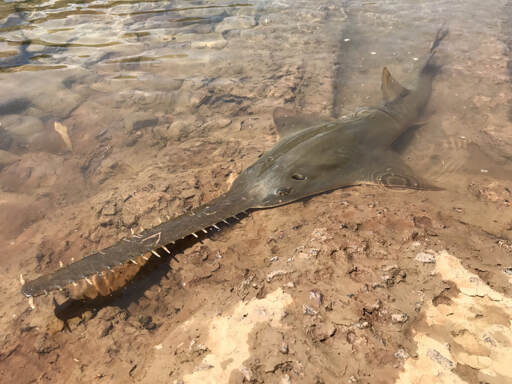
Sawfish, a group of large marine rays, derive their name from a striking appendage: Their long, saw-like snout lined with teeth-like scales. Nature intended these fish to use their snout, also called a rostrum, to send out electric signals that shock unsuspecting prey, slice it like a sword to impale it, and devour the catch. Humans, on the other hand, use these sharp teeth as cockfighting spurs — a spiky object strapped to a game cock’s legs so it can deliver lethal blows to its opponent and win the fight. For centuries, practitioners of the sport in Latin America have carved sawfish (fam.Pristidae) teeth into spurs. But in the 2000s, as sawfish became overfished for their fins, many cockfighting associations in the region officially banned using their teeth as spurs. In 2007, all sawfish species were added to CITES, the global wildlife trade agreement, and their commercial international trade was banned. A sawfish’s rostrum is lined with sharp teeth-like scales, which are carved into cockfighting spursCredits: Vassil – CC0. A recent study, published in the journal Conservation Letters, found that international commerce in sawfish rostra and teeth continues in Latin America despite bans. Talking to cockfighting practitioners and association representatives, the researchers found most rostral teeth entering the trade came from Peru, Brazil, Ecuador, Central America and Colombia. Peru topped the list as a destination. They call for stricter law enforcement and coordination in these countries, and urge CITES to take action to curb the “hidden” trade. Although the peak…This article was originally published on Mongabay
From Conservation news via This RSS Feed.