



Photo: J. Carl Ganter / Circle of Blue
Wildfires are raging in every province and territory across Canada, leaving entire First Nations communities burnt, upending the lives of thousands of evacuees and creating plumes of toxic smoke dirtying the air in major cities like Toronto and New York.
While some politicians claim the out-of-control wildfires are being primarily caused by improper forest management, scientists agree that climate change, driven by greenhouse gas emissions from fossil fuels, is the main culprit.
To stop contributing to the problem, the Canadian government could be implementing strict limits on the oil and gas industry for their carbon dioxide emissions. But Prime Minister Mark Carney has rejected that idea, opting instead for an unproven technological fix.
In doing so, The Narwhal reported this week, the prime minister has become the latest in a long line of politicians to make big promises about carbon capture and storage to cut industrial emissions, despite the technology’s meager track record in Canada.
Read on to learn more.
- Climate change from fossil fuels is making wildfires more severe and more frequent
Climate change is altering rainfall and storm patterns, creating hotter and drier conditions and more lighting strikes, causing fire seasons to start earlier and last longer and making those fires burn hotter, grow bigger and spread quicker. The result: Canada’s most recent fire seasons have been among the worst on record.
There’s only one real way to slow this escalating problem, scientists say: stop using so much coal, oil and natural gas, the fossil fuels that generate the emissions that are trapping heat in the atmosphere, changing the climate and leading to more extreme weather.
In Canada, the oil and gas industry is the country’s largest source of emissions. That’s partly because the type of petroleum in Alberta’s oilsands, the world’s fourth-largest proven oil reserve, requires extra electricity, steam, fuel and machines to turn it into usable products like gasoline compared to some other oil deposits. Oilsands emissions have grown from 41 million tonnes in 2007 to 92 million tonnes in 2024.
- Carney expects Canada will soon generate more, not less, emissions
As Ontario faces its deadliest wildfire season on record and other provinces and territories have been similarly devastated in recent years, Carney is focused on coordinating an emergency response with those jurisdictions, including managing the thousands of firefighting personnel and hundreds of aircraft involved. The prime minister says he’s committed to deploying “every resource needed to keep Canadians safe.”
He also signed a deal with Alberta meant to increase oil production. The deal, which includes a commitment to build a new oil pipeline, is expected to result in more carbon pollution. Carney has admitted his government’s actions will raise emissions. More Canadian emissions means Canada is contributing more to the global problem of climate change that’s making wildfires worse.
Environmental advocate Catherine Abreu, a former member of Canada’s Net-Zero Advisory Body, told MPs in June that Carney’s government has “repealed or weakened virtually every climate policy and regulation that Canada had developed in the last decade.”
- Instead of capping emissions, Carney is betting on carbon capture technology
Carney’s deal with Alberta promises not to follow through with a proposal, first made during the government of former prime minister Justin Trudeau, to implement an emissions cap on the oil and gas sector.
A cap is a government mandate to prevent emissions from rising beyond a certain point. It’s something the industry itself previously said was achievable: in 2022 a group of oilsands producers came out with a plan they said could cut 22 million tonnes of annual emissions by 2030. That plan involved carbon capture, a technology that filters out carbon dioxide from industrial exhaust streams and stores it so it doesn’t get released into the air.
But even though the Trudeau government proposed the emissions cap as a way to ensure the industry followed through with that plan, oil companies fought the cap proposal and Carney eventually agreed not to implement it.
Now, Carney’s deal with Alberta includes an agreement to build a carbon capture and storage network in the province, but the ambition has been dialed back considerably. Five oilsands companies agreed in July to use carbon capture technology to remove just six million tonnes of emissions per year by 2035, and a “range of technologies” to eventually capture 16 million tonnes per year by 2045.
Compare that with an average of 20 million tonnes a year in new emissions from the oilsands that the Canadian Climate Institute has estimated will result from higher production levels to feed the new oil pipeline in the deal.
- The track record for carbon capture of industrial emissions in Canada is bleak
Carbon capture and storage is real, and in use at nine commercial operations in Canada. But the technology is expensive and requires lots of new construction to scale up, while globally it has underperformed, according to the International Institute for Sustainable Development.
The results speak for themselves. Over a 24-year period, 68.7 million tonnes of carbon dioxide was captured across Canada, according to Environment and Climate Change Canada. That means the oilsands added more to the atmosphere in one year than carbon capture technology has ever stopped from industrial sources over more than two decades.
While oilsands emissions more than doubled from 2007 to 2024, the cumulative amount of carbon being captured from industrial sources is still “on the order of several [million] tonnes per year,” a Natural Resources Canada spokesperson told The Narwhal.
But that’s relatively tiny, compared to the eye-popping figure of 600 million tonnes a year that a government report had once claimed Canada could theoretically capture.
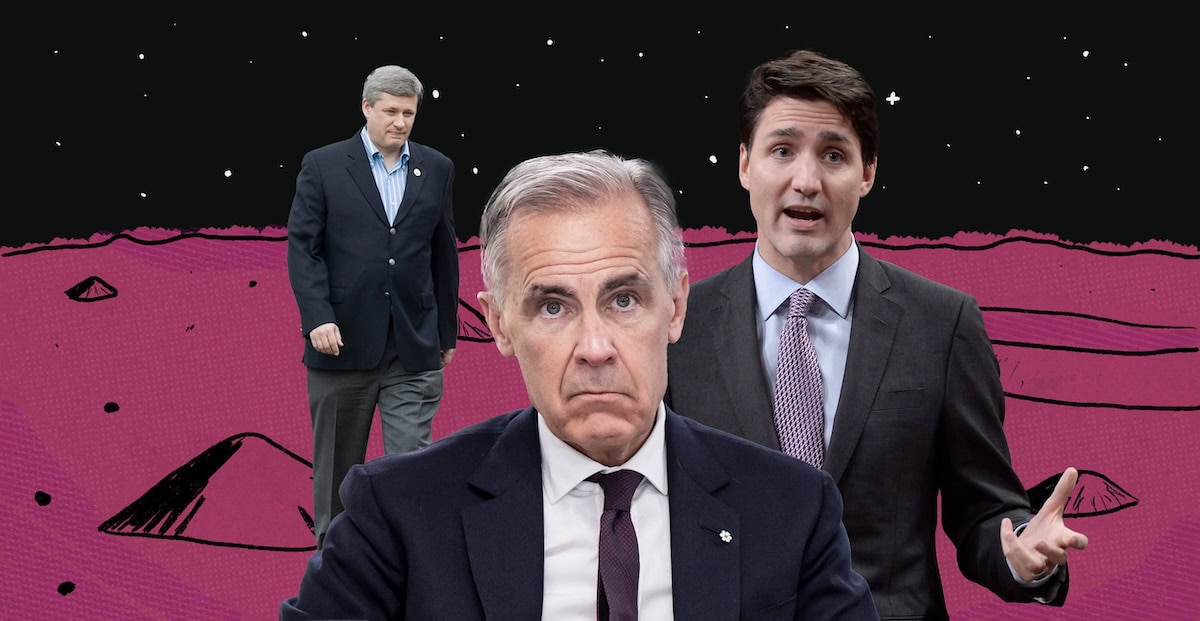
As early as 2007, then-prime minister Stephen Harper was touting the benefits of “the exciting new technology called carbon capture.” After nearly two decades of political enthusiasm about the technology, carbon capture has yet to deliver significant emissions reductions. Photo illustration: Shawn Parkinson / The Narwhal. Photos: Tom Hanson, Christopher Katsarov Luna and Adrian Wyld / The Canadian Press
- Carney’s support for carbon capture makes him the latest in a long line of politicians to tout its benefits
Despite this underperformance, both Liberal and Conservative federal governments in Canada keep projecting optimism about carbon capture’s prospects, dating back to former prime minister Stephen Harper, who gave a speech in Edmonton in 2007 that sounds strangely familiar now. This week, The Narwhal peered into the historical public record — and the national archives — to show just how real the enthusiasm has been.
In Edmonton, Harper talked about “the exciting new technology called carbon capture and storage.” He told Canadians that, “instead of pumping tonnes of carbon dioxide into the Earth’s atmosphere, we may be able to collect it from our oilsands … and pump it deep underground where it will remain for eternity.” He projected confidence, saying he felt “the era of empty rhetoric on the environment is over” and “we’re taking real action that will produce real, tangible results.”
In 2011, his then-natural resources minister Joe Oliver called Canada “a world leader in carbon capture and storage” and “in an excellent position to use this technology on a wide scale.” (Oliver recently wrote an op-ed opposing the latest carbon capture proposal in the oilsands, in part because of the technology’s spotty track record.)
After Trudeau won power in 2015, his first natural resources minister, Jim Carr, told a ballroom full of people in New York in 2016 that carbon capture is one of “the most pressing issues of the day.” One of Carr’s successors, Seamus O’Regan, would go on to describe carbon capture as “an integral part of lowering emissions” that was part of “how we get to net zero.” In 2021, he said Canada was “on the cusp of doing a lot of these things.”
Last year, Carney’s minister of energy and natural resources, Tim Hodgson, a former oilsands company board member, told a Calgary business crowd that the government, as much as private industry, should be pulling for the carbon capture project in the oilsands. In a faint echo of Harper, he said this government “will not be a government of talk, but a government of action.”
The Narwhal’s reporters are telling environment stories you won’t read about anywhere else. Stay in the loop by signing up for our free weekly dose of independent journalism.
From The Narwhal | News on Climate Change, Environmental Issues in Canada via This RSS Feed.