

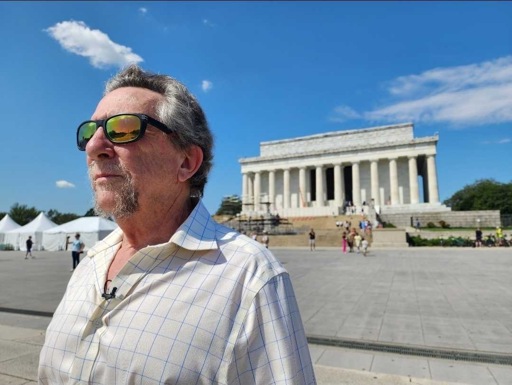
“Existence is struggle,” says Marc Steiner. “It always has been, and always will be.”
In this podcast series, we’ve looked at the attacks on free speech rights today in the United States. We looked at the history and how movements and organizations have stood up for and exercised free speech in their work. We looked at how social media, AI, and disinformation are undermining our free speech, and at how people are responding in the United States and abroad.
In the final episode of this series, we’re focusing on what free speech means within the context of the life of one person who has been through it all — co-host Marc Steiner. He turned 80 earlier this year.
In this episode, Michael Fox sits down with Marc to discuss all of these incredible layers of his life, from fighting civil rights and community organizing to underground newspapers, street theater, education, and journalism. What do they all mean for him, how do they all add up to nearly seven decades standing up and fighting for free speech, and how they fit into the battle for free speech today?
“You have to step back and really listen to what people are saying so you can bring out their truth so others can wrestle with it,” says Marc. “And if they need confronting in their process, you confront it and push back. Which is why when I think about what we do, how important it is — We have a critical role to play in bringing understanding to the world. The truth lives in every corner. And you have to listen. No one has a hold on it.”
In our conversation, Marc says right now the battle for free speech is more important than ever.
“I think we’re politically facing the most dangerous moment in my lifetime,” says Marc, “where the right is seizing power across the country — the racist right is seizing power. And that now the battle for free speech is more critical than ever. We cannot let them take it away. We have to stand up to that.”
The Battle for Free Speech Podcast is a production of The Real News Network.
Hosted by Michael Fox and Marc Steiner. Theme music by Michael Fox, Jordan Klein and Daniel Nuñez. Other music from Blue Dot Sessions and Epidemic Sound. Production and Sound Design by Michael Fox and Stephen Frank. Editorial support by Kayla Rivara. Research by Ben Schweiger.
Guests
Resources
- You can hear more from Marc on the Marc Steiner Show on The Real News Network.
- You can see Marc’s archives at the Center for Emerging Media.
- Marc Steiner’s Peabody-award winning documentary series, Just Words.
- Marc Steiner’s documentary series Shared Weight, which looks back at the Vietnam War and its legacy.
Many thanks to everyone who has supported this show.
Follow The Battle For Free Speech on Spotify or Apple Podcasts. Support Michael Fox’s reporting at patreon.com/mfox. Never miss an episode — sign up for The Real News newsletter at therealnews.com.
Transcript
The following is a rushed transcript and may contain errors. It will be updated.
Marc Steiner: This place has changed so much. Wow. When we were kids, this is where the black and Jewish world met right here. Oh, because Jewish was this side, Jewish and then Baltimore’s 125th Street was Pennsylvania Avenue and that was down that way. So that’s where it all…
Michael Fox: Wow. Late last summer when I was in Baltimore, you and I went over to Mondamin Mall. Oh,
Marc Steiner: That’s right.
Michael Fox: And you told me the story of your first political activism. All right. And if you could just set us up, where are we right now?
Marc Steiner: We’re at the Mondamin Mall on the west side of Baltimore and it looks really different than it did when I was a kid. We’d done the whole outside, probably inside as well. But this was a predominantly white mall and we used to shop here and my mom and I came down here it was 1960 and we went down. I forget what we were shopping for, whatever we came for. And so we were there and we’re looking over the railing. And as we looked over the railing, there were these line of black collar students, turned to be black collar students, picketing the white coffee pot, which was an appropriate name because it was segregated. They had restaurants all across the city. So I asked my mom, I was 13, not quite 14. I asked my mom, could I join the picket line? And she said in her English accent, “All right, my dad, go ask the captain and see what he says.” So we went downstairs and they said, “Sure.” And that’s the first day I marched.
And so from that moment on, I was in the civil rights movement and then a couple years later I became the youngest person to be arrested in civil rights in Maryland. In Cambridge, Maryland, not Baltimore, but in Cambridge, which was like, we used to call that Maryland’s Mississippi, Eastern Shore, which is one of the last lynchings in America took place on the Eastern Shore. And so that was what opened up this world for me. And I would say from 11 years old to like 17 when I was expelled from high school, my world was different. It was segregated, but my world was black because of Boy Scouts, the street corner, the all black frat. It was middle class black guys. I mean, so that was my world. And in Baltimore, people forget Baltimore is a Southern city. It’s a mixture of the industrial north with immigrants coming from all across Europe and later from Latin America that was later from all across Europe.
And it’s a southern city. It’s a deeply segregated town. It’s still very divided. I mean, there are very few interracial neighborhoods in Baltimore, even to this day. Most neighborhoods are mostly black or they’re white or they’re Latino.
Michael Fox: This is the Battle for Free Speech, a multi-part narrative podcast series brought to you by The Real News. I’m Michael Fox and today we’re going to spend the entire hour speaking with my co-host, Mark Steiner. First, let me say that if you’ve been listening to this podcast, you will notice that he’s been absent lately. Unfortunately, he’s been dealing with some health issues and he had to take a step back. That is all the more reason why I’m so excited to get to speak with him today for the entire hour. And let me just put this into context. In this podcast, we’ve looked at the attacks on free speech rights today in the United States. We looked at the history and how movements and organizations have stood up and used free speech in their work. We looked at how social media, AI and disinformation are undermining our free speech and how people are responding in the United States and abroad.
In this final episode of the series, we’re going to focus on what free speech means within the context of one person who’s been through it all. That is my co-host, Mark Steiner. He turned 80 earlier this year. Today I sit down with Mark to discuss all of these incredible layers of his life, community organizing, theater, education, journalism, what they all mean for him and how they all ad up to nearly seven decades standing up and fighting for free speech and how they fit into the battle for free speech today. That is where we’re going to spend this hour. I’m so excited because the stories of his life are incredible. They’re often funny. And for me, they really take the idea of free speech to another level. I hope you enjoy our conversation.
Marc Steiner: And the backstory is that A, my mother always raised us with clarity about race, that there’s no difference between races. We’re all the same. We’re all human beings. And when I was 11, I wanted to join the Boy Scouts, just dying to be a Boy Scout. Read all the books. My English grandmother and uncle sent me books about British Boy Scouts and I was just really into it. And so my mom and Mrs. Jackson, who is a black woman who worked as a domestic in our home, were sitting at the end of the workday together as usually did having coffee and cake before Mrs. Jackson left. And she was being picked up by her nephew, Mr. Dennis Foster. And so they were eating and I ran downstairs saying, “Mom, mom, I’ll be 11 years old next week. I got to join the Boy Scouts. You got to sign me up.” And she said, “All right love, we’ll sign you up straight away.
Beth de Phillip, Monday morning,” which is the local synagogue that we used to go to. And I said, “Mom, I don’t want to be in a Jewish troop. I want to be in a troop with all kinds of kids,” which didn’t exist. And Mr. Foster, who’s African American, put his coffee cup down, looked over the table and said, “I’m a scout master. You can join my troop.” And my mother, I remember, I could still see her face. She said, “Oh, that’s a lovely idea.” And she knew exactly what that meant. And so that Monday he picked me up in his Mercury at the house and we drive off from Northwest Baltimore and past the golf course and went down to a street called Garson Boulevard and into Warbrook Junction, which was the separating line between black and white neighborhoods. And we kept on going down North Avenue and all of a sudden the world became black.
Went down, made a right on Broadway, which is a deeply working class black neighborhood. Made a left on Ashland Avenue and ended up in front of the Faith Baptist Church. And there I joined an integrated troop, as I always say, because I integrated it. And so I was a little Jewish boy in 1957 in segregated Baltimore in an all black Boy Scout troop where I learned firsthand about racism as a little boy. Whether it was the Boy Scout troops that we camp near in the Boy Scout camp, they’re mostly white troops. And then one kid saying to me, “What are you doing in a troop with all those ends for?” And I remember that just shocking, a Boy Scout would use that word. Or when we went out with Mr. Foster to get some ice cream or whatever and we stopped in front of an ice cream shop and kids spot out of the car.
And I remember sitting there in the car and I’ll never forget his words. He looked in the window and said, “Mark, wherever we can go, you can go.” And those kind of things became foundational for me in understanding what kind of society we live in as a little boy, what we faced. And so that time when I was 13 and we were at Mondomy Shopping Center and my mom said, “Well, that’s the picket captain.” And I went down there and Skip Logan was the leader of the picket line. And he was also the head of the civic interest group, which was Baltimore’s arm of SNCC, the Sudan Violent Cordinating Committee, which is a major radical civil rights group. I said, “Sure.” Gave me a picket sign and I started going to CIG meetings and became very active. They wouldn’t let me sit in until I was 16 because they didn’t want me getting arrested if I didn’t.
And the first arrest I had was in Cambridge, Maryland, which we used to call Maryland’s Mississippi. It’s rough. I was 16, arrested, and I was the youngest, whitest thing there. And they pulled me out and put me in this room, looked like a kitchen.
And then all these cops, maybe I don’t remember how many, six, eight cops around in the table. And wanted me to sign this document that said I was coerced by communists to come down to full man trouble among the Negro population of Cambridge, Maryland.
Michael Fox: Wow, Mark.
Marc Steiner: And I refused to sign. And then it proceeded to get hot and they poured hot coffee on my head and smacked me around and punched me around and hit me and all kind of stuff. And I wouldn’t sign. And it’s a digression. My mother, she was a tough lady. She was beautiful and tough. But she always told us, the three of us, the kids, to come home on your shield. That was her line to us. You are around, her maiden name. We never back down. You come home on your shield. So I didn’t sign.
Michael Fox: Wow. And
Marc Steiner: So mom got me out, took me home and I got fixed up. So I continued on the picket line and continued working in Cambridge and going between Cambridge and Baltimore. The only trouble was that I started screwing up in school because I was so involved between the civil rights movement and the street corner. I didn’t get much school time in.
Michael Fox: What was it about Cambridge? What was it about Cambridge, Maryland that was –
Marc Steiner: Cambridge was, there were two focal points of the civil rights movement in Maryland. One was Baltimore because it was the biggest city
With the largest black population, except for all black towns in Prince George’s County and some other places. And Cambridge, Maryland, which was the Eastern Shore of Maryland that you had passed through going to Eastern Shore. Eastern Shore was literally like Mississippi. It was the deep South in Maryland. So our work was in both places. And in Cambridge, we were both picketing to integrate things, but we were sitting in and we were registering people to vote. And the leader of that movement was a woman who became very famous in America just because she became a figure. Her name was Gloria Richardson.
Gloria Richardson: Still had segregated hospitals, housing, jobs.
Marc Steiner: I interviewed her years later on my radio show in the 90s. She was really old then. And I remember one of the greatest days of my life because I was in Cambridge, set the equipment up, about to do the interview. And she looked at me and said, “I remember you. You were that little white boy.” That was a great day. She actually remembered me. And so it was a rough place. And I really literally was beaten and tortured in the prison. They wanted me to sign a paper I wouldn’t sign. But anyway, that was the civil rights era. And I had a very weird teenagehood.
It started out because I was a white boy in an all black Boy Scout troop on the east side of town, which was a working class community. I started hanging out with this group of black guys, two groups of black guys. One was the Imperials who were the sons of black doctors, lawyers, judges of middle class guys, still close to some of them. And the other was the guys on the corner that happened because when I was in junior high school in the seventh, eighth grade, I was friends with some of the black guys in class and it was newly integrated and majority of kids were white, but there was a huge population of black students and we became friends and I started hanging out with them and that was the street corner. So I had these two worlds and I was part of. And I was also a member of the Young Socialist Alliance, which was a Trotsgate Youth Group that I joined when I was 15.
And so I was a young revolutionary.
Michael Fox: Mark, you also refused to say the Pledge of Allegiance and the Lord’s Prayer in school, right?
Marc Steiner: In the 10th grade when I got to Citi, which was a high school, I refused to take part in opening exercises, which then became part of a Supreme Court decision that I was mentioned in. So you had a pledge of allegiance and you read the Lord’s prayer. And I refused to do that. It was the Lord’s prayer as well. I refused to do the Lord’s prayer. And when they did opening exercises, I would leave the homeroom and stand out in the hallway till it was done and then have to walk back in. And the same thing when it came to giant student assemblies. I get up, walk out of the assembly with thousands of students and walk back in after the opening exercises. So I became a target. One day there used to be these trucks that would be outside the school on lunchtime selling food to kids who didn’t want to eat in the cafeteria to go out to get food from these food trucks.
And I was standing outside the pizza wagon. And these, I don’t remember, seven or nine white guys semicircled me around the wagon. And I looked back and I said, “Okay, here we go.” And I ordered my pizza and the guy said, “We don’t like no N lovers in the
School.” And I looked back and I said, “Sounded like a personal problem to me, man. What you want me to do about it?” And they came at me and when they did, the pizza came out. I grabbed the hot pizza and pulled it out and threw it in his face. So he had this hot pizza burning on his face. Oh my gosh.
And these guys jumped to me and beat me up. And I walked back into the classroom after lunch and my shirt was torn. I was bloody and shit. The teachers told me, “You need to go to the nurse.” The guy sitting next to me was a guy named Stokes who was black. Because our chairs were assigned by alphabetical orders. So I was sitting next to Stokes since I’m Steiner. And Stokes said, “What happened to you, man?” I told him, he said, “What?” Next thing I knew after school, all these black guys beat up all these white guys because of what happened to me. And I got suspended. And I cut school, got suspended. And then one morning the homeroom teacher said, “Steiner, this is no damn standing. Go sit in your seat.” And I said, “Mr. Camps, you can’t speak to me with a little respect.
Don’t talk to me at all.” And he said, “What did you say?” And he walked over to where I was sitting and he had his yardstick in his hand and he picked it up. Said, “What did you say, Steiner?” When he raised the yardstick, I went boom, and hit him. And so all these teachers came in and grabbed my ass and took me down to the principal’s office, vice principal office, Mr. Yost and Dr. Greenberg, who was a vice principal who had graduated at that high school with my father in the class of 29. Oh my gosh. Called the hospital where my dad had just gotten out of surgery. He was a surgeon. Pop had to come up to the place and vice principal went, “Al, this is Mark’s junior year at City.” He opened up some whiteout, which was when people typed on typewriters had whiteout to cross things out.
Opened up a bottle of whiteout. Said, “This is Mark’s junior year at city. Get him out.”
Michael Fox: My gosh. Oh my gosh, Mark.
Marc Steiner: So I was banned from all city schools and my junior year never existed. I was sent away. And I saw I was in the civil rights movement. And it was after that that I got beaten up in the Eastern Shore and my parents came and got me and brought me back. But I kept staying in that. And my life was between civil rights movement and the street corner and some other radical groups I was part of, Young Sources Alliance, Fellowship House, things like that. What I didn’t do was go to school.
Michael Fox: This Supreme Court case that you said that you were part of for refusing to say the pledge of allegiance and the Lord’s Prayer and stuff, what was this court case? My
Marc Steiner: Name was only mentioned. It wasn’t my case. But there was a student in Baltimore who also refused to take part in opening exercises. His case went all the way up and that’s the reason they took prayer out of schools. Wow. Wow. And so it was me and two other guys in Baltimore who didn’t take part in the opening exercises. Wow. It wasn’t my case though.
Michael Fox: Yeah. You know what’s fascinating about this, Mark, is that when I was talking with Marianne Franks, she’s the professor, the law professor at George Washington University. She said that for her, one of the most, and I don’t remember the court case, I don’t remember if it was this one or another one, but she said that the court case in the Supreme Court, which defended people’s right to not say the pledge of allegiance was exactly what the First Amendment should be. Because not only should it give us the right to speak out, but it should also give us the right to remain silent in moments that we don’t want to follow the doctrine of the US. And she said that is the example of what the First Amendment and what free speech should be in the United States. I though that’s so interesting. I didn’t realize that you had a similar experience.
Marc Steiner: It was in some ways an isolating experience because I would walk out of the homeroom and I have to walk out of these assemblies that I said earlier. And it was jarring because I was like this target for being this weird kid.
Michael Fox: Why did you not say it? Why did you not participate in the assemblies?
Marc Steiner: Because I believed that religion had no place in public schools as a kid. My father wasn’t real happy with it, but both my parents were atheists. Even though my mother converted to Judaism, they were both atheists. I mean, I was raised in this contradictory world where both my parents were atheists. And every twice a week, because I was also kicked out of Jewish schools. When you were Jewish, if you didn’t go to Jewish school, you went to Jewish school twice a week in the afternoon. It’s like Hebrew lessons and everything else. And I was kicked out of there too. And so Mr. Manashevitz, who was a Holocaust survivor who taught there, would come to my house twice a week to teach me the Talma, the Torah, Hebrew, Jewish history. And so I was steeped in that as a kid. Well, first to me, it was Christianizing the prayer in school.
And what about us who don’t believe in Jesus?
Michael Fox: How incredible was it that your mom supported your organizing? She supported your activism. Did she always kind of remain steadfast in defending you and in supporting you standing up?
Marc Steiner: Yeah. I mean, she was always. She was a radical Brit. She came from a family of minors who ended up owning the coal mine in England. She was a radical as a young person. She was a member of the communist party in Britain for six months. Didn’t jive with her free spirit till she left. But she was always a little different than the rest. Everybody loved her, but she was a little different than the rest. She was an actor. And with my kids, we went out and caught butterflies and labeled them and found amphibians and reptiles in the rivers and brought them home and created terrariums. And she also liked her vodka. Mom liked her vodka. She was a trip. She was a trip.
Michael Fox: Wow. Mark, I want to move forward a little bit in the timeline. When you were banned from city schools in Baltimore, you ended up going, was it called Stockbridge? Yeah. Tell me about Stockbridge. And is it true that you actually shared a room with Arlo Guthrie?
Marc Steiner: We were roommates. Wow. That was in our junior year. We still stay in touch in our junior year. So I ended up at Stockbridge because I couldn’t go to any public or private school in Baltimore because I also punched out the kid showed me around friend school the day I was supposed to go to Friends. I asked him a simple question. His father owned Gwendo Commusement Park that we were picketing to integrate.
When he said we keep our ends to a minimum, I said, “What did you say?” And that was it. That’s all she wrote. So I couldn’t go anywhere. So when we ended up in Stockbridge, the headmaster came down to Baltimore to interview me. His name was Hans Mader. And Hans was a Marcusian socialist who was in the anti-Nazi resistance in Germany in the 30s and 40s and an educator. Interesting guy. Hans Maeder, M-A-E-D-E-R. I say Hans because we all called our teachers by their first name at Stockbridge. And we went out to Miller Brothers, which is in Baltimore’s fanciest restaurant. And so he asked me, this is 1963. He said, “So tell me a mark. I want to know who your heroes are.” I said, “Che Guevara and Malcolm X.” And he said, “Oh, is this a wonderful? You must come to my school.” And I ended up in this co-educational interracial international boarding school in the Berkshires with this incredible radical faculty.
And many of my best friends are still from that era, from my experience there. So that’s why I ended up there. And I graduated in 65 instead of 64, but it’s all right. And it was a great experience. It saved my ass. It saved my ass, A, from the street corner because I was on the road to ending up in juvenile jail for other stuff. And it was a great place to have having it ended up. That county had a couple of really progressive schools for whatever reason. They flocked to Berkshire County.
Michael Fox: Wow. Amazing. Amazing. Mark, were you at the March on Washington?
Marc Steiner: 63?
Michael Fox: Yeah.
Marc Steiner: Oh yeah.
Yeah, yeah absolutely there. Cause I was in the civic interest group, which as I said was Baltimore’s arm of SNCC, student on violence coordinating committee. And we all took the bus down from Faith Baptist Church down to DC. It was an amazing day. I mean, it was hot as hell. I dressed the wrong way, but it was okay. So yeah, I was there because I was in the civil rights movement. And so all of us who had been part of what was going on in Cambridge and in Baltimore and on Route 40, Freedom Rides, we were there. Yeah, we were there.
Michael Fox: Wow. That’s such an iconic moment in US history. It’s almost hard to believe that actually even happened in real life because it’s so iconic.
Marc Steiner: A quarter of a million people of all races together in Marchington, DC at one time.
Michael Fox: What did that feel like, Mark?
Marc Steiner: It was amazing. I mean, because you’re on demonstrations and you maybe have 20, 30 people with you and you’re on picket line or we’re sitting in or whatever. It was very different. This is a mess of America from across America. That and being part of the Poor People’s ampaign in 68 were amazing experiences just because of what they brought and the numbers of people from all different communities across the country being in DC at one time. It was amazing. Yeah, it was a day I’ll never forget. I mean, it was huge for me because I wasn’t in school either. So I was a full-time activist and getting ready to be shifted off to Berkshire County.
Michael Fox: Talk to me a little bit about the Poor People’s Campaign. Your organizing for it. I mean, I know that you were there in DC in those days. Tell me a little bit more about your role.
Marc Steiner: Well, I was living in DC. We were founding Liberation News Service at the time and I was working with the Washington Free Press. And in SDS, there’s a thing called ERAP.
Michael Fox: Students for Democratic Society.
Marc Steiner: I’m sorry. Students for Democratic Society, which was the leading radical left group and campuses across the country. And within SDS, there was a thing called ERAP, Economic and Research Action Project, which were people in SDS who went into poor communities to move into communities to organize. And so one of those communities was in Chicago in Uptown.
Speaker: A lot of people who’s migrated from the South to the North, do better jobs and stuff like that. We had a school set up to teach neighborhood people how the system works in the United States.
Marc Steiner: And they had an organization there called the Young Patriots who were the equivalent of the Black Panthers in the poor white community. So I got very close to them when I was in SDS and did a lot of work with them. And still one of the guys there, High Thurman, is back down. He’s still around. I’ve done a bunch of interviews with him about his work over the years. So our job was to organize the poor white community into Resurrection City. And so we went all through poor white working class communities in the United States, especially in the Northeast, at least I did, and in Appalachia itself to organize them to come down to be part of Resurrection City.
Speaker: Since the middle of May, the campsite of Resurrection City has housed the poor marchers campaigning in Washington. The murder earlier this year of Dr. Martin Luther King gave renewed intensity to the demands for equal opportunities as the underprivileged came to petition the power for a new deal and a new help.
Speaker: A lot of people knew the condition of some of these places. And I think that when they see and know the condition that a lot of people will be interested enough to try to make things better.
Marc Steiner: It was interesting. Encampment of mostly white Southern poor that flew the battle flag of Dixie above their encampment. Wow. Because it was the rebel flag. Nobody gave a shit in the camps about that. And it was a pretty amazing experience. I mean, he had this encampment of black folks from across America, Mexican Americans, Puerto Ricans, poor whites, some Asians, some Chinese and Japanese people in this living together, eating together, cooking together, working together. And it made a statement that to this day, it’s what pushes me to do the work I do because you can see what is possible if you organize and fight.
Speaker: We’re building our own house over there and I want to tell you something. It looks better than anything that we have in Brownsville. We got our house better than anything in Flatbush, which is middle class.
Speaker: It is working down in Resurrection City. And please listen to that. That beautiful thing down there is just the top of a movement that stretches from coast to coast.
Speaker: This is the last chance, I think, for this country to sort of respond to the quiet and peaceful petitions of people for asking for very, very just solutions to very, very real problems.
Marc Steiner: So I was there until they tore down Resurrection City when they came in. And I had an apartment in DC because that’s where I was living. That and the Institute of Policy Studies became like refugee centers for people who were forced out of the Resurrection City. The saddest part of it was there was no structure beyond that moment And to keep it together, to create a movement that did change things, but could really have changed things had we had something to solidify it and make it come together. But many things came out of that in different parts of the country. It was a historically important moment in this country, critically important. It began when King was assassinated and his body laying in state in DC for a while and it could have been a greater moment than it was, but it was an important moment in our history.
Michael Fox: Mark, I want to just pause for a second. All of this organizing activism, obviously this is a podcast about free speech and I want to connect it up to free speech. What does all of this mean for you for free speech in your mind? How does free speech straddle all of these issues in terms of organizing in your teens and your 20s?
Marc Steiner: The movement that began at Berkeley with Mario Savio, who was a civil rights worker. What’s important to take a note here is that that movement exploded and it was led by people who were white, who were civil rights workers in Mississippi, Alabama and Georgia, and then went back to their campuses. And so I always look at the free speech movement was birthed by the civil rights movement.
They were radicalized to fight when they go back. And that was one of the causes on their campuses that they fought for. And it happened across America. I mean Berkeley was a center, but I was at Maryland, the University of Maryland, 65. And in 64, I was still at Stockbridge, but it became something I was just obsessed with. It was a movement that frightened the establishment because in part what it came from, the civil rights, but also because these academic establishments were these quote unquote state institutions that controlled life on campus. This was the first major disruptions that took place in decades on campuses.
Speaker: You could never believe such a thing could happen at the University of California where this many students said they’ve had enough and they’re going to stand up right now. Thank you.
Marc Steiner: And that helped radicalize an entire movement, student movement in this country. That was the beginning of it. Without the free speech movements, there wouldn’t have been an SDS with that kind of power. So I mean, it was a critical movement in changing America. And many of those students remained radicalized, organized, and continued on. And I think that’s why people forget even though the movement kind of waned and died, that particular movement, the people in it continued to push. Most universities were run by the wealth of this country and this establishment figures who ran that wealth also ran universities. That was the first major confrontation against that in that era.
Michael Fox: Mark, talk about the Washington Free Press and the Liberation News Service. How were you involved? What were those outlets?
Marc Steiner: Well, I was involved first off with the Washington Free Press. After I was flunked out of college, I moved to DuPont Circle, which is a neighborhood in DC, which is around the corner from Washington Free Press. And I met the guys, the people from Washington Free Press. We hit it off immediately and I started writing for them and working for them. And also with SDS at large in DC. We actually had… The radical movement had rented a building near DuPont Circle and Logan Circle, which was three stories. The different movements had their headquarters in that building.
Michael Fox: Wow.
Marc Steiner: I was there a guy named Marshall Bloom and I organized a national conference of all the underground papers in the country to come to DC for a week long meeting because there were underground papers across America then. I mean, every city had one. I mean, everybody had one. Small cities, big cities, college towns, they were everywhere. And so we brought them together to start what became Liberation News Service, which really became an effective movement. We were collecting source from across the globe, across the country and giving it out to all the papers across the country to use and creating a communication between the underground papers and some college papers, Michigan, Chicago, Wisconsin, other places around the country. So in its lifetime, it was a very effective group.
Michael Fox: I think it’s fascinating to think about how that communication was happening back then because right now everything is, oh, it’s all internet. You just send an email. It’s super easy.
Marc Steiner: Oh, right. There’s no internet.
Michael Fox: Right. No. And so back in those days, what is this? Over telephone, you’re sending –
Marc Steiner: Telephone and US mail.
Michael Fox: Wow.
Marc Steiner: Yeah. Telephone and US mail. That was the only way to communicate, only way it could happen.
Michael Fox: What was it about the media, the underground media and the writing? What it that called your attention? Why did you want to get involved in this?
Marc Steiner: The largest group created papers that were alternative weeklies speaking to a different population against the war for the civil rights movement, for the radical movement, the countercultural movement that took place in the late ’60s, early ’70s. So it had its audience and in alliance with groups like the Black Panther newspaper and other Black and Latino newspapers around the country that were part of it as well. But it was this alternative press that made a bi difference because people actually read it. It kind of brought community together in ways that doesn’t exist right now. I mean, we’ve got this right here where we’re working at Real News, which in some ways is the grandchild of the underground press. But there were so many, every locality had one. I can’t think of a part of our country did not have a piece of the underground press. So we were able with Liberation News Service to share stories around the country, to bring stories in from Europe and Asia and Africa and share them with the papers around the country and also bring people together to talk strategically about what it means to create a newspaper and underground press and how that’s an organizing tool.
It was a great period. I mean, it was the same period where we were involved in traffic resistance. It was the same period where we were smuggling people out of the country into Canada to get out of the army that I was involved in as well. We actually thought the revolution was in hand. Little did we know. It wasn’t about to happen. But it was a significant movement.
Michael Fox: Was there a backlash by elites by the forces that be against the underground papers or was it so underground that it wasn’t a big deal?
Marc Steiner: That’s a great question. What was the demise of the underground papers? That’d be a really interesting question to explore. I mean, part of it was people drifting away and getting older and the movement dissipating and just not being there anymore. It could have been something as simple as that.
Michael Fox: But it’s at the same time as CO INTELPRO was happening, right? Oh
Marc Steiner: No, no, no. Look man, here’s the story. I guess this was 1960, early 68 maybe. And we had some telephone problems. So we asked the local Washington company to come over and fix it. And they were doing that. And then the guy who was working on it said, “Hey, you want us to fix the other phones?” And we went, “Sure. Which other phones do you mean?” And he said, “Just half a block away at whatever the number was, 17 something P Street.” We were 1719 P Street. And we said, “Oh, sure. You can take those out.
Marc Steiner: Wow. So they were bugging. So the feds were collecting information on us literally across the road. There were no real indictments of the place, at least where we were in Washington. But when the movement got more militant and more aggressive and like all my friends in SDS who became part of the Weather Underground, that was a different time. Then they came after everybody. In 68, I went to Cuba. January, February, March of 68, I was in Cuba. They came after us who went there. They tried to seize our passports. They harassed us. They got me fired from a job and one job wouldn’t fire me. That was a couple of years later when they came again. So they did go after… If you were on the left and you were still active, they came over to silence you.
Michael Fox: Yeah. Mark, fast forwarding a couple years, talk about the Tenants Union Group in Baltimore.
Marc Steiner: So as I said earlier, in SDS, there’s group called ERAP.
And these were people who went out, Tom Hayden, others who was probably the most famous of the crew, went out to organize in different working class communities across the United States. So that was the early stages of people doing that. We weren’t part of ERAP, but we were just revolutionists and radicals who wanted to go introduce organizing. Baltimore had up because of the steel mills, because of the docks. A lot of people ended up taking jobs in those places, the auto plant, to organize internally inside unions in the workplace. And then people moved into the communities to continue the organizing in the community. So we had collective houses across Baltimore in neighborhoods like Waverly, South Baltimore, Pig Town, I mean across the city. And so there were four of us who knew each other really well. And we moved down to South Baltimore and got really involved in both the South Baltimore voice and in created their tennis union group.
We went out to organize tennis of these slumlords, mostly white. Well, white and blacks. There was a street called Charles Street, which is the main thoroughfare in Baltimore. But the bottom part of it in this part of Baltimore was the divide between black and white working class communities in South Baltimore. The black community was called Sharpled and Hall, which before the Civil War is one of the oldest, biggest free black communities in the country. Anyway, so we began to organize. And other things were happening too. Radicals in Charles Village is a neighborhood and those of us organizing in Waverly, another white, black working class community, we created the People’s Free Medical Clinic with radical young doctors and nurses to serve the people. We created a People’s Free grocery store where my ex, so my dear friend and my daughter lived above it. And it was a grocery store where there were no profits made, but were there to serve the people to give them food.
They can buy food at cost. And we had a People’s Free Garage that was started by two people in the John Brown Collective that I was part of as well. After South Baltimore, I was part of the John Brown Collective. And the People’s Free Garage was a place where these two guys, Michael O’Brien and Gene Flanagan, Jean was a vet. And Mike was just one of the big Irish boys. And they knew cars and they started this garage where people could come fix their cars
And work on their cars and be taught how to work on their cars. So we had all these collective cooperative movements that we started in the city. So it was really a center of radicalism that hasn’t gotten much play in terms of our history. And it was mostly really a working class movement. It wasn’t just college kids, but people who lived in the community who were radicalized in different ways so that when in 1971, when the invasion of Laos happened, we organized a demonstration against the war. In that demonstration, there were a lot of Vietnam vets who were part of our work and other people as well. And what they didn’t expect the police was that they thought we’d be like college kids and run. The difference was it wasn’t that kind of group. It was a group of hard fighting, hard drinking, crazy working class kids.
So when the police attacked, we all stood and fought and really fought. The headline I still have on my wall at home, which said 21 police sent to the hospital.
People got charged like assault and battering to intend to commit mayhem and murder and other things like that. And I was charged, but that’s another story because I broke this cop’s nose when he tried to arrest me. So it was a really center of radicalism, both in organizing and in militancy in the city. And it changed laws. I mean, Tug changed the tenant laws in Baltimore working with radical legal aid lawyers who were on the left working in legal aid. And we would organize rent strikes and put the money aside in case we had to give it back. But anyway, we actually changed the law to benefit the tenants of Baltimore through our work, through our rent strikes. So I mean, it was a heady period in the early ’70s here. We were doing a lot of stuff. I mean, People’s Food Medical Clinic was unheard of.
It was like doctors and nurses giving their time when they were not getting paid to work in a medical clinic for poor working class people in the city. So it was a very special time to be part of. Nobody planned it that way. It just happened. We
Were just there and we just began to organize and work.
Michael Fox: Yeah. There’s something I think that’s really important that is oftentimes missed or people don’t make this connection. And that is the deep roots between organizing activism, standing up and our right to free speech. And I don’t necessarily mean the free speech movement. I just mean our right to stand up and speak out. I feel like these are two different things. Someone might be, oh, First Amendment. Oh yeah, that’s over here. Or oh, that’s our right to speak. And then organizing activism or protesting, it’s as if they’re separate, but they’re not. You said something a couple of episodes ago that really stuck with me and you said free speech is organizing. It is coming together and taking action to actually organize. Can you talk a little bit about that?
Marc Steiner: Free speech is at the root of the struggle for independence in the 18th century in this country. That’s where it began. You may have gone past that in terms of marks and the wobblies and the rest, but the roots we’re in is very American.
And that we demand the right to say we have to say and to organize and to stand up and speak. And if it’s done right, it can be a very scary opposition to those in power. And I think that’s what we saw. And I think there’s a movement afoot now to clamp down on free speech in this country. I see a lot of what we face in America today as a reaction to what we did 50 years ago that’s been building over these decades. And the fight to stop free speech as part of it. You’re seeing it across the country. I mean, on campuses today, many campuses are doing their best to shut down radical protestors on their campuses to end the right to stand up and say what you have to say. It’s one of the fundamental rights in any democratic society. You can’t have it without it.
It’s uncomfortable. It can be misused, but you have to have it.
Michael Fox: Yeah. Mark, talk to me about theater and what theater means to you. It’s been a huge part of your life, but it’s something that when I go back and when I hear stories or you tell stories, it’s like the theater piece, which is so important and that you’ve worked in theater for years, those stories end up sidelined a little bit or I don’t hear that often. Talk to me about what does theater mean to you and how important has this been in your life and why?
Marc Steiner: Theater’s always been part of my life since I was a teenager, especially once I got to Stockbridge, the high school I graduated from. But we had this Broadway theater guy as our acting teacher and stuff. But I think that theater of the streets and the underground theaters across America and the world played a vital role. We would do street theater against the Vietnam War where we would act out what’s happening to the Vietnamese and actually pulling people into it who are on the street. It didn’t always work so well because people resisted, but that was part of it. And we made the bridge between this is what happens to the Vietnamese people and we’re dressed like American soldiers. So I mean, I think that there’s always been a radical left element in theater, especially in Europe and here in the United States. And I think that it has always played an important role.
Things like the living stage in DC. The gorilla theater movements in New York and San Francisco and LA and Baltimore where we would act out things on the corner to show the world what was going on in Vietnam, to show the world what was going on in poor communities, to show the world the threat against our very democracy and rights to freedom in this country. God, I haven’t thought about this in a while.
There were some brilliant theatrical minds who dove into this all over. And I think that in retrospect, it had a greater effect than you think. I mean, because you’re bringing theater into community and into the streets that make people stop, especially when you pull them into it, force them to be part of it. And they weren’t expecting that. So what people don’t realize it doesn’t get much play. I got play in some books is that theater has always been part of political movements, especially on the left.
More on the left than the right for sure. And they were in the civil rights movement. There was Freedom Theater and part of SNCC Student Nonviolent Boarding Committee. And the music was the Freedom Singers as well. And we had Living Theater in New York City, which was a group nobody knows about anymore, but it was this incredible theater to the streets. They went out and did this incredible work, original work that we talked to issues and talked to people. They were an influence on me. I’ve been in theater forever. And I taught Baltimore School for the Arts for 15 years. This sophomore ensemble was mine. And I worked in the prison theater. I ran a therapy program for inmates under 21 in an adult prison. And a world famous actor came out of our group, Charles S. Dutton, who left us too soon. He became known as Rock and he had a TV show called Rock.
So I started a theater company in the prison and we performed in the prison and guys flocked to it because I did theater classes twice a week inside jail. A good part of my life was at the center of my work.
And being inspired by left theater in Paris, in London, New York, in Palestine, Israel where actors were crossing boundaries early. The Palestinian Israelis coming together to do political theater. And those things are getting lost.
Michael Fox: And
Marc Steiner: They’re very effective and they become a voice that doesn’t get heard otherwise. People don’t realize in SNCC, the Freedom Theater that performed all throughout the South. Nobody talks about that anymore, but they were doing these performances in churches in cotton fields across the South. And political theater seems to have lost its power at this moment. It may resurrect itself. Always does. But it’s incredibly important because you’re doing… When we had gorilla theater in the streets around the Vietnam War, we did it al
You must log in or # to comment.