

Bullets:
Despite massive capital commitments by Western governments and the Pentagon, few projects are yet underway to produce critical minerals for weapons makers.
China’s export bans on gallium and other key materials have demolished supply chains for arms suppliers.
Now the War on Iran is liquidating arsenals far faster than the munitions can be replaced, and policymakers have pledged billions of dollars to build out new sources of supply.
But the economics and pricing of the metals will always be a concern: Chinese costs are just far lower, and companies need long-term price guarantees to begin new mining projects.
The refining and purification processes also add years to the actual delivery timelines.
Inside China / Business is a reader-supported publication. To receive new posts and support my work, consider becoming a free or paid subscriber.
Report:
Good morning.
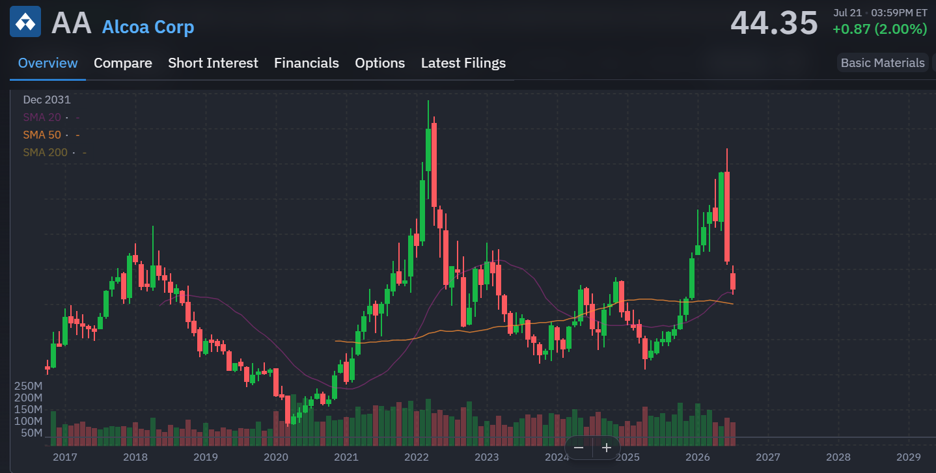
This is the stock chart for Alcoa, the Aluminum Company of America. The company is as valuable today as it was three years ago, in early 2023. Going back even further, investors who bought Alcoa in 2018 are back to where they started. The company does pay dividends, under a percent or so. So most investors were better off putting their money into a money market account, than buying Alcoa shares.
And that wasn’t supposed to happen to American industrial companies in general, and for Alcoa specifically. That’s because Alcoa, specifically, should be doing much better.
The Pentagon is in desperate need of more gallium to build missiles and radars, gallium is a by-product of the aluminum mining and refining industry, China has cut off exports of gallium from its aluminum companies, and the Pentagon contracts are going to fall right into Alcoa’s lap, if they can get gallium production up and running.
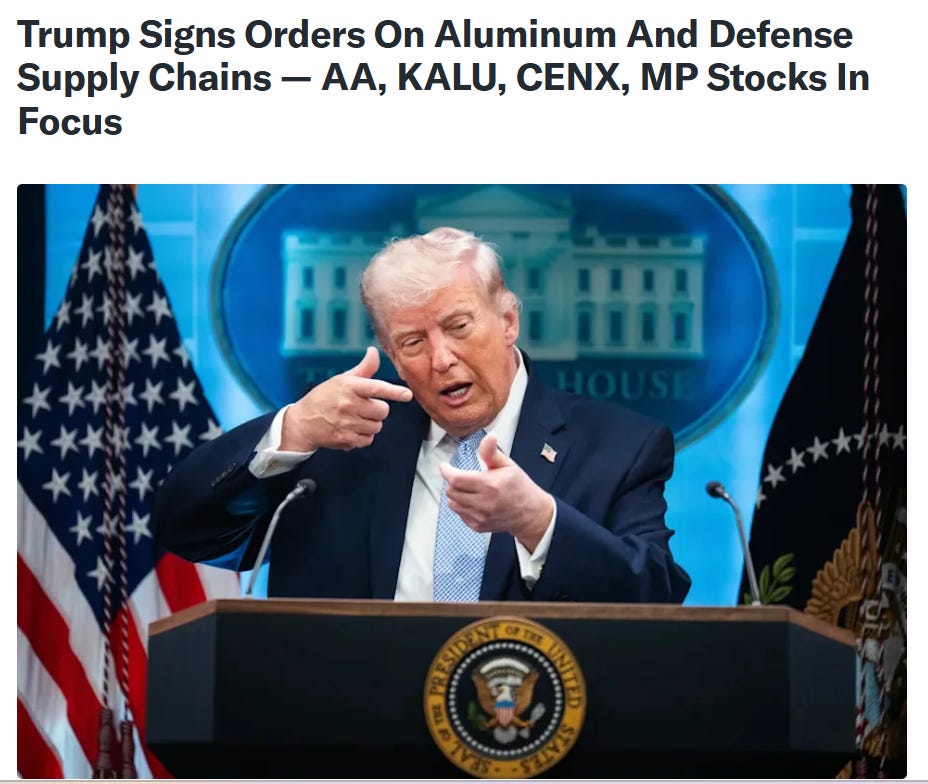
Consider these two headlines, both from yesterday. The first comes from the White House. President Trump signed executive orders that may as well have been written by Alcoa lobbyists. Pentagon defense contractors typically get waivers from the restriction to source their raw materials and components only from friendly sources. Trump’s first EO makes it much harder for that to go on. Alcoa has large operations in the United States and Australia, so they don’t need those waivers to sell to weapons makers; but other companies do require those waivers.
The second order is for new tariffs and incentives to increase aluminum production in the United States.
Headline number two comes from Alcoa itself. They are cutting their forward guidance for production of aluminum by at least 200,000 tons for 2026, and also said that expenses will be higher than they thought for the year.
But that second part shouldn’t matter, because Alcoa is perfectly positioned, at least in theory, to take advantage of China’s export bans on the gallium, and the Pentagon is a money-no-object customer. China’s market share of the global gallium market is 99%, and gallium prices are rocketing higher ever since China’s export bans were announced.
The gallium shortage is an urgent problem for Western militaries, because gallium is so critical in radar systems, communications, and electronic warfare platforms. Policymakers in the United States are suddenly aware of the problem, now that the Pentagon is blowing through their arsenal of weapons far faster than they can be replaced, and without gallium they cannot be replaced anyway.
But the same chemical properties that make gallium so valuable for weapons makers, also make it attractive for civilian high-tech industries: Semiconductors and civilian telecom services. China’s the only country building 6G systems, but they’ll need a lot of their gallium to stay at home to get that done.
In response the United States has abandoned free-market capitalism and is buying stakes in mining and exploration companies. The Pentagon now outright owns gallium production projects, and is on the other side of the table as a huge customer. As of February they had committed over $2 billion in a group of companies in the United States. But those projects are still early in development.
The most advanced gallium production project currently underway is in Western Australia, and is an Alcoa operation. Project managers are aiming for an opening date later this year, and with hopes to eventually scale to 100 tons per year. Margins for gallium are much higher than for aluminum, especially at these record-high price points. All very bullish for Alcoa, then.
Here is where things get tricky though. Gallium production just costs a lot more, when performed outside China. Production costs in the US are higher than China’s by at least 20%, so when prices fall, American companies are losing money a long time before any losses are felt by Chinese firms. New environmental regulations can be written, and likely will be on the first day of the next presidential administration.
Developers of the project in Western Australia hope that none of that will affect them. The partners are guaranteed access to gallium supply, and the implication here is that even if gallium prices fall below the production cost, government buyers will guarantee profits for all concerned.
Alcoa will build and operate the plant, and the United States, Japan, and Australia are putting in capital. Here we find a lot of conditional language, again—the plant “could provide” “up to 10%” of the current global supply. Construction activities “are expected to begin” after the site is ready. If none of that sounds very definitive, this one isn’t going to be any better. The plant will yield “about 60 tons of gallium” and “could be up and running as soon as the first half of next year.” So could be some time before 1 July 2027. That “could be followed” by a second phase, and it’s only after that is done, that Alcoa gets to that 10% target for global market share.
All that said, Alcoa may be in a better spot than any other Western company, to break the dependency on China for gallium. The governments of the United States, Japan, and Australia are all-in, critical mineral projects are being fast-tracked for approval already, and the Alcoa project in Australia is turn-key ready since it is already a major producer of aluminum.
So what’s the problem? Why are investors selling shares instead of buying more? And when we look at the time-to-market for that new gallium production, they’re still years away. Even though everything is going smoothly so far.
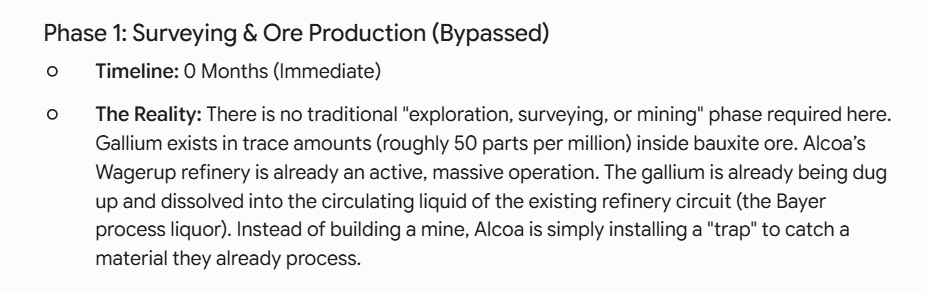
Phase I is already done. Exploration, surveying, and mining are already complete. The refinery is in place, and gallium is already being produced; Alcoa just needs to finish up the sitework to process the material they’re already piling up.
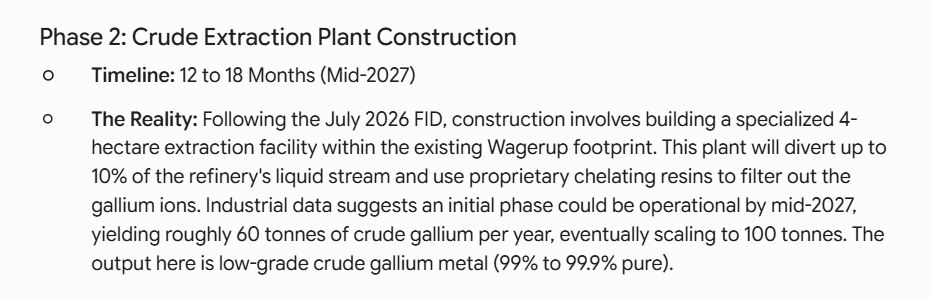
Starting with Phase II, investors begin to understand why American aluminum producers abandoned the gallium business in the first place. A specialized extraction facility needs to be built and brought online to separate gallium ions from all the other junk coming out of the ground. That “could be operational” by the middle of next year, and producing gallium that is 99 to 99.9% pure.
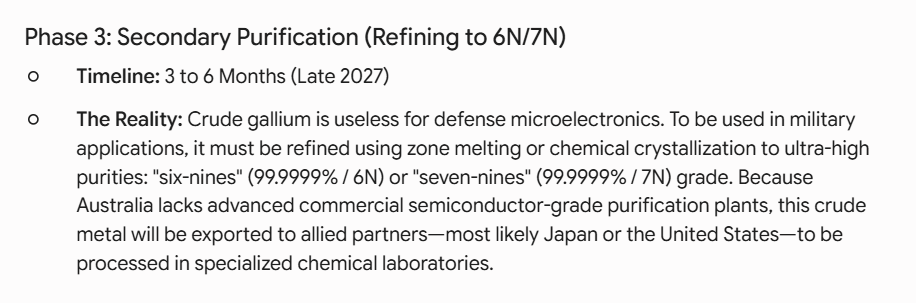
But that’s not nearly pure enough, which brings us to Phase III. Further refining is required to get to “Six Nines and Seven Nines” purities for the gallium, because it’s only at those levels that the gallium is usable by industry. Australia doesn’t have refineries for those processes, so it will be shipped out to places that do—probably in Japan or in the US. That adds another three to six months.
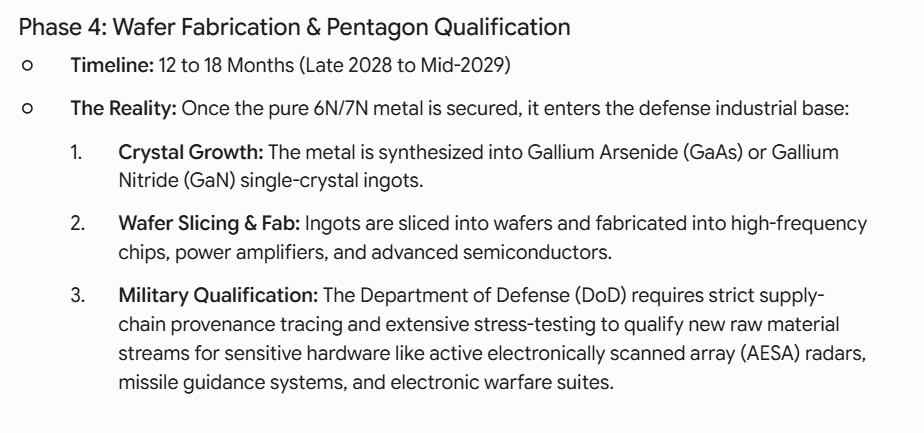
For Phase 4, it’s another year to year and a half: that high-purity gallium is processed into gallium arsenide or gallium nitride, then sliced into wafers, and turned into other things. They call themselves the Department of War, now, and they require heavy testing of those materials before they are put into multibillion dollar weapons platforms.
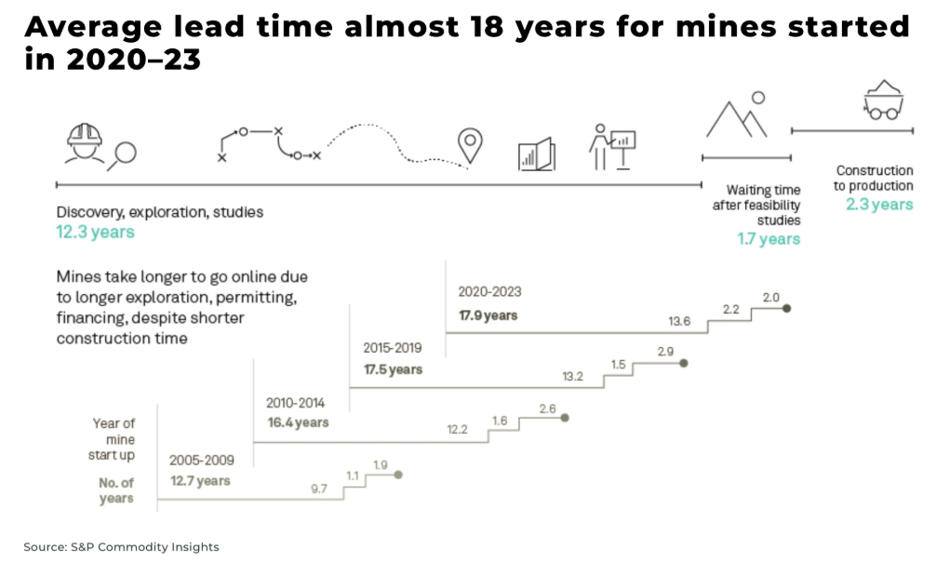
So the good news is that it’s usually a decade to bring a new mine online. The bad news for arms makers is that even if everything continues to go perfectly well down in Australia, the new supply chains for gallium won’t be formed for at least three years.
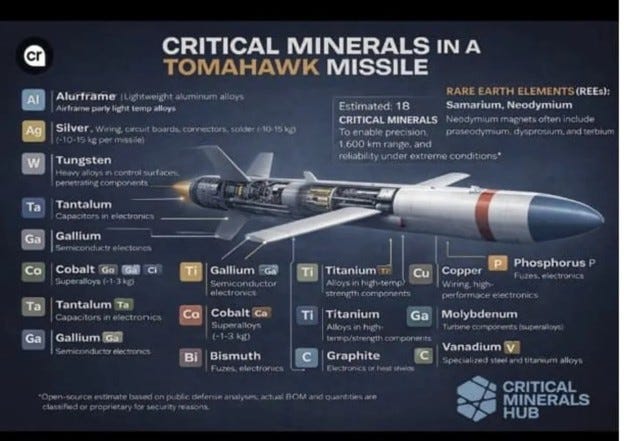
But the other bad news, is the supply chains for everything else. That particular Alcoa project in Australia is far along, relatively, and may in fact be delivering weapons-quality gallium to the Pentagon in 2029. But gallium is just one of the critical minerals that go into building weapons, and China has export bans on most of those too.
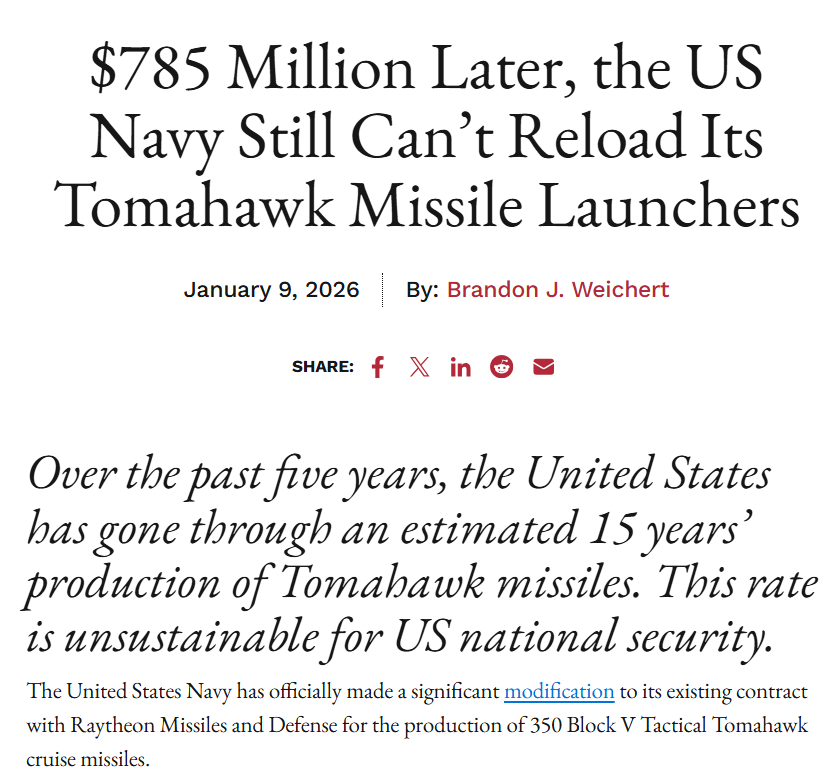
From 2021 through 2025, the United States blew through 15 years of production of Tomahawk missiles, in just five years. Then came the War on Iran, and four days after that kicked off a “Tomahawk missile shortage” looked inevitable, and a week after that the US military was running out. Savvy equity investors can do what I just did—take an hour or so to learn that the Pentagon’s appetite for gallium is total—they’ll buy all they can, today and for years to come.
But even if Alcoa gets their 100 tons a year of gallium out of the ground in Australia and refined in Japan and shipped to the United States so Raytheon can build more Tomahawks, RTX still has to get new supply chains up and running for the graphite, tungsten, neodymium.
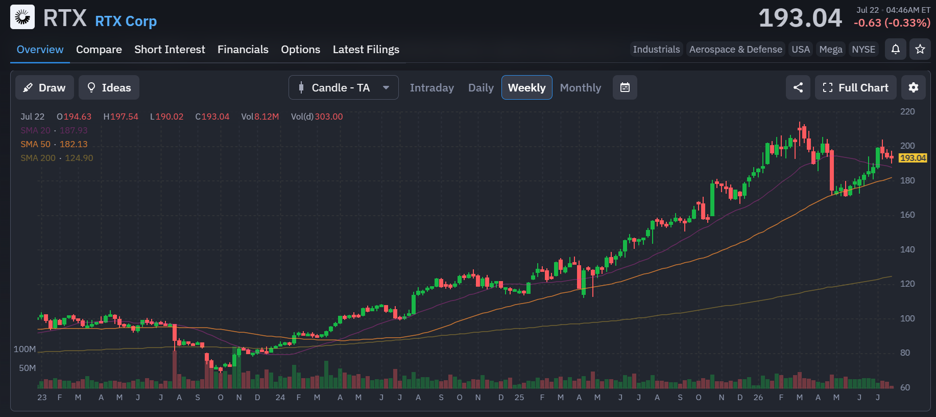
But investors know that if Raytheon can eventually get them, and can build their missiles again, they can name their price. So their chart looks a lot better.
Be Good.
Resources and links:
Alcoa Greenlights Gallium Plant in Australia With U.S. and Japan Backing
https://oilprice.com/Company-News/Alcoa-Greenlights-Gallium-Plant-in-Australia-With-US-and-Japan-Backing.html
Australia, Japan, the United States and Alcoa Announce Final Investment Decision for Gallium Project in Western Australia
https://news.alcoa.com/press-releases/press-release-details/2026/Australia-Japan-the-United-States-and-Alcoa-Announce-Final-Investment-Decision-for-Gallium-Project-in-Western-Australia/default.aspx
Alcoa greenlights Australia gallium plant with US, Japan and domestic backing
https://www.reuters.com/business/energy/alcoa-greenlights-australia-gallium-plant-with-us-japan-domestic-backing-2026-07-14/
Australia strengthens global gallium supply chain with major Alcoa investment
https://minerals.org.au/resources/australia-strengthens-global-gallium-supply-chain-with-major-alcoa-investment/
Alcoa Explores Feasibility of Gallium Critical Mineral Production in Western Australia
https://news.alcoa.com/press-releases/press-release-details/2025/Alcoa-Explores-Feasibility-of-Gallium-Critical-Mineral-Production-in-Western-Australia/default.aspx
Critical Mineral Gallium Sees Increased Project Activity
https://www.industrialinfo.com/news/article/critical-mineral-gallium-sees-increased-project-activity--360245
Pentagon’s US Gallium Strategy Targets 2026 Production Independence
https://uscriticalmaterials.com/pentagons-us-gallium-strategy-targets-2026-production-independence/
Trump Signs Orders On Aluminum And Defense Supply Chains — AA, KALU, CENX, MP Stocks In Focus
https://finance.yahoo.com/economy/policy/articles/trump-signs-orders-aluminum-defense-234722200.html
Alcoa cuts production outlook, citing refinery issues
https://finance.yahoo.com/markets/commodities/articles/alcoa-cuts-production-outlook-citing-121100153.html
Chinese Publication Claims U.S. Has Two Months of Rare Earths Left
https://finance.yahoo.com/energy/articles/iea-warns-china-rare-earth-130600541.html
Gallium nitride as a key material for the next generation of wireless technology
https://wiot-group.com/think/en/articles/why-gan-makes-6g-satellite-communication-possible/
China begins large-scale delivery of gallium chips for space-ground 6G network
https://www.scmp.com/news/china/science/article/3356321/china-begins-large-scale-delivery-gallium-chips-space-ground-6g-network
New mines take nearly 18 years to build in 2020-23
https://theoregongroup.com/investment-news/new-mines-take-nearly-18-years-to-build-in-2020-23/
US backs companies to restart domestic gallium production after 40-year gap
https://www.miningreporters.com/noticia/news/2026/04/us-supports-domestic-gallium-production-critical-minerals
Report: US burned through half or more of critical missiles interceptors
https://responsiblestatecraft.org/stockpiles-iran/
Inside China / Business is a reader-supported publication. To receive new posts and support my work, consider becoming a free or paid subscriber.
From Inside China / Business via This RSS Feed.