

Since President Donald Trump’s operation in January to overthrow Venezuelan President Nicolás Maduro, the US has taken more than $13 billion in revenue from Venezuelan oil sales. But nobody, including Congress, is entirely sure where the money has gone.
The Financial Times, which reported the figure on Wednesday based on estimates of oil sales out of Venezuela since January, pointed out that the Trump administration has given vague and contradictory answers about who currently controls the revenues from the Latin American nation’s largest export and source of wealth.
Trump said in the days after the US attack that Venezuela’s oil wealth would be “controlled by me.” At a rally on Wednesday, he boasted that the US “won in Venezuela” and had paid for the operation “many many times over” by “taking tremendous amounts of oil” from the country.
He added that “Venezuela is doing better than they’ve ever done before.” But economic data from the country tells a very different story.
According to economist Francisco Rodríguez of the Center for Economic and Policy Research, in the first quarter of this year, Venezuela had just 2.5% growth in its gross domestic product—its worst in five years. This is despite the fact that its oil exports grew by 25% during the first quarter.
He said this was likely “because the US didn’t transfer to the Venezuelan government the totality of its increased oil revenues.”
While the executive order signed by Trump in January describes the proceeds from oil sales as nominally belonging to Venezuela, they are being held in accounts controlled by the US Treasury Department. It prohibits Venezuela from independently withdrawing from the accounts without approval from the secretary of state, Marco Rubio.
At a Congressional hearing this week, Michael Kozak, a senior State Department official, acknowledged that “it’s their money, but they have to get our permission” to receive it.
While the State Department has claimed that “billions of dollars have been disbursed to the Venezuelan economy” and that “financial monitoring is under way to ensure funds benefit the Venezuelan people," the FT found little evidence that this is the case.
A website set up by the Venezuelan government to track exports from US-run oil sales shows just a single transfer of $300 million in March.
The administration has made explicitly clear that it is using the oil revenues as a tool to exert leverage over Venezuelan policy. In January, Vice President JD Vance said that the administration would allow Venezuela to sell oil as long as its policies “serve America’s national interest.”
A senior US official told The New Yorker that the administration has authorized about $6 billion to be disbursed to the government of Venezuela’s interim president, Delcy Rodríguez, though there was no indication it had actually been transferred or spent.
Francisco Rodríguez said that even if it was, this “leaves an obvious question: where are the remaining $7 billion?”
He speculated that some of it might have been paid directly to joint venture partners, but noted that this would only account for a “fraction” of the difference and said there could be “other more complex explanations, beyond the possibility that the US is simply sitting on the money.”
However, he said, “what is becoming increasingly clear is that the main reason Venezuela’s economic recovery has been so sluggish is that, while the country is generating more oil revenue, it is not collecting on it.”
In April, Kozak said the administration would provide quarterly reports on where the funds have gone. But Democrats on the Foreign Affairs Committee said they had not received them.
The lack of transparency has drawn concern from members of both parties in Congress, which Rep. Joaquin Castro (D-Texas) said has been “kept in the dark.”
“Trump’s invasion of Venezuela has been about oil, power, and graft from the very beginning, with billions of dollars in Venezuelan oil revenue being controlled by the Trump administration without transparency or safeguards,” Castro told the Financial Times.
Even María Elvira Salazar (R-Fla.)—who promoted a Trump-led regime change effort in Venezuela by saying it would be a “field day” for US oil companies—has called for the administration to publicize reports on where the money is going.
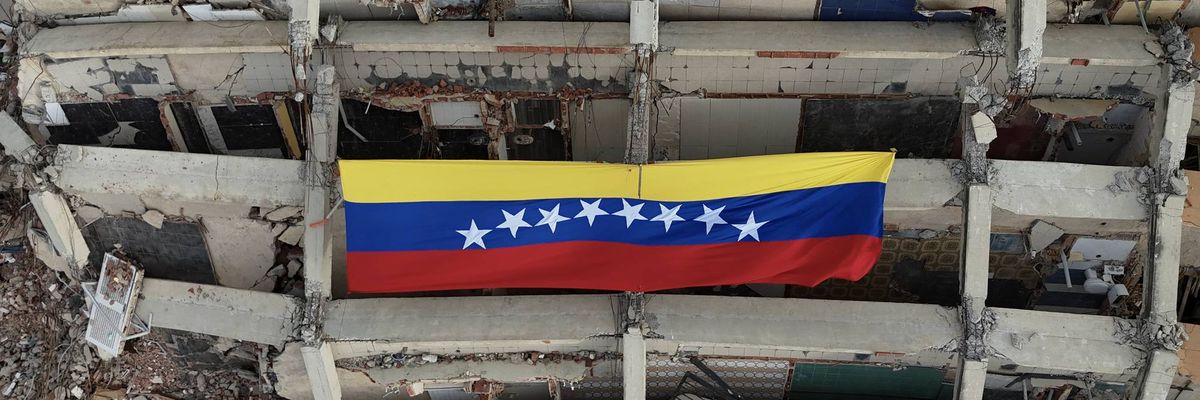
The question of what has happened to Venezuela’s wealth is made more urgent by the twin earthquakes the country suffered in June, which killed about 5,000 people, injured 17,000, and left 18,000 homeless, according to government figures.
A World Bank report released Thursday estimated that reconstruction could cost close to $50 billion.
The earthquake has been met with calls for the US to lift its harsh sanctions on Venezuela, which have cost the country tens, if not hundreds, of billions of dollars in lost revenue since 2015 and which advocates have said are further hobbling the nation’s recovery.
Trump ratcheted up these sanctions in the months leading up to his operation to overthrow Maduro, and many have remained in place following the earthquake.
The US has provided more than $386 million in earthquake-related assistance to Venezuela. But it’s just a fraction of the oil wealth it appears to be holding.
Francisco Rodríguez said the apparent hoarding of Venezuela’s oil wealth does further damage to Trump’s claim that his intervention was meant to benefit its people, as well as the US.
“The bottom line is that this arrangement is not proving advantageous to Venezuelans,” Rodríguez said. “The picture now coming into focus is that the intervention has been, as its critics have long accused such actions of being, little more than a pretext for extracting economic wealth that rightfully belongs to the people of Venezuela.”
From Common Dreams via This RSS Feed.
Into Trumps bank account