

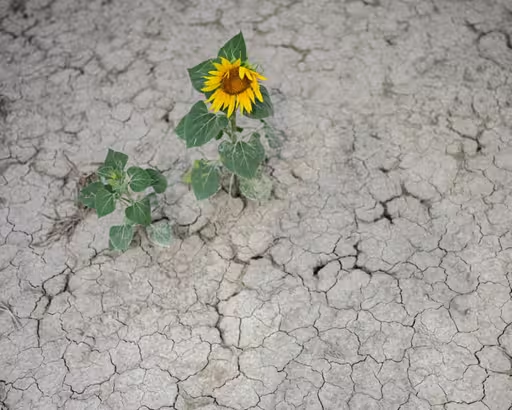

A new scientific assessment links rising temperatures to depleted water reserves, dry soils and growing wildfire risks across Europe.
Climate change is worsening drought across Europe, as heat episodes accelerate the loss of water through evapotranspiration, dry out soils and create conditions that increase the risk of wildfires, according to a study by World Weather Attribution (WWA).
RELATED: Italy Issues Red Alert As Heatwave Scorches 15 Cities
The study, Drought in Europe: Extreme Heat Depletes the Continent’s Water Reserves, warns that while regional rainfall trends remain uneven across the continent, heat that was once largely limited to the summer months is arriving earlier and is increasingly accompanied by a drier atmosphere.
Researchers from the Netherlands, Switzerland, Austria, the United Kingdom, Hungary, Romania, Slovenia, Germany, Lithuania, the Czech Republic and Spain say these conditions are worsening drought across Europe by drying soils and increasing the evaporation of available water reserves.
Heatwaves and wildfires
WWA experts warn that, although the European summer is still far from over, relentless heatwaves and drought conditions have already caused agricultural losses, dangerous wildfires and historically low river levels.
In Spain, 101,163.82 hectares of forest have burned between Jan. 1 and July 22, compared with 24,133.26 hectares during the same period in 2025, according to figures released Wednesday by the Ministry for the Ecological Transition and the Demographic Challenge (Miteco).
Thousands of people are being evacuated from areas of southern France as firefighters battle huge wildfires.
Researchers say climate change is intensifying heat and drought, creating conditions for larger and more destructive wildfire seasons across Europe. pic.twitter.com/P9f1dmK6jA
— Al Jazeera English (@AJEnglish) July 23, 2026
The ministry also reported 22 major wildfires so far this year, compared with an average of nine during the same period over the past decade, based on provisional figures provided by Spain’s autonomous communities and the European Forest Fire Information System (EFFIS) under the Copernicus programme.
The WWA study, based on EFFIS data, found that nearly 42,000 hectares have burned in France since the beginning of the year, a figure far higher than during the same period in 2025.
Researchers warned that French farmers are facing their worst maize harvest in the last 50 years, while Romania has lost more than one million hectares of crops.
The drying of Europe’s major rivers, another consequence of climate change, is affecting inland water transport and putting energy production at risk. These impacts, the study says, threaten to increase the price of essential goods.
Heat, evapotranspiration and drought
The summer of 2026 in Europe has been characterized not only by “exceptionally high temperatures,” but also by “exceptionally dry” conditions across Central and Western Europe, according to data from the Copernicus Earth observation and monitoring programme.
The findings show that while long-term rainfall trends vary, between April and June this year broad areas of the continent — from southwestern Portugal to northeastern southern Finland — “recorded below-average rainfall.”
The study also notes that in Western Europe, neither observations nor climate models show a long-term change in low April-to-June rainfall patterns.
Taking the average across Western Europe between April and June, researchers conclude that the lack of rainfall is not clearly due to climate change.
Climate change is exacerbating drought this year in Europe as extreme heat evaporates water supplies, scientists said in an analysis, after low water levels disrupted shipping, farming and industries in countries including Romania and Greece https://t.co/dowRkoZj91
— Reuters (@Reuters) July 23, 2026
Instead, the WWA study identifies heat as the determining factor behind worsening drought, with extreme heat episodes accelerating evaporation and the depletion of soil moisture.
It adds that for potential evapotranspiration, both observations and climate models show significant increases across the region, making agricultural and ecological drought increasingly likely and more severe.
From teleSUR English via This RSS Feed.