

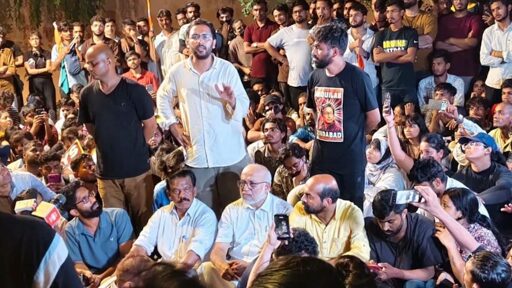
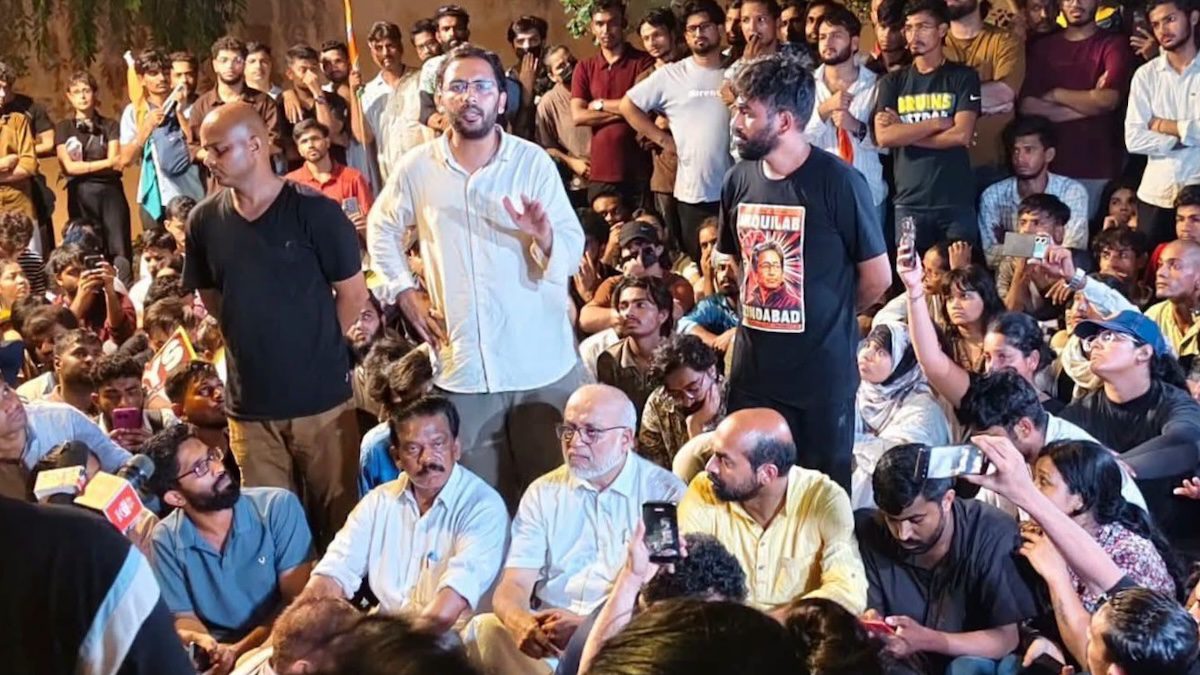
Hours after facing a large-scale police crackdown on Monday, with hundreds injured and detained, thousands of people gathered in the Indian capital, Delhi, to continue the protests demanding accountability from the Narendra Modi-led union government.
Protesters re-gathered at Jantar Mantar, a central protest location near the country’s parliament, and re-arranged the site destroyed by the police hours prior.
Thousands of people, including M A Baby and other leaders of the Communist Party of India (Marxist), and members of parliament (MPs) from India’s left parties decided to stay with the protesters for the night. The protesters are led by Abhijit Dipke and other leaders of theCockroach Janta Party (CJP).
Largest protests in years
The CJP was formed in the context of India’s Chief Justice dismissing the initially small-scale protests that erupted against the cancellation of exams. Justice Surya Kant claimed that those participating were “professional protesters” and compared them to cockroaches. The movement has now evolved into a broader platform, bringing all major opposition parties together and making it the first major mass uprising in the country in years.
The Narendra Modi-led government has so far refused to engage with the protesters in any meaningful way. The pro-government media channels and social media pages are now trying to dismiss the protests as another attempt by the opposition to create “instability and violence” in the country.
This has been the standard approach of the pro-government media towards any popular protests against the Modi government since 2014. All major protests in the last decade, such as the one led by JNU students in 2016 against the destruction of universities, or protests against the Citizenship Amendment Act (CAA) in 2019-20 or even the protest by farmers on Delhi borders in 2020-21 faced similar accusations of being “anti-national.”
The media’s wrongful portrayal has helped the BJP government repress the protesters with impunity and little backlash. Several leaders of the anti-CAA protests, for example, are still in jail booked under draconian laws, such as the Unlawful Activities Prevention Act (UAPA).
Movement escalates demanding education minister’s resignation
On Monday, protesters launched the call for a march to the Parliament. The call came after almost a month-long hunger strike and sit-in at the Jantar Mantar, demanding the resignation of the country’s education minister Dharmendra Pradhan. The sit-in was led by social activist Sonam Wangchuk and leaders of the left-leaning student unions, such as Neha Bora from the All India Student Association (AISA) and Student Federation of India (SFI).
Thousands of students, activists, and supporters turned up for the march to Parliament, despite rains and humidity, filling almost all streets leading to the Parliament.
The police and security personnel cordoned off the parliament and erected barricades at various places, and proceeded to condemn the march as illegal. They attacked the protesters with batons and fired tear gas shells at them after the protesters refused to abandon the march.
Hundreds of people were injured in the attacks carried out by the security forces. The police also detained hundreds of other protesters. Some protesters claimed they were hit by pellet guns and were admitted to hospitals.
Though the government called the leaders of the protests for a meeting, the talks were inconclusive as the government refused any discussion on the resignation of Pradhan.
Youth precarity and sabotaged opportunities at center of uprising
The CJP and left-leaning student unions have claimed that over a dozen students have died after committing suicide in the last few months, following the cancellation of various centralized exams over alleged corruption and irregularities.
According to various media reports, dozens of such exams related to medical, engineering entrance, lecturerships, and various government jobs have been cancelled either at the last moment before the due date or immediately after they were conducted citing technical or legal reasons.
In India, such exams are attempted sometimes by millions of students or aspirants and they are often competing for a few hundred seats or vacancies. The majority of these students coming from middle or lower-middle class families see these exams as opportunities for social mobility. Given the systemic neglect of public education in the country, families spend a large part of their income on educating their children or arranging special coaching to prepare them for these exams.
Due to the economic cost each exam cycle involves and the stress it creates for most of the students and their families, the cancellation of exams or questions of irregularities in them often cause massive economic and emotional setbacks.
As mentioned earlier, allegations of irregularities and corruption leading to the cancellation of such exams have increased many fold under the ultra-right-wing Bharatiya Janata Party (BJP) government. This has resulted in massive popular outrage and demands for accountability.
The current protests, which began with the demand for the resignation of Pradhan in June, have now taken on a much broader form, with the inclusion of demands such as scrapping some of those centralized exams, such as NEET altogether. Some protesters have also raised the issue of the larger collective responsibility of the Modi government and demanded the whole administration must go.
Growing nationwide support
Protests are now being organized in hundreds of other towns and cities across the country to express solidarity with the CJP protests in Delhi. Hundreds of students and activists have marched in India’s other major cities, such as Kolkata, Mumbai, Bangalore, and Trivandrum, since Monday’s crackdown with SFI and AISA calling for more such nationwide protests in the coming days.
The student protests have now been supported by various other sections of the society such as the farmers and workers unions who have organized their own solidarity protests or issued statements in solidarity.
All major opposition parties such as the Indian National Congress (INC) have been calling for their own protests now. INC organized a parallel protest in front of the prime minister’s residence on Tuesday leading to the leader of the opposition Rahul Gandhi being detained.
The CJP protest has also attracted support from various progressive movements from across the world with the International Peoples’ Assembly (IPA) issuing a solidarity statement on Tuesday.
“When examination systems are compromised by corruption and organized malpractice, it is these students who pay the price. Their futures are put at risk while those with wealth and power continue to benefit from an unequal system,” IPA statement said, claiming “repeated failures expose an education system increasingly shaped by inequality, commercialization and impunity.”
From BT News via This RSS Feed.