

Ukrainian President Volodymyr Zelenskyy’s recent dismissal of Defense Minister Mykhailo Fedorov – credited by many for Ukraine’s drone strikes into Russian territory – has triggered widespread protests, exposing continuing instability at this level of government. At the same time, European leaders continue approving new loans for Ukraine’s armament and imposing fresh sanctions on Russia, while the Ukrainian working class bears the brutal cost through violent street conscriptions.
In this interview with BreakThrough News, sociologist Volodymyr Ishchenko analyzes the presence of colonial-style exploitation and class conflict in the war in Ukraine. He explores scenarios ranging from nuclear war to failed-state fragmentation, emphasizing that Ukraine’s fate is tied to global shifts – it is now up to the international anti-militarist left to challenge the austerity-and-armament agenda driving the catastrophe.
BreakThrough News: Ukrainian President Volodymyr Zelenskyy recently dismissed Mykhailo Fedorov from the post of defense minister, triggering widespread protests across the country. Demonstrators demanded Fedorov’s reinstatement and the removal of Commander-in-Chief Oleksandr Syrskyi [editor’s note: the interview was conducted before Syrskyi was removed from the post on July 21]. How should we interpret this cabinet reshuffle and the mobilization that followed?
Volodymyr Ishchenko: These events stem from the same fundamental conflict that has defined Ukrainian politics since the collapse of the Soviet Union, the very conflict that stands behind this war. On one side are local political capitalists, businesses that grew out of post-Soviet predatory privatization and selective state benefits, yet have consistently failed to establish sovereign rule in Ukraine. On the other side is a professional middle class aligned with transnational capital, betting on integration into the crumbling US-centered international order.
The recent escalation is a direct continuation of last year’s events, when Zelenskyy tried and failed to take control over anti-corruption institutions. In an article with Peter Korotaev last year, we discussed how anti-corruption bodies designed by comprador “civil society” and supported by the West became a “state within the state” in post-Euromaidan Ukraine, and why the conflict around them was never truly about democracy. Since then, this conflict has not been developing in Zelenskyy’s favor. Anti-corruption bodies revealed large-scale corruption schemes involving some of the president’s closest associates. His chief of administration, Andriy Yermak, Ukraine’s “grey cardinal” for years, was forced out and now faces charges.
Now comes Fedorov. In pro-Western circles, he was credited with Ukraine’s only significant successes since 2022: the medium- and long-range drone strikes that caused gasoline shortages across Russia and electricity cuts in Crimea. He was becoming popular, and within comprador circles, he was increasingly seen as a potential successor, or even a replacement, for Zelenskyy. Behind this lay competition between patronage networks over military supplies and associated corruption schemes. So Fedorov did not go quietly. His public attack was not just on Syrskyi. It aimed at further weakening Zelenskyy. Essentially, the pro-Western compradors demanded the power to change the commander-in-chief in the middle of the war.
It is worth remembering that all Ukrainian presidents have failed to consolidate a sovereign state. This was prevented not just by protests, which were historically far more massive than anything we have seen in support of “anti-corruption” institutions or Fedorov recently, but also crucially by rifts and the power of local opportunistic elites. Zelenskyy failed last year primarily due to pressure from the EU, and it is unclear whether he can succeed this time. So far, his vacillations regarding the name of the new defense minister, and his hints that certain changes in the army might follow in response to the protests, only contribute to further destabilization.
Compare this to Russia. In 2023, Putin met a much stronger challenge: a real mutiny by the private military company “Wagner,” which demanded the dismissal of the defense minister and the chief of the general staff, whom Yevgeny Prigozhin blamed for the Russian army’s setbacks in 2022. Putin eliminated Wagner’s leadership, restructured the group, and only afterwards removed Sergei Shoigu and launched an unprecedented crackdown on corruption in the army. The sociopolitical cohesion achieved in Russia, contrasted with the disintegration occurring in Ukraine, is one of the crucial manifestations of the different paths that these two countries took in the post-Soviet period – a difference that has decisive implications for how this war develops.
BT: One of the things that comes through your commentary on the war is that it should not be understood only as a conflict between states or geopolitical blocs, but also viewed through the class structures of post-Soviet Ukraine. How has the war impacted the relationship between Ukraine’s political and economic elites, the middle classes, workers and the rural population?
VI: Looking at Ukraine today, the ruling class – the political capitalists, including but not being limited to the “oligarchs” – has been weakened economically and politically, but the overall structure of the post-Soviet class conflict remains largely unchanged. The ways of making money are essentially the same, as shown by recent scandals involving President Zelenskyy’s cronies that I have just mentioned. Basically, those connected to the presidency have seized significant opportunities to profit from the war. Despite numerous ongoing investigations, practically no one has actually been held accountable.
Meanwhile, transnational capital and an aligned professional middle class have been empowered by Ukraine’s dependence on Western funding and weapons. Those working on projects funded by Western donors are exempt from mobilization. In 2024, an official list identified 133 Western-funded NGOs whose staff were granted draft exemptions.
Similarly, so-called “Ukrainian voices” have launched careers in the international public sphere. We’ve seen a similar pattern with “Cuban voices,” “Venezuelan voices,” and “Iranian voices.” These “voices,” claiming to speak on behalf of the entire people, are typically drawn from privileged classes and are used to legitimize imperialism.
On the other hand, subaltern classes – primarily the working class and rural population – have borne the brunt of military conscription, exacerbated by corruption. These are the people who cannot afford bribes to evade the draft or escape the country. So, the fundamental structure of class conflict remains unchanged. But the war has deepened the asymmetry within it: those who were already organized and connected have grown stronger, while the atomized majority is now even less able to defend its interests.
BT: Another topic you’ve written about is forced street mobilization or busification, and about the large number of Ukrainian men trying to avoid registration, conscription or military service. How widespread and systematic are these practices, and what do they tell us about the relationship between the people of Ukraine and the state?
VI: Busification and resistance to it need more attention because it’s something that has been escalating throughout the war. Busification happens every day: every day, on Ukrainian social media, you see another video from another city showing how brutally men are dragged to military recruitment offices.
The reason is pretty simple: the number of army volunteers is extremely small, a shrinking minority at this point. One indication was last year’s experiment where they offered young men aged 18 to 24 much better conditions to join: higher pay, even a promise they could leave the country after just one year of service. Even with those promises, they only attracted a tiny fraction of people.
This shows it’s not just about conditions in the army, but also a fundamental distrust of the state. With Peter Korotaev, we position this as a consequence of the broken post-Soviet social contract. For decades, the state offered Ukrainians less and less in terms of welfare, benefits, or prospects. At the same time, it didn’t ask for much in return; you could evade taxes, for example, and this was done en masse. But then the war started, and the state began demanding that people sacrifice themselves or their relatives for a state that had offered them almost nothing in life.
This couldn’t work. By late 2022, most joining the army were mobilized, not volunteers. And already in 2022, social media channels emerged helping people avoid mobilization patrols by sharing which streets recruiters were hitting in which cities. Those channels had hundreds of thousands of subscribers in big cities like Kharkov.
Mass draft dodging has only grown since. The latest data we have on criminal cases opened against those absent without leave (AWOL) is in the hundreds of thousands. The numbers are so high that last year, the state officially classified the statistics because it represented a threat to national security, showing how little Ukrainians want to fight for this state. People massively avoided even updating basic contact info they were required by the law in 2024, making it harder for the state to send draft notices strategically.
Read more: Ulrike Eifler: ‘The workplace is a place where we have to fight against war’
This resistance is growing and becoming more frequent, perhaps showing qualitative advances too. Until now, most resistance was spontaneous, passersby or relatives trying to help a guy escape from minibuses. There was no organization or evidence of coordination between different initiatives. But recently, it has taken on a more massive scale, like riots. These are still spontaneous but start involving whole neighborhoods. One recent case in Lviv caused quite a stir among pro-recruitment supporters.
There’s also evidence of emerging strikes against mobilization, particularly by drivers of private minibuses. In the context of the post-Soviet collapse of public transport, these private operators took on large shares of urban transit. Unlike public transport companies, they are not exempt from the draft, so drivers have been regularly recruited – and they’ve protested this. One of the examples worth noting was a recent demonstration in Vinnytsia, where minibus drivers stopped working for half a day. This is important because it’s not just spontaneous resistance; it’s a sign of organized action by the working class or petty entrepreneurs defending their collective interests against state mobilization.
BT: Ukraine’s state and state-guaranteed debt now runs into hundreds of billions of euros, with the EU being one of the largest creditors. What does this relationship with the EU mean for the future of the working class in Ukraine?
VI: Most likely, Ukraine won’t be able to pay this money back. Basically, the newest loans are structured so that Ukraine repays only if it receives reparations from Russia, which probably isn’t going to happen.
We’ve seen how the United States, during the second Trump administration, revised its position on aid to Ukraine, imposing a minerals deal whose exact conditions remain still unknown to the Ukrainian public. Supposedly, Ukraine is going to pay for American weapons by allowing the extraction of valuable resources or by handing over valuable assets in Ukrainian infrastructure to American corporations. It’s essentially a colonial relationship.
It’s a bit different with the EU right now, but it depends on what kind of governments emerge there in the future. If we see an Alternative for Germany administration in Germany or the National Rally seizing power in France, they may also revise their conditions for supporting Ukraine – or stop support altogether.
But so far, the money from the EU is more or less about outsourcing security to Ukraine. The EU pays Ukraine because they are buying themselves time to prepare for a future war with Russia. They’ve said this quite openly, even though the consequences of European rearmament create social and political tensions within the EU that weaken European governments and deepen divisions within European countries. This doesn’t decrease the chances of a potential Russian attack; it probably increases them. But in relation to Ukraine, they are paying money to buy time with Ukrainian lives, at the cost of destroying the country’s future.
Read more: NATO summit promises billions for arms industry
Because of this, Ukraine is becoming some sort of “function-state,” existing not to represent the citizens living on its territory, but to serve European elites’ security. For it to fulfill this function, it doesn’t matter much how well the people living in Ukraine are doing. It doesn’t matter whether they have human rights or not.
Let’s also note that Ukraine is becoming depopulated. The most recent UN forecast says Ukraine’s population will drop to 15 million by the end of the century, down from 52 million after the Soviet Union’s disintegration in 1991 – a decline of some 70%. But even this might be enough for Ukraine to fulfill its function toward Europe, because what matters is the army, the necessary infrastructure and civilian sectors to serve the army, and employees for American corporations to extract resources from Ukrainian soil. Nothing more is necessary to fulfill the role they see for Ukraine.
BT: Is a different scenario possible, or a possibility for European countries to actually adopt a fairer approach to the war in Ukraine?
VI: Different scenarios are possible because there’s a crisis tendency all around the world, and the future is pretty much uncertain. What I’ve been describing isn’t even the worst-case scenario. The worst would be nuclear war. This might not be the most probable outcome, but it is a real possibility.
Read more: 80 years after Hiroshima and Nagasaki: nuclear war is closer than ever
In a better scenario, Ukraine might become something like Georgia. That depends not only on European elites, but also on the choices of Ukrainian elites, who might choose to accommodate certain Russian demands and try to maneuver. Since 2012, the Georgian Dream government has similarly tried to balance between Russia, the EU, and China. Segments of the Ukrainian elite might consider this a better way forward compared to continuing down the path of turning Ukraine into what the Roman Empire called foederati – so-called “barbarian” tribes and states bound by treaties to Rome to protect its borders against other “barbarian” tribes. Ukraine could become a foederatus of the European Union, protecting the borders of “civilization” against “Russian barbarians.”
It could also turn out to be a completely failed state, something like Syria or Libya, with parts of the territory controlled by the government in Kyiv, but other parts controlled by occupying powers (and this wouldn’t necessarily be just Russia), but also non-governmental formations. In Syria, this was ISIS. In Ukraine, it could be radical nationalists who are growing stronger and more autonomous. In the case of state failure, formations around the so-called “Azov movement” might start serving quasi-state functions for the local population in terms of security and organizing the basics of human life. That would also be a disaster scenario.
But in fact, Ukraine is now in a state of catastrophe, and basically all the most probable visions are pretty bleak.
BT: And what way is there to try and address this bleakness?
VI: What’s important to understand is that the possibility of a better future is now decided on a global level. It’s not decided within Ukraine. Unfortunately, Ukraine is no longer a sovereign country, and what happens there depends much more on what’s going on in Russia, Europe, or the US. The possibility of a better future is something we’ll have to develop globally and internationally.
It will depend on the capacity of European left-wing movements to offer a very different agenda for European countries – one that is anti-militarist and socially expansive. The connection between ongoing rearmament and further austerity in Europe is pretty obvious, clearly linked to the administrations of Merz, Macron, and other centrist governments.
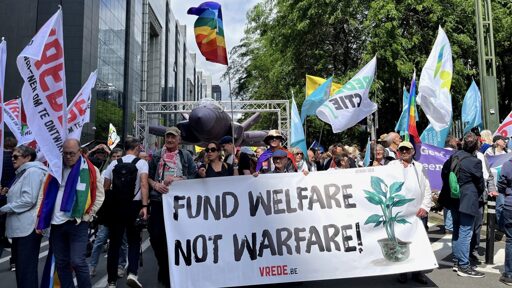
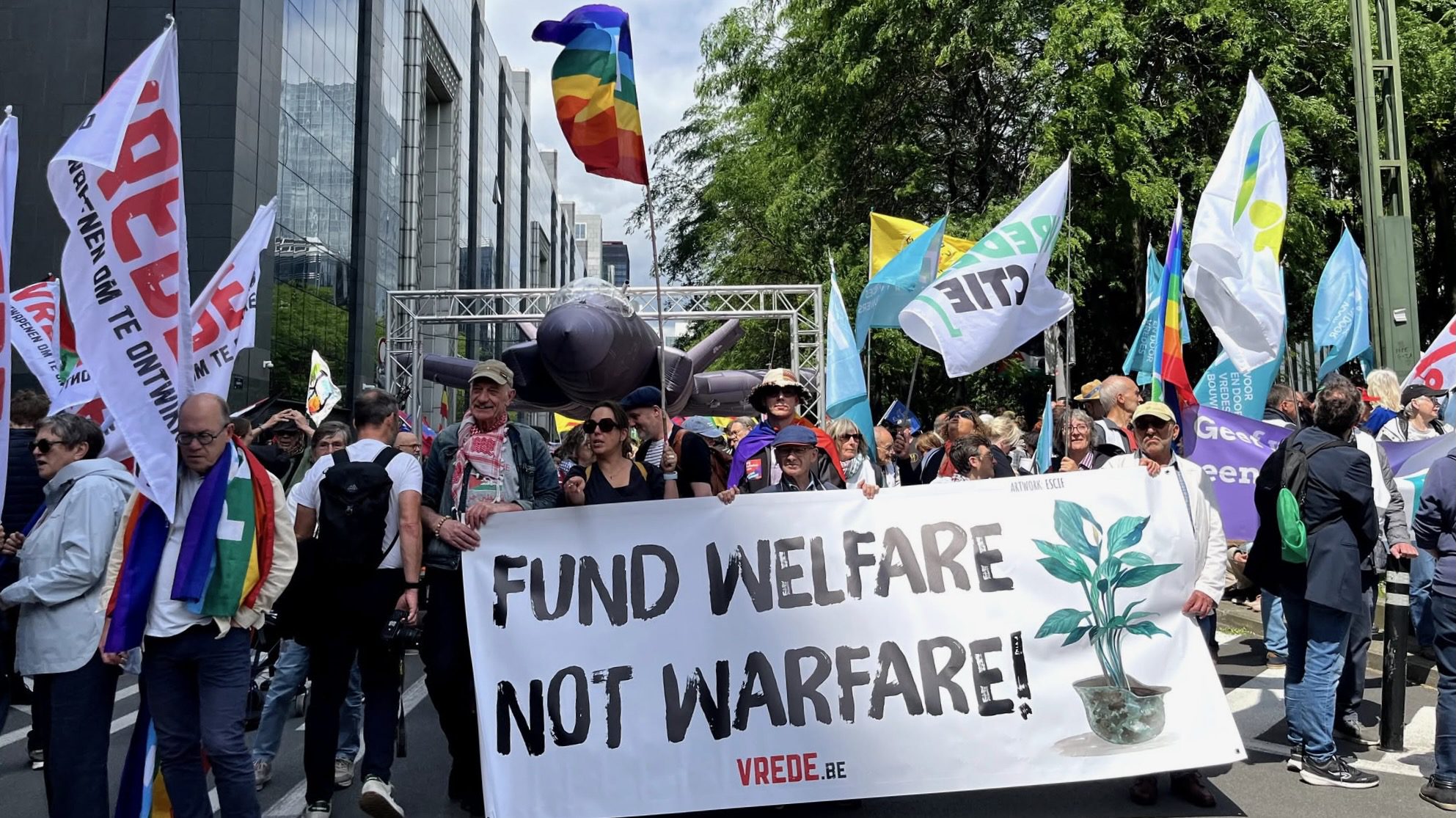
Whether the European left will be capable of offering an alternative is also a big question, but there have been certain shifts in that direction. There have been important rallies in Paris, London, and Brussels. We still need to see where this is heading, but the outcomes of austerity and armament policies could also produce stronger resistance. A chunk of this resistance could be snatched by the far-right – but it’s a crucial opportunity which the left should not just give up to the far-right.
Read more: ‘Welfare Not Warfare’ protest in Brussels demands halt to Europe’s rearmament project
Developments in Russia – whether Putin’s regime will become more stable and powerful or not – as well as developments in China, will also play a role. China might be opening a different vision of the world amid the disintegration of US hegemony. But the question remains: what is next? What kind of order might be offered, and by which state?
We need to think about Ukraine in this global and long-term perspective, and consider the possibilities of organizing a better future for all of humanity, including Ukraine. Right now, basically, Ukraine is not a place of hope. It’s a place that shows how catastrophic the outcomes of the ongoing crisis can be. It’s a kind of magnifying glass for the world: it shows the most extreme futures that may wait for other parts of the world if we do not find a better alternative.
From BT News via This RSS Feed.