

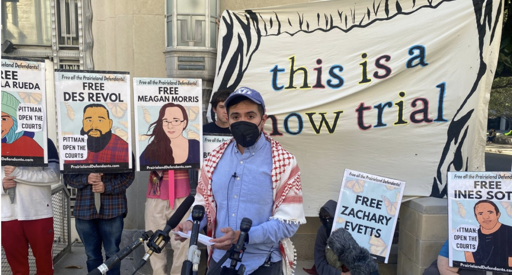
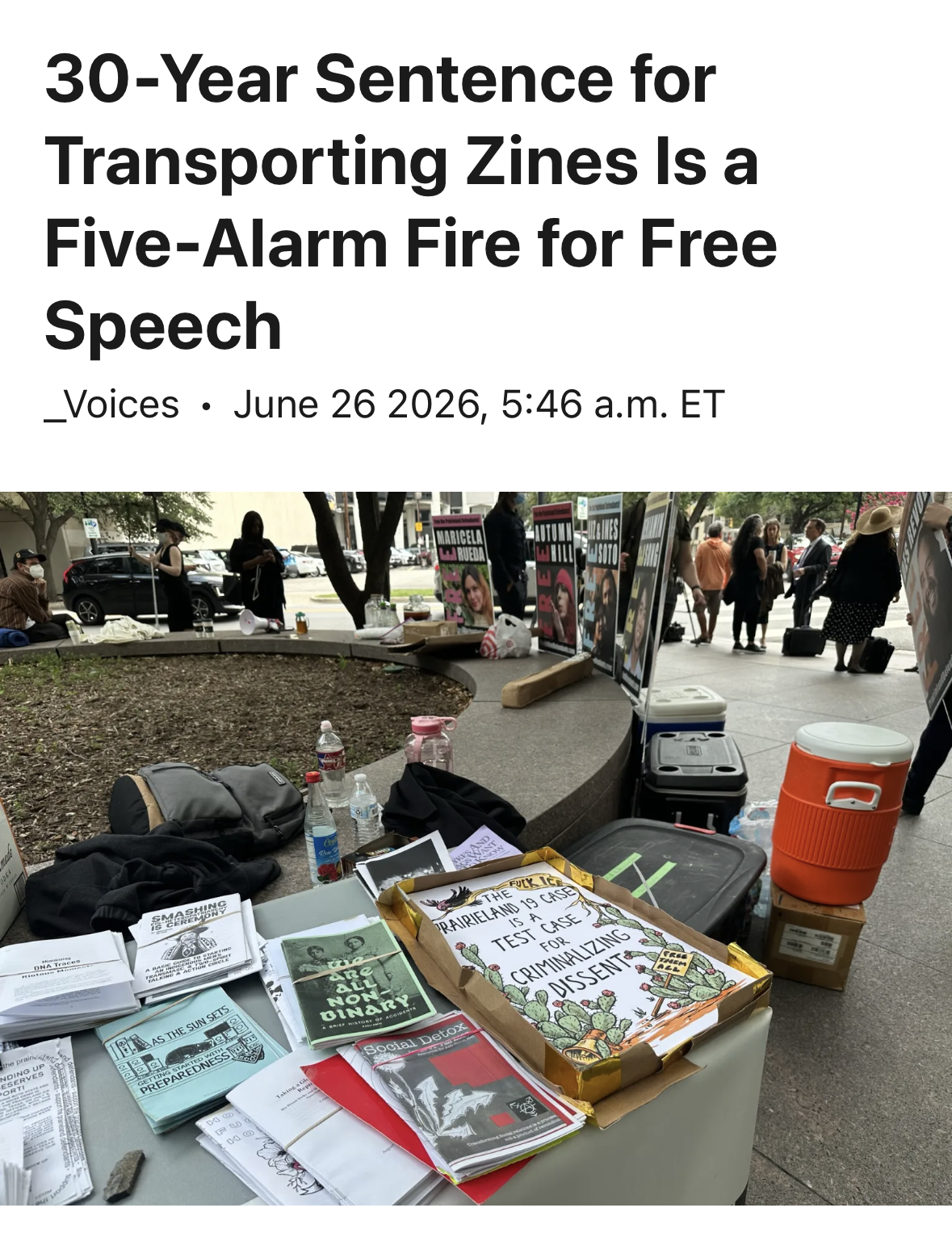
It was hard to find urgent headlines like the Intercept‘s (6/26/26) in corporate media after Prairieland protesters were sentenced to decades in prison.
“Thirty-Year Sentence for Transporting Zines Is a Five-Alarm Fire for Free Speech,” an Intercept headline (6/26/26) shouted days after a federal court sentenced eight anti-ICE protesters to a combined 450 years in prison.
The case stemmed from a July 4, 2025, protest outside the ICE Prairieland detention center in Alvarado, Texas. People had gathered for a noise demonstration to show their solidarity with the detainees inside, and one protester discharged his rifle after a police officer pulled his weapon, resulting in a minor injury to the officer.
Charges were brought against a total of 22 people from the Dallas/Fort Worth area in November 2025, after Trump signed an executive order declaring “antifa” a “terrorist organization,” and after the related National Security Presidential Memo 7 was issued declaring a wide swath of First Amendment-protected political views as “terrorist.”
Eight of the defendants were convicted in March and sentenced on June 23; another eight were sentenced in early July, four of whom became prosecution witnesses and received shorter sentences. This was the first successful government prosecution testing the claims of EO-18709 and NSPM-7 that previously protected views and protest activity are “terrorism.”
One of the defendants, Daniel Sanchez Estrada, was not even at the protest. He was, as the Intercept’s headline correctly reported, sentenced to 30 years because he moved a box of zines. “Five-alarm fire” seems an accurate assessment.
No alarm bells
Yet the extremely harsh sentences for Sanchez Estrada and the others did not set off any alarm bells among corporate media, and were underreported by national news outlets that should have covered their clearly national implications. The New York Times (6/23/26) published an online piece that ran on page A14 in print—two days later. The Wall Street Journal (6/23/26) ran an article both online and in print, while the Washington Post (6/23/26) gave the story web-only treatment.
Meanwhile, national broadcast media largely sat this story out. CBS and ABC took a pass altogether. NBC (6/23/26) ran a version of AP’s reporting on its website, as did CNN (6/23/26), but no original reporting and nothing on their flagship evening news shows. PBS NewsHour (6/24/26) ran an analysis piece (I use that term lightly) the next day; and NPR’s Morning Edition (6/24/26) gave it two minutes.
The coverage of the Prairieland sentencing was similar, in both content and quantity, to the reporting on the case overall. The verdict in March garnered a single article from several national news outlets, but the trial itself was barely covered. An NPR Up First piece (2/17/26) reported on it when it started; the New York Times (2/24/26) ran a piece at the start of the second trial, after the mistrial; the Washington Post (3/5/26) reported on the trial once halfway through.
By comparison, the New York Times alone ran 153 pieces on Kyle Rittenhouse, the white supremacist who shot and killed two people during a Black Lives Matter protest in Kenosha, Wisconsin, during the month of his trial in November 2021, a Nexis search revealed. Given the enormous stakes in the Prairieland case—NPR (2/17/26) accurately said “it could have nationwide implications for how left-wing movements are prosecuted”—the relative lack of coverage itself may well have implications for how left-wing movements are prosecuted.
But corporate media’s disinterest in the case is just the beginning of the problems. (There’s so much to cover on this that we’re not gonna have time for the mistrial, but the National Lawyers Guild can catch you up on that.) This piece will focus on the coverage of the June 23 sentencing as representative of the overall national reporting. (It does not look at local coverage.) If anything, the draconian prison terms should have made that coverage more skeptical than the previous coverage, but it did not.
‘Taking part in an armed assault’
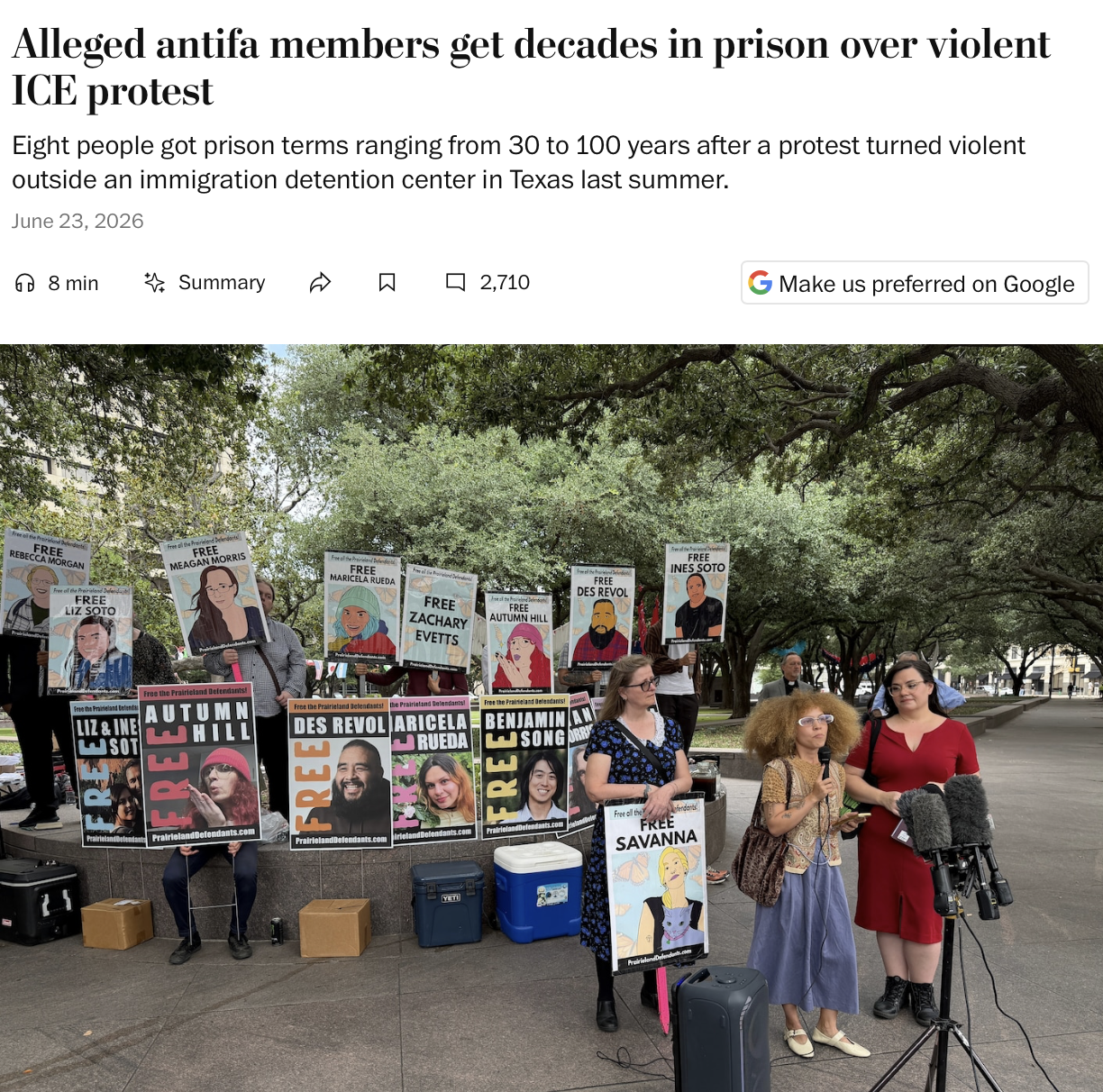
The Washington Post‘s (6/23/26) headline, in contrast, highlighted what the Trump administration wanted the public to believe: that the protesters were “antifa” and “violent.”
With the exception of PBS, every other national outlet covering the June sentencing framed the central and salient nature of the protest on July 4, 2025, as violence. The New York Times lead (6/23/26) said a jury had found the protesters “guilty of supporting terrorism while taking part in an armed assault.” The Wall Street Journal lead (6/23/26) said protesters were “accused of carrying out an attack on a Texas ICE facility.”
The Washington Post headline (6/23/26) characterized the demonstration as a “violent ICE protest.” The AP story (6/23/26) framed the event as “immigration center shooting and protest” (note the order), while NPR’s headline (6/24/26) described it simply as an “immigration center shooting.”
What actually happened that night was that protesters set off fireworks as planned for their noise demonstration, and the evening was peaceful at first. Some protesters then engaged in property damage, including graffiti and slashed tires. When a police officer drew his gun and pointed it at the protesters, one of them, Benjamin Song, fired “suppressive shots,” aiming his rifle at the ground, in what he claims was self-defense. The bullet that struck the police officer “showed signs of impact with a hard surface,” as In These Times (3/26/26) reported, suggesting that it ricocheted off the ground. None of the national news stories on the sentencing included this information.
In the wake of the killings of Renee Good and Alex Pretti in Minneapolis, Song’s fear certainly seems plausible, but the judge in the case had barred the defense from arguing a self-defense claim. That fact was mentioned in only one outlet, NPR (6/24/26), and without any context. And no one mentioned that Kyle Rittenhouse—who actually killed two people—was acquitted on self-defense grounds. Song’s conviction on attempted murder charges would be laughable if it weren’t so horrible.
To describe these events as “an armed assault” is at best a wild exaggeration, and at worst a deliberate mischaracterization. Between the uncritical adoption of the government’s framing of the protest as violent and the omission of so much evidence that contradicts that claim, national reporting on the sentencing missed the actual story almost entirely: that a group of people opposed to the government’s ethnic cleansing policies were given decades-long prison terms for their political views and the exercise of their First Amendment right to protest.
PBS (6/24/26) stands out as the only outlet to have framed the story this way, leading with the headline, “Anti-ICE Protesters Sentenced to Decades in Prison in Latest Crackdown on Dissent.” It interviewed George University Law Center professor Paul Butler, who said, “The concern is, when people are labeled terrorists based on their political views, that chills free speech”—an understatement.
Neither NPR nor the Wall Street Journal managed to even mention the First Amendment, and the Washington Post’s only mention of it (6/23/26) was in a quote from a federal prosecutor who said the protesters’ actions were “a far cry from a peaceful protest or First Amendment expression.”
‘Convicted on terrorism charges’
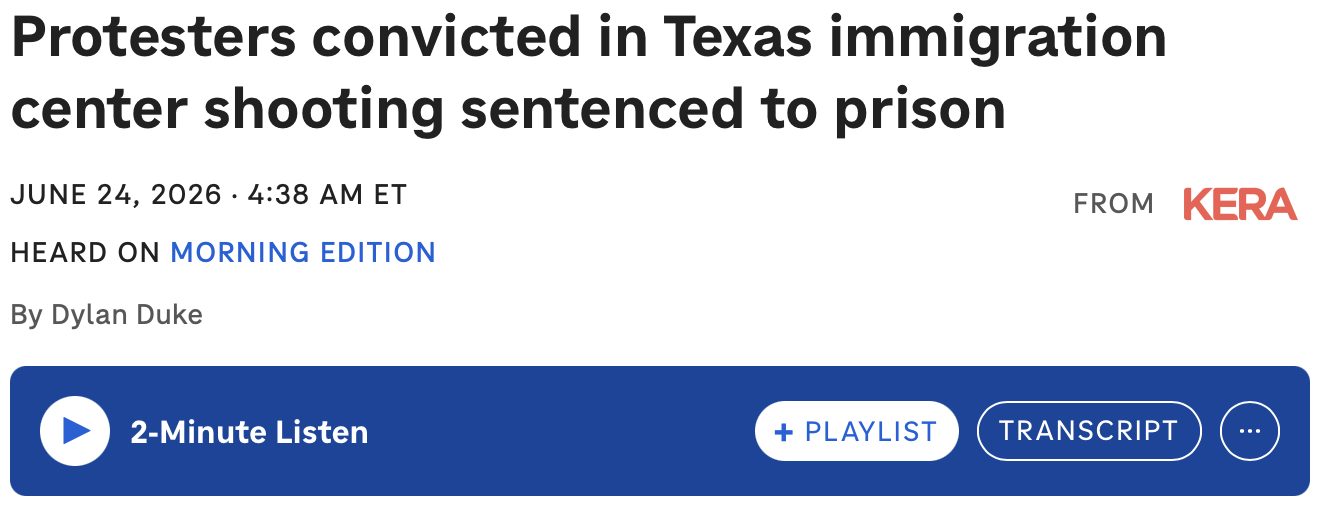
NPR‘s Morning Edition (6/24/26) told listeners the protesters faced “terrorism charges”; it didn’t mention the First Amendment.
National news stories also failed to interrogate the central claim by the government that the protesters’ action amounted to terrorism, and none explained the charge of “material support for terrorism,” the central charge all but Sanchez Estrada were convicted on.
Several outlets simply conflated “terrorism” and “material support for terrorism,” though the two are legally and substantively distinct. New York Times (6/23/26): “Six of the defendants who were convicted of terrorism charges…which was the first time terrorism charges had been brought against purported members of antifa.” NPR (6/24/26): “The group faced terrorism charges.” AP (6/23/26): “All but one of the eight defendants sentenced Tuesday were convicted on terrorism charges.”
By casually and inaccurately turning the protesters’ convictions into “terrorism” convictions, these outlets further reinforced the government’s narrative of violence and subversive threat.
The actual charge, material support, rests on that “support” being linked to an identified terrorist organization, and the novelty and grave danger of the Prairieland case was precisely in linking the defendants’ banal activities that allegedly prove their membership in “antifa”—wearing black, being part of a book club that reads anarchist books, having left-wing literature in their possession—to a made-up domestic terrorist organization called “antifa.”
Most of the national reports on the sentencing mention Trump’s executive order designating “antifa” a “domestic terrorist organization,” and a few point out in a half sentence that there is no provision under US law for such a thing as a domestic terrorist organization (New York Times, 6/23/26; PBS, 6/24/26; AP, 6/23/26). But none spell out the alarming precedent being set here by a court legitimizing a legal category that literally does not exist in US law.
(The Brennan Center has an excellent primer on the executive order and NSPM-7 that presciently points out “extending the foreign material support for terrorism regime [to domestic organizations] would allow the government to formally assign the label to domestic groups with unpopular beliefs and prosecute anyone who supports them.”)
‘A decentralized movement’
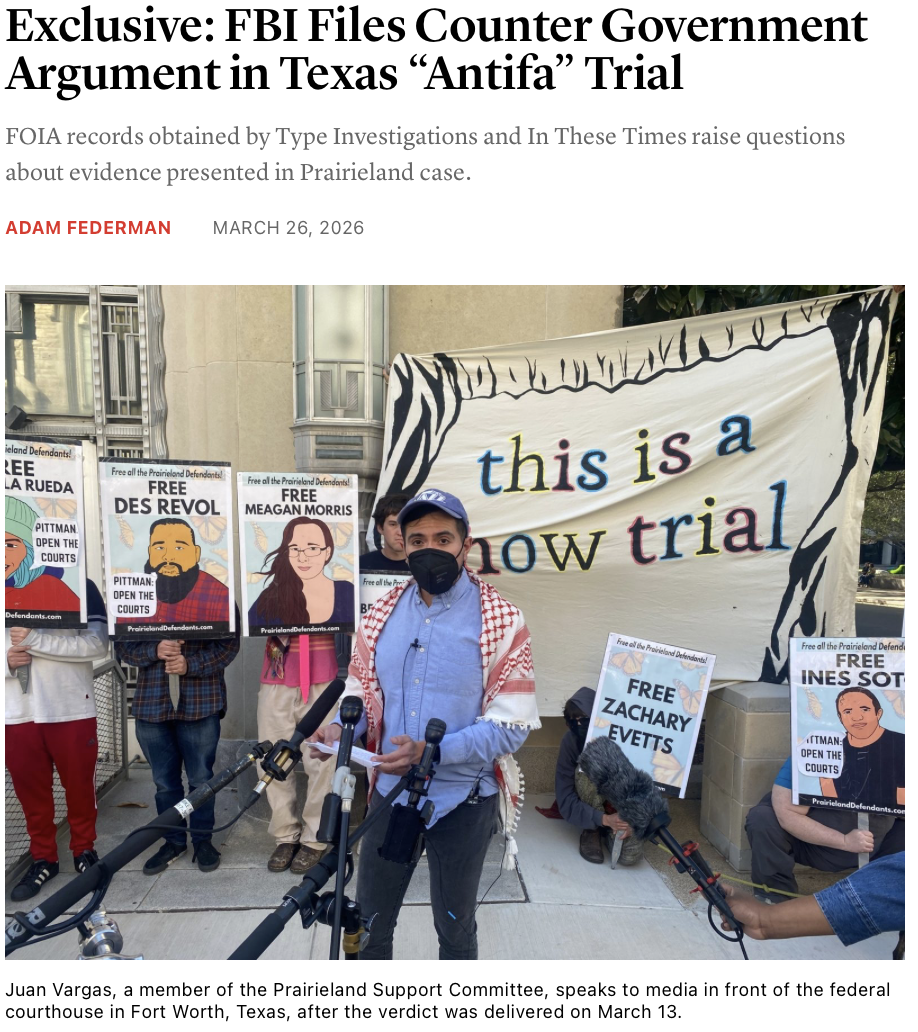
A FOIA request by Type Investigations and In These Times (3/26/26) found that an FBI investigation into “antifa” in North Texas under Trump 1.0 was closed in 2018 because “no potential criminal violations or priority threats to national security warranting further investigation were identified.” The prosecution did not disclose this information before or during the trial, as obligated by law.
All this brings us, of course, to “antifa.” All the news pieces found a way to counter the government’s fiction that antifa is an organization, variously describing it as “an umbrella term” (AP, 6/23/26), “a decentralized movement” (PBS, 6/24/26), an “ideology, not a centralized organization” (NPR, 6/24/26 ), “a loose network” (Wall Street Journal, 6/23/26), a “loosely knit movement” (Washington Post, 6/23/26) and a “movement [with] no central structure or formal membership” (New York Times, 6/23/26). A few reminded readers that “antifa” is short for anti-fascism.
But every single one of them also characterized it as “far left.” Has opposition to fascism really been defenestrated from the Overton Window? Or are corporate (and semi-corporate public) media contributing to the delegitimation of “antifa,” even as they recognize it is not exactly what Donald Trump declares it to be?
More fundamentally, “antifa” isn’t really any of those things the media say it is, either—a network, a movement, an ideology. It is a right-wing boogeyman constructed precisely for the purpose it is now being deployed to fulfill.
There are a handful of organizations in the US that explicitly identify as antifa, but the overwhelming majority of US leftists never used the term before the contemporary right, abetted by the media, put it on the map. At which point, most of us reacted with: “Antifa” isn’t a thing, but yes, I am proudly anti-fascist.
By leaving out the deliberate right-wing creation of “antifa,” while characterizing it as “far left,” media are contributing to the government narrative that “antifa” is a real and dangerous thing. This helps legitimize the legal fiction that is being used to criminalize dissent.
That a government with strong fascistic tendencies is going to smear its opponents as dangerous and violent is a given at this point. That a court will wholeheartedly follow them down the path of creating legal fictions in order to prosecute those opponents is an alarming development. But that a national press corps is so cowed by government cries of “terrorism!” that they fail to interrogate those legal fictions is a danger to the very freedoms they purport to embody.
From FAIR via This RSS Feed.