

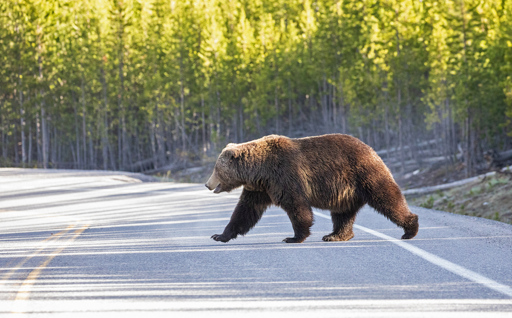
BRITISH COLUMBIA, Canada — On a sunny Thursday in May, Kent Kebe had to scrape yet another bighorn sheep carcass off Highway 93/95 running through Radium, British Columbia. The necropsy confirmed what Kebe, the village’s protective service manager, already knew: A car collision killed the ram. Roadkill deaths hit this community hard. Residents love their sheep so much that the village center sports a huge steel sculpture of sheep horns that stands roughly 12-meters- (39-foot-) wide and 6-meters- (19-feet-) tall. The Big Horn Cafe on the main drag features artwork of bighorn rams and serves custom-blended “Headbanger tea.” In the 1990s, about 350 bighorn sheep (Ovis canadensis) milled around, drawn to the golf course and the grasses along the highway. “It’s like a candy store for them,” Kebe says. But by 2022, the herd’s numbers had dwindled to 140. While some sheep died from natural causes, vehicle collisions played a big role in the death toll. “There’s a tension where the sheep are the mascots of the village, but the traffic is killing them,” says wildlife scientist Clayton Lamb, who works with the nonprofit Biodiversity Pathways and the University of British Columbia. He helped bring attention to the issue in 2022. Habitat loss is a major threat to species, but highways, railways and towns impact how animals move to eat, meet and mate — and that can endanger their survival. A 2025 review in the journal Science warned that while the world aims to protect 30% of the planet by…This article was originally published on Mongabay
From Conservation news via This RSS Feed.