

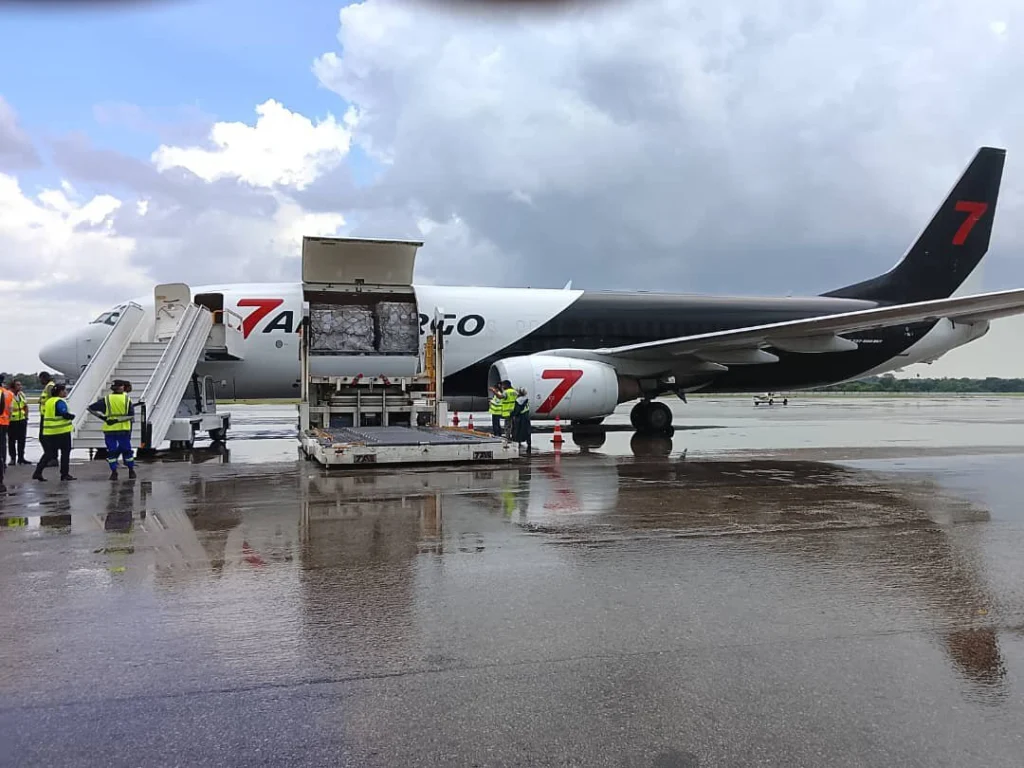
The first shipment of the $100 million U.S. aid package arrived in Cuba on Tuesday, consisting of 18 tons of food and hygiene kits, as Cuban officials denounced Washington’s intensified six-decade blockade and questioned the assistance’s funding and distribution mechanisms.
The cargo, which departed from Miami International Airport, includes 700 modules containing rice, beans, cooking oil, hygiene items, medical equipment, and lanterns. Caritas Havana will distribute these through local parishes in the municipalities of Alquízar and Bejucal, located in the western provinces of Artemisa and Mayabeque respectively.
RELATED: Cuba Cancels Premium Habano Festival Amid Tightening U.S. Oil Blockade
U.S. Under Secretary of State for Foreign Assistance, Humanitarian Affairs, and Religious Freedom Jeremy Lewin stated before the departure that the plan aims to reach 196,000 families through air and sea shipments. The delivery responds to the commitment announced last May by U.S. Secretary of State Marco Rubio, which was not officially communicated to Cuban authorities—whom the State Department insists on not recognizing.
Cuban Foreign Minister Bruno Rodríguez Parrilla at the time called the initial announcement a “fable” and questioned the funding and distribution mechanisms. He also denounced that Washington attempted to block the approval of a $116 million food aid program for Cuba from the World Food Programme (WFP).
The assistance adds to support provided after Hurricane Melissa a year ago and to the $3 million package promised last October. Cuban Deputy Foreign Minister Carlos Fernández de Cossío confirmed the prior receipt of 2.5 million of that amount in food and hygiene bags.
Catholic Relief Services (CRS) and Caritas are handling distribution logistics on Cuban territory. CRS president Sean Callahan and U.S. officials indicated they plan to make shipments on an almost weekly basis starting next year, though the parties did not specify the date of the next cargo.
Cuba no se opone a la ayuda siempre que beneficie al pueblo y no se utilicen sus necesidades para lucrar políticamente; la acepta como un gesto del pueblo estadounidense sustenta, que con sus contribuciones, los fondos públicos que utiliza su gobierno. #mincex @polivaoscar pic.twitter.com/k9vzjMfXKo
— MINCEX
(@MINCEX_CUBA) July 21, 2026
According to figures presented by Rodríguez during a recent UN General Assembly session, economic damages caused by the blockade between March 2025 and February 2026 amounted to $8.103 billion at current prices—a seven percent increase over the previous period—raising the accumulated impact to $178.7 billion.
New U.S. sanctions imposed this year have limited Cuba’s capacity to acquire fuel, prompting an energy crisis that causes constant blackouts throughout the island
From teleSUR English via This RSS Feed.