

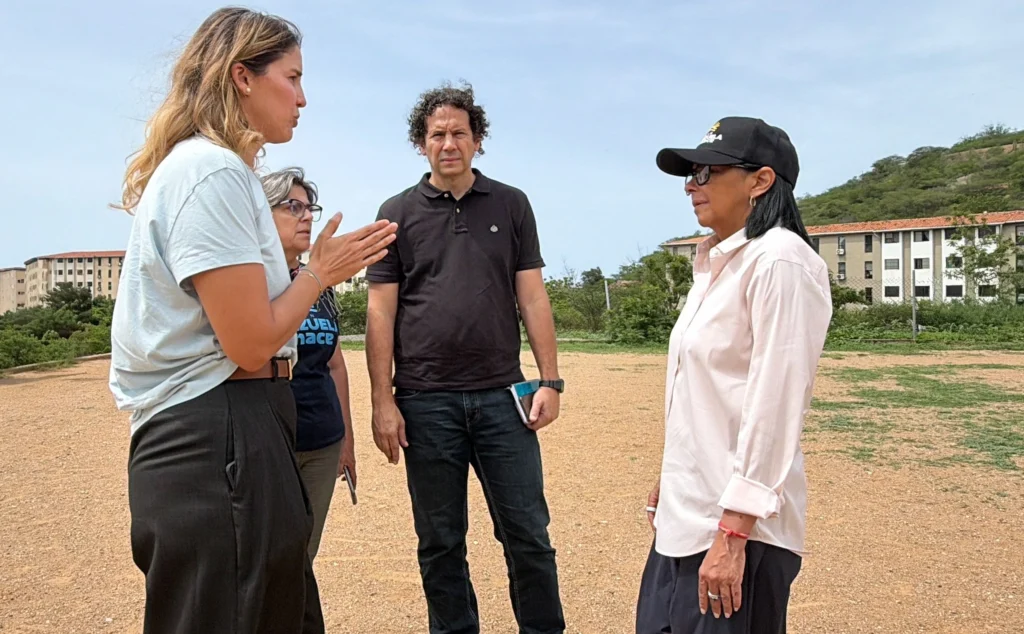
The Venezuela’s government is making progress in geological verification of more than 40 properties covering 584,000 square meters in La Guaira, space intended for the construction of more than 25,000 housing solutions under anti-seismic standards.
Venezuelan Acting President Delcy Rodriguez led this Tuesday a technical inspection of land in La Guaira state, with the aim of assessing and certifying plots suitable for the development of safe housing projects.
Meanwhile the Venezuelan state advances in the completion of buildings and in the implementation of other immediate solutions for families who remain in temporary camps after the double earthquake.
RELATED: Venezuela Delivers First 240 Homes to Earthquake-displaced Families
Acting President Delcy Rodriguez detailed inspections of unfinished works across Caracas and other states as part of “Venezuela Rises” Plan, aiming to complete over 10,000 recovered homes by 2027 and reform rental laws after the devastating June 24 earthquake doublet that left 5,346 people dead and 16,740 injured.
Rodriguez confirmed that inspections of unfinished construction works are already underway across multiple states, as part of a comprehensive rebuilding strategy. The effort will be complemented by the acquisition of properties in the secondary real estate market, alongside a reform of the rental law and real estate guarantee mechanisms to expand housing supply for affected families.
Ver esta publicación en Instagram
Una publicación compartida de teleSUR English (@telesurenglish)
As part of the reconstruction process, detailed mapping campaigns and soil studies have been deployed in La Guaira state, which tasks aim to organize the transfer of people affected by earthquakes, assess the risks associated with earthquakes, torrential avalanches and select safe land for housing.
“We have just visited several plots in the state of La Guaira, where preliminary studies show that housing can be built there,” Acting President Delcy Rodriguez reported, highlighting the progress of field assessments in the coastal entity.
Reconstruction Plan
The twin seismic shocks -a magnitude 7.2 foreshock followed 39 seconds later by a magnitude 7.5 mainshock- caused widespread destruction across north-central Venezuela, with La Guaira state suffering 80% of its buildings collapsed.
More than 128,324 families have received comprehensive humanitarian attention, while 107 transitional camps are currently housing 23,587 displaced persons across the affected zones.
The reconstruction effort is being coordinated through the “Venezuela Rises” Plan and the General Staff for Camps and Housing, two inter-institutional mechanisms designed to centralize response and accelerate recovery. Acting President Rodriguez emphasized that the housing strategy goes beyond emergency shelter, aiming at durable structural solutions that address both the immediate crisis and long-term urban planning gaps.
In this sense, the reform of the Rental and Real Estate Guarantees Law seeks to create legal incentives for property owners to offer housing in the rental market, increasing the stock available for families who lost their homes during the seismic event.
With nearly 130,000 families already receiving aid and more than 23,000 people still in temporary camps, the success of the housing plan will be a defining measure of the administration’s crisis management capacity in the wake of one of the deadliest natural disasters in Venezuelan history.
A Long Road Ahead
While the reconstruction target of 10,000 homes by 2027 represents a significant commitment, the scale of the destruction suggests the recovery process will extend well beyond that timeframe. Experts have pointed to the need for stricter building codes, seismic retrofitting of existing infrastructure, and a sustained investment in disaster preparedness to mitigate the impact of future seismic events on the nation’s densely populated coastal corridor.
“We continue to work tirelessly,” Rodriguez affirmed.
Rodriguez’s announcement signals the state’s intention to assume a leading role in rebuilding, combining direct public investment with regulatory reforms aimed at unlocking private sector participation in the housing market. Whether these measures will be sufficient to meet the needs of the affected population remains to be seen, but the plan marks the most concrete recovery roadmap presented since the earth shook Venezuela on that devastating June afternoon.
From teleSUR English via This RSS Feed.