

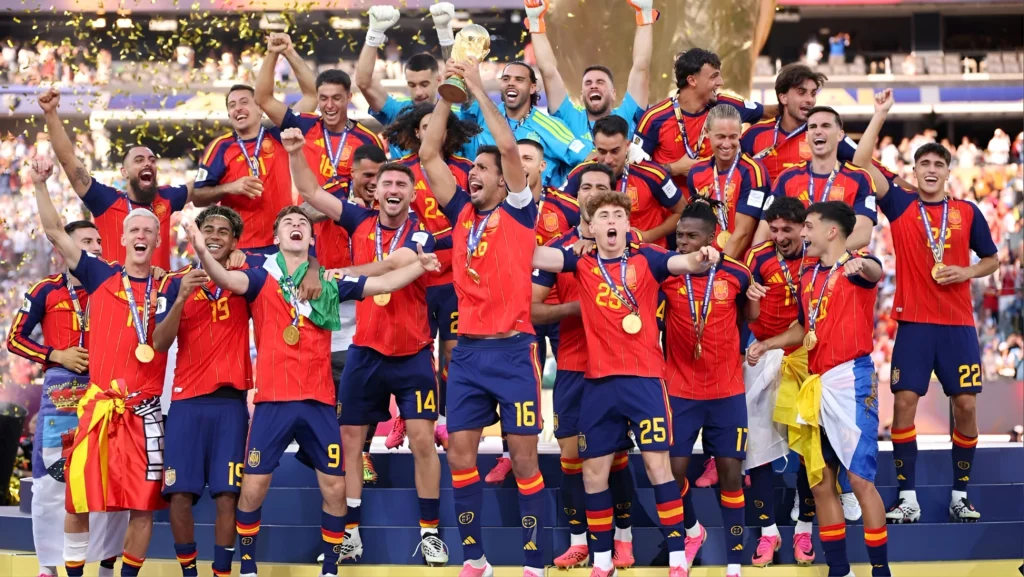
Community-rooted youth development, working-class migration, and democratic club ownership provided the blueprint for victory on football’s biggest stage.
Spain’s national football team, “The Red” (La Roja), secured its second FIFA World Cup title in 2026, defeating Argentina 1–0 in extra time in New York. The victory capped a tournament marked by high-possession tactics, organized collective pressing, and youth integration.
RELATED:
Spain Champion of FIFA World Cup 2026
Beyond the immediate athletic achievement, the Spain team’s composition and path provided a clear case of how sports intersect with broader socio-economic conditions, migration patterns, and labor structures in contemporary Europe.
The 2026 Spanish squad reflected the historical demographic and structural shifts in the country. In a period characterized by intense public debate over immigration policies, working-class integration, and regional identity across Southern Europe, “The Red” operated as a practical demonstration of multicultural cohesion and shared labor.
The Working-Class and Immigrant Core
Spain’s primary offensive engine in the 2026 team featured two wingers whose family backgrounds directly connect to migration routes and working-class neighborhoods: Lamine Yamal and Nico Williams.
Lamine Yamal was born in Esplugues de Llobregat, Spain, to an Equatorial Guinean mother and a Moroccan father, and raised in Rocafonda, a working-class neighborhood in Mataró, Catalonia. At 19 years old, Yamal became the third-youngest player to win a World Cup.
Tournament statistics show that Yamal finished as the top individual dribbler in the 2026 World Cup, recording 35 completed take-ons and generating 22 direct scoring chances. A representative gesture that uses Yamal, with his hands, to celebrate his goals, is forming the digits ” 304 “, the last three numbers of Rocafonda’s postal code (08304).
Another star dribbler is Nico Williams. Born in Pamplona, Spain, to Ghanaian parents who migrated to Spain after crossing the Sahara Desert and entering the country through Melilla. Williams developed through Athletic Club Bilbao, a club renowned for its policy of deploying players developed in the Basque Country and operating under a socio-based, member-owned governance structure.
In the 2026 World Cup final, Williams provided the assist for Ferran Torres’s winning goal in the 108th minute. Over the course of the tournament, Williams logged 114 minutes, completed 28 progressive carries, and maintained an 89% pass completion rate.
The inclusion and prominence of Yamal and Williams challenge prevailing anti-immigrant political discourses in Europe by presenting concrete data on how social integration directly contributes to collective achievement.
Champions.#FIFAWorldCup pic.twitter.com/h7BTVx8R6A
— FIFA World Cup (@FIFAWorldCup) July 19, 2026
The Anchors of Collective Labor
While the attacking flanks attracted global attention, Spain’s structural integrity was sustained by a central core that prioritized positional discipline, ball retention, and defensive coverage.
Midfielder Rodri Hernández and central defender Pau Cubarsí served as the primary anchors of this collective system, demonstrating how specialized, disciplined roles form the backbone of modern team dynamics.
Rodri Hernández, born in Madrid, functioned as the tactical centerpiece of The Red. Recognized as the tournament’s Golden Ball winner, Rodri completed a tournament-high 756 passes with a 93.2% accuracy rate across seven matches. His role extended beyond distribution; he recorded 48 ball recoveries and won 68% of his ground duels.
Hernandez’s methodical playing style reflects an emphasis on structural balance rather than individual spectacle, anchoring the team’s transition defense and dictating the tempo of play.
Alongside Rodri, 19-year-old Pau Cubarsí established himself as a central figure in Spain’s defensive line. Raised in Estanyol, a small rural village in Girona, Catalonia, Cubarsí developed through FC Barcelona’s youth academy, La Masia.
Awarded the World Cup Best Young Player, Cubarsí logged 750 minutes during the tournament, completing 668 passes and committing four fouls. His ability to initiate buildup play from the back line allowed Spain to break opposition presses without relying on long, uncoordinated clearances.
The performances of Rodri and Cubarsí highlight Spain’s defensive stability and possession metrics, built on precise positioning, shared workload, and disciplined spatial awareness.
The Squad Beyond “The Galactics”
The structural strategy of head coach Luis de la Fuente featured a notable departure from traditional Spanish national team selections. For the 2026 World Cup roster, De la Fuente did not select Real Madrid players (The Galactic) in his initial starting lineups, relying on talent developed at FC Barcelona and regional clubs such as Athletic Club, Real Sociedad, FC Barcelona, and CA Osasuna.
This selection model shifted the national team’s core away from the commercial “The Galactic” framework, toward players trained in domestic academies focused on collective tactical development.
Goalkeeper Unai Simón, a product of Athletic Club’s Lezama academy in the Basque Country, set a World Cup record by recording 7 clean sheets and maintaining 650 consecutive minutes without conceding a goal.
Forward Mikel Oyarzabal, developed at Real Sociedad, led the tournament in high-intensity defensive pressures (58 forced turnovers) while tying Spain’s individual World Cup scoring record with 5 goals.
The success of this squad composition demonstrates that elite international performance can be achieved without relying on hyper-capitalized super-clubs.
Lamine Yamal’s name carried a story long before it was known across the football world.
Before he was born on 13 July 2007, his parents were going through a difficult financial period. His mother, Sheila Ebana, was only 16 when she gave birth, while his father, Mounir Nasraoui,… pic.twitter.com/CH8DeJANbE
— Wolf of X (@WolfofX) July 20, 2026
Public Infrastructure vs. Financialized Football
The structural foundation of Spain’s 2026 World Cup success highlights a contrast between public, member-driven sports infrastructure and the private financialization defining top-tier European football.
While multi-club ownership groups and private equity firms increasingly acquire European clubs to trade player registrations, Spain’s tactical core relies on community-rooted academies operating as long-term training centers.
Facilities like FC Barcelona’s La Masia and Athletic Club’s Lezama operate within member-owned (socio) frameworks rather than private corporate ownership models.
Athletic Club, for instance, reinvests roughly 10% of its total annual operating budget directly into its Lezama youth development network. This continuous investment funds local youth scouting across 160 regional partner clubs, full residential services, and comprehensive educational support.
The statistical output of the 2026 national team reflects this structural stability. Spain led the tournament with an average of 60,2% ball possession, completing 774 passes in the final against Argentina.
Rather than relying on individual physical isolation plays, The Red’s side maintained strict spatial organization, rapid ball circulation, and immediate counter-pressing upon turnover.
These technical principles are taught uniformly across Spanish regional academies from early youth levels, enabling seamless tactical integration when players transition to the senior national team.
Nico Williams won a World Cup. And he gave the medal to his mom. Because she raised him to be a champion on and off the pitch.
pic.twitter.com/vl7Z0k9ba7
— RATEL EMPIRE (@Ratelsempire) July 20, 2026


A Blueprint for Counter-Hegemonic Sport
Spain’s victory at the 2026 FIFA World Cup demonstrated that international competitive success can be achieved through collective tactical discipline, structured public and regional academy funding, and the social integration of diverse working-class communities.
The visibility of players like Lamine Yamal and Nico Williams, representing working-class urban neighborhoods and second-generation immigrant families, provides a practical counter-narrative to xenophobic political rhetoric in Europe.
By rejecting commercialized club models in favor of homegrown talent developed through member-owned institutions, Spain provided a blueprint for collective labor on the pitch.
The 2026 The Red demonstrated that when access to elite athletic development is democratic and rooted in community investment, sports can function as a platform for shared achievement and popular unity.
Sources: teleSUR – Al Jazeera – BBC – The Guardian – El País – El Salto Diario – La Base – Marca – FIFA Official Page
From teleSUR English via This RSS Feed.