

Nearly a month after the US Supreme Court overturned almost a century of precedent to give President Donald Trump king-like power to purge independent agencies, consumer groups on Tuesday sounded the alarm over his nominees to the Consumer Product Safety Commission.
Before the high court’s recent ruling, Trump last year fired the three Democratic commissioners appointed by his predecessor—hamstringing the CPSC, which needs at least three members to conduct official business, but currently only has acting Chair Peter Feldman.
Trump nominated Karen Sessions as a commissioner in February and Brien Lorenze, the agency’s executive director, in early June. Later last month, the GOP-controlled Senate began considering the nominees, but has not yet confirmed them.
In a Tuesday letter to Sens. Ted Cruz (R-Texas) and Maria Cantwell (D-Wash.)—respectively, the chair and ranking member of the Senate Committee on Commerce, Science, and Transportation—dozens of consumer groups detailed their concerns.
Led by the Consumer Federation of America and National Consumers League, the coalition urged the senators “to protect the independence and nonpartisanship” of “the nation’s chief household product safety regulator,” stressing that “hazards have no partisan leanings, and neither should the commission tasked with addressing them.”
The letter highlights that the agency, created by Congress over five decades ago, cannot have more than three commissioners affiliated with the same political party, and the law bars all of them “from owning stock or bonds of substantial value in a company that sells or manufactures consumer products, or from being in ‘any other manner pecuniarily interested in such a person.’”
“Historically, the agency’s independence has buffered the commissioners from political pressure from the White House and large donors. This has ensured that the agency has acted with transparency and a diversity of views, which has benefited the American people,” the groups wrote. “Further, the presence of minority commissioners provided a layer of oversight and accountability on CPSC actions.”
“With this independent and nonpartisan structure, the CPSC has had a lifesaving effect,” the coalition emphasized, pointing to drops in residential fires, child poisonings, bicycle and pool injuries, and deaths from cribs, garage door incidents, and refrigerator entrapments.
The organizations stressed their concern that Trump ousted “the three Democratic, Senate-confirmed CPSC commissioners” without cause, and then “nominated two individuals of his own political party, threatening to further undermine the independence and nonpartisanship of the CPSC.”
“Silencing the voices of subject matter experts with whom the president politically disagrees or who may not serve his financial interests can have a chilling effect on the CPSC’s functions,” they argued. “The president’s assertion of control over CPSC commissioners has eliminated the transparency provided by minority commissioners and the independence of those who remain.”
“This is particularly troublesome given the conflict of interest created by the president’s financial stake and those of his family and supporters in consumer products the CPSC is entrusted to regulate,” the groups noted.
Specifically, as the letter lays out:
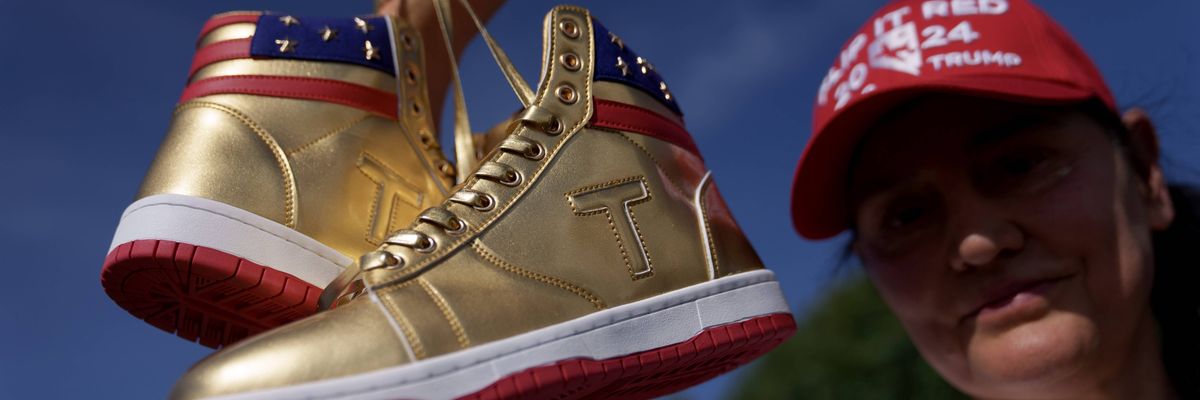
President Trump financially benefits from the distribution of a vast array of consumer products, including Trump Watches, Trump Sneakers, and “45” Guitars. The president also has substantial financial interests in major manufacturers, retailers, and online marketplaces, including Whirlpool Corp., Newell Rubbermaid, Macy’s Retail Holdings, and Amazon.com Inc. The Trump Organization, helmed by Donald Trump Jr. and Eric Trump, sells a wide variety of consumer products, including toys and children’s products; apparel, footwear, and accessories; sporting goods; pet products; and household goods such as drinkware, kitchenware, linens, candles, and home décor. First Lady Melania Trump, through MelaniaTrump.com, is associated with the sales of jewelry and Christmas ornaments. Lara Trump and Kai Trump sell apparel through their respective online stores. Secretary of Education Linda McMahon maintains a significant financial stake in TKO Group Holdings, which has lucrative licensing deals for World Wrestling Entertainment toys, apparel, and accessories. Mike Lindell, a prominent supporter of the president, is the founder of MyPillow, which sells bedding and apparel. Former special government employee Elon Musk profits from sales of Tesla’s Powerwall systems and the Tesla Cyberquad for children. Political ally and Ultimate Fighting Championship (UFC) CEO Dana White profits from UFC’s sale of apparel, combat-sport equipment, and collectibles.
“These extensive financial and familial interests heighten concerns that the president could use his authority to influence CPSC enforcement decisions in ways that protect his and his associates’ interests, as the administration has done in matters before other federal agencies,” the letter warns, citing various actions involving the US Department of Justice and Securities and Exchange Commission.
In addition to those actions—from the attempt to create an “Anti-Weaponization Fund” to pay off Trump allies, to dropping investigations into his backers—the president has blatantly cashed in on his return to the White House, pocketing at least $2.2 billion, according to recently released annual financial disclosures.
“We are concerned that without balanced representation at the CPSC, this small agency with a big mission will be unable to independently carry out its congressionally mandated duties and provide the public with the transparency it deserves,” the coalition told Cruz and Cantwell. “The CPSC is no place for political favoritism. We therefore urge you to oppose reporting favorably the nominations of Brien Lorenze and Karen Sessions to serve as CPSC commissioners.”
From Common Dreams via This RSS Feed.