

When you enter La Guaira, not far from Caracas, and look toward Venezuela’s main port, you see U.S. warships, their radars working at full capacity, and entire columns of marines on the march. The country’s main airport, in Maiquetía, is in the hands of U.S. military personnel and Venezuelan staff. In reality, the Americans command and the Venezuelans obey. Overall, La Guaira is under imperialist military occupation.
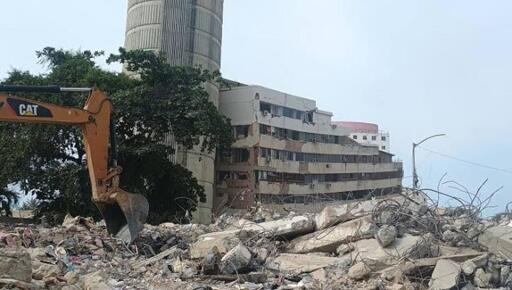
Meanwhile, following the devastating double earthquake on June 24, families continue to clear paths and move rubble in an attempt to rescue survivors, or at least recover bodies. The official death toll as of July 11 stands at nearly 4,400, but the number of missing remains unclear. It is certain that several thousand more deaths will be added to the initial count.
The work continues to be carried out, in most cases, by the families themselves, with makeshift tools and little state support. According to official figures there are 28,362 volunteers. Families with money have been able to buy construction equipment, but the majority continue to desperately plead for help, while rejection of the state’s actions is widespread: both for what it failed to do in the early days and for what it still fails to do today.
Meanwhile, the social crisis is worsening, both for the families directly affected — in addition to the deaths, 16,740 are injured, nearly 856 buildings are damaged, not counting those that have collapsed, and nearly 18,000 people now have nowhere to live — and for workers in general, with rampant inflation and the dollar becoming more expensive every day.
At the same time, the 180 days allowed by the constitution for an interim presidency have expired. It was under this arrangement that Trump, Rubio, and the Chavista leaders of the government that remained in Caracas after the imperialist attack of January 3 had agreed to give a veneer of “formality” to the neo-colonial tutelage regime that had been established. The mere fact that Delcy remains in the government would already constitute a violation of constitutional provisions. Adding insult to injury, some sectors of the right-wing opposition are demanding new elections, as if the imperialist attack were enshrined in an article of the national constitution! For a long time now, the struggle for power in the country has ceased to be resolved through the channels of bourgeois legality itself, and has instead been openly defined by coups, particularly by American bombs.
What is certain is that there is widespread social discontent with the government and its lack of legitimacy among the population. María Corina Machado, aware of this, insists on returning to the country: “Now is the time,” she says. Trump disagrees; for the moment, he prefers to maintain the protectorate with Delcy Rodriguez.
But is it possible that after the mourning period, the social crisis will transform into a political one? If so, will imperialism resort to María Corina Machado as a Plan B to continue its national subjugation? Will it continue to support its current loyal allies, or will it take a chance on an “outsider” like Lorenzo Mendoza, the powerful Venezuelan businessman and owner of the Polar agribusiness group? And what about the working class, the impoverished people? Where do we stand in all of this? How can we avoid becoming prisoners of this power struggle in the upper echelons, which has nothing to do with our own interests?
The government responds to the country’s needs with force of arms
The indignation towards the national government is more than justified: it responded late and poorly, attempting to impose its bureaucratic, authoritarian, and often ineffective control over what people themselves were already trying to resolve. According to a recent survey, 6 out of 10 people directly or indirectly affected by the earthquakes judged the government’s response to be poor (8.3 percent) or very poor (52.4 percent); only 2 out of 10 approved of its handling of the situation.
However, one key player emerges almost unscathed from the public outrage over the tragedy: the United States government. The discontent is focused almost entirely on those in power from Miraflores, the Venezuelan presidential palace… But don’t those in Miraflores receive their orders from the White House? Delcy Rodríguez’s government is essentially a puppet state, subordinate to the imperial dictates of the United States. Why shouldn’t the United States bear some responsibility for the situation?
Indeed, one could ask the United States a question similar to the one angrily asked about Venezuelan National Guard: They sent more marines than shovels, more soldiers than rescuers! According to reports, 250 rescue experts arrived, while at least 900 marines were deployed; some reports even indicated a higher number.
Marco Rubio, the very man to whom the Delcy government must pay a monthly budget to authorize the release of our own money — the country’s money — promised “big, fast, and effective” aid. But where they have proven most significant and effective is in their military deployment on national soil. While relatives and volunteers work tirelessly to clear away the concrete to find people and meet the urgent needs of survivors, the American military has quickly established far more than a simple foothold in our country; all in collusion with the Venezuelan government.
Oil and the economic embargo: the responsibilities of American imperialism
But the responsibility of American imperialism goes back further and is more direct: it’s not simply a matter of demagoguery with promises of aid and exploiting misfortune to militarily occupy part of the country. Beyond the proven inability of those at the head of the Venezuelan state to manage a situation like this, it is an objective fact that we are dealing with a state whose capacity to react is quite limited, and this results from local corruption, the transfer of oil revenues to private capital to facilitate capital flight, and long years of American aggression against the country’s economy.
It has been almost a decade since the first economic sanctions were imposed on the country in 2017; these sanctions intensified significantly starting in 2019, under the first presidency of the very man who now leads the country that exerts its influence over the Venezuelan government. These sanctions have included obstacles to oil sales, access to credit, and the acquisition of goods and raw materials; reprisals against those who traded with Venezuela; and a multitude of other barriers, including the direct confiscation of national resources abroad. All this before the January bombing, which resulted in the theft of several months’ worth of oil production that the country had been unable to export due to the U.S. naval blockade itself, and in the seizure of the majority of Venezuelan oil exports: it is to the United States that, for the past six months and to this day, payments for these sales have been arriving, of which the Trump government is only handing over a tiny part to the country.
How could all this banditry and imperialist plunder possibly have nothing to do with the country’s reduced capacity to respond to a crisis like the one caused by the earthquakes? How could there be no link between this and, for example, the lack of personnel, equipment, and tools in the fire departments and Civil Protection agencies?
It is true that today this responsibility is not clearly apparent to the country’s conscience; a considerable sector even expresses its confidence in the United States to lead a post-earthquake “reconstruction” process. This is another of the political responsibilities attributable to Chavismo and the way it ended: the depth of the Chavista government’s economic and repressive attacks against the working class and popular sectors facilitates the demagoguery and propaganda behind which imperialism conceals its responsibility for national calamities.
The reality is that, as can be seen in any conversation in the country, we Venezuelans do not consider ourselves better off than before the imperialist military incursion; even among many who, exasperated by the government and the endless crisis, applauded the aggression, one already hears: “It’s even worse than with Maduro,” which is saying something. The economy was growing, and it continues to do so, at the cost of an unprecedented deepening of social inequality. A small sector concentrates the wealth, expands its consumption, and the majority, week after week, survives. According to the Atlas & Bloomberg survey, only three out of ten Venezuelans consider their family’s economic situation to be good, eight out of ten say the country’s economic situation is bad, and six out of ten believe that in the future, the country’s economy will remain the same or worsen.
A government without popular support. Who supports it?
Maduro, lacking popular support, was propped up by internal repression; the Delcy Rodriguez government is likewise a government without a genuine base of support of its own, not relying on mass support. The country’s economic situation has led to a steady increase in disapproval of the government in recent months, and its handling of the tragedy has accelerated this process. In this regard, demonstrations of rejection are occurring daily; these are no longer isolated incidents, but numerous expressions that reveal an unbridled anger, even in the face of the presence of repressive forces, which more and more people are daring to defy.
However, the political regime in Venezuela changed after January 3: despite the cries of the traditional right wing claiming that “nothing has changed,” “the Chavista dictatorship continues,” etc., the political regime is the neocolonial regime imposed by the United States and local collaborators. The Venezuelan executive branch, parliament, and armed forces are subordinate to Washington; they pass laws demanded from the north, they follow the steps dictated by Trump and Rubio.
Numerous actions and decisions demonstrate U.S. support for the current government. When a U.S. official was questioned about the Venezuelan government’s potential mismanagement of the figures and the tragedy in general, he said the government was doing things right and that the numbers were being carefully managed. When an incident occurred in a street between Interior Minister Diosdado Cabello and one of the U.S. “volunteers,” the Trump administration downplayed the matter and claimed everything was cleared up. Those who, in their colonial mindset, yearn for the U.S. military to also detain Diosdado are irritated and demand an explanation as to why, on the contrary, John Barrett and high-ranking U.S. officials are meeting cordially with him (especially given that a U.S. reward for Diosdado’s capture is still in effect).
The most recent disillusionment for those who place all their hope for a change of government in imperialist decisions was Trump’s declaration in which he explicitly stated that no elections are currently planned in Venezuela. The country has sunk to Third World status; it is not in a state to hold elections. Washington will continue to govern the country until it deems it stable and mature enough to elect its own government — that, in essence, is what the imperialist zealot said.
In the country, we could be entering a social climate where patience is wearing thin in the face of the suffering endured and the promises of “improvement” following the imperialist incursion. For now, the gap between Trump’s agenda and María Corina’s faction seems to be widening, following the small-scale demonstrations — which are nonetheless a gesture that the imperialist powers seem unwilling to tolerate — organized by some union bureaucrats linked to the MCM (of the Trade Union Coalition) in front of the U.S. embassy, challenging U.S. support for the Delcy Rodríguez government. However, if the social crisis worsens, we should not rule out the possibility that imperialism might turn to María Corina as a Plan B to maintain the stability of the protectorate. In any case, the outcome of the U.S. midterm elections in November, where a Trump defeat is likely, will bring new elements to this situation.
The Venezuelan working classes, left to our own devices, must walk on our own two feet
The absence of the working class and popular sectors as autonomous political subjects has left the field open to reactionary outcomes, contrary to the interests of the majority. Even today, elites decide our destinies: from the government to the so-called “reconstruction” of La Guaira, everything is negotiated between the occupiers, politicians subservient to the United States, the armed forces, the State of Israel, and large construction companies.
Now more than ever, we must rely solely on our own strength as a working people: no one in the upper echelons will look after our interests! After January 3, all the powerful secured their own interests: the foreigners, control of the country; the ruling class, its survival as a lobby; the bosses, a government that gives them everything they ask for. The needs of the working class, however, remained completely outside this power game. Today, after the earthquakes, it will be no different, unless we unite our strength against all these interests.
If there’s one thing the enormous grassroots response to this tragedy has demonstrated, it’s what we are capable of when a collective will is mobilized. We must recognize this potential. The massive, self-organized activity of thousands of people in neighborhoods and communities is a central foundation for establishing structures of mass self-organization. Developing this potential counter-power from below is the only way to build a fundamental solution that is truly our own.
With this awareness underpinned, and with a view to the political independence of the working class, we must refuse to allow this bureaucratic, authoritarian state, serving imperialist interests, to control the aid and organizational processes following the earthquakes. The fate of the affected families cannot be left in the hands of a government that has reacted belatedly and inadequately; these families must have the right to democratically choose their representatives in each shelter and to coordinate with representatives from other shelters in order to express their interests in an organized and forceful manner.
Faced with imperialist occupiers, we must demand an end to all their control over national resources; Venezuela must have full sovereign control over its resources under all circumstances, and especially now to meet its many needs. All U.S. sanctions against the economy, this strangulation from which the country has not been freed even in the midst of the Covid-19 pandemic, must cease permanently, and not at the whim of Trump and Marco Rubio, who loosen or tighten the noose according to their imperialist interests.
This article was first published in Spanish at La Izquierda Diario on July 12, 2026.
The post Venezuela After the Earthquake: American Occupiers and People’s Suffering Create Conditions for a Major Crisis appeared first on Left Voice.
From Left Voice via This RSS Feed.