

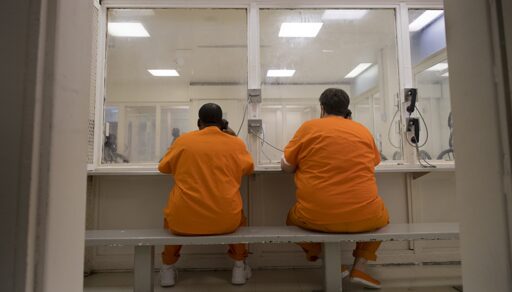
A groundbreaking new report reveals a direct link between prison phone call rates and prison safety: higher rates fuel more violence within prisons; lower rates and free phone calls dramatically reduce it. In this episode of Rattling the Bars, host and former political prisoner Mansa Musa speaks with Peter Mayer, director of research and data innovation for Worth Rises.
Additional links/info:
- Worth Rises website, Facebook page, Bluesky page, X page, and Instagram
- Peter Mayer & Bianca Tylek, Worth Rises (May 2026), “Critical Connections: The Power of Free Communication in Prisons and Jails”
Credits:
- Producer / Videographer / Editor: Cameron Granadino
Transcript
The following is a rushed transcript and may contain errors. It will be updated.
Mansa Musa:
Welcome to this edition of Rattling the Bars. I’m your host, Mansa Musa. Prior to being released from prison, I served 48 years and days and months. When I first went in prison, we ain’t had no telephone system. So everything was letters. Then they put a telephone system in. And when they put the telephone system in, this created a whole new attitude in the prison population. People was able to get on the phones to talk to their families. They had organized a phone system where you can get designated time so you ain’t have to worry about staying in line. It was like something unusual. And when they first started talking about it, most of us were skeptic. Oh, they ain’t going to put no telephone. But now this is a major feature in every prison in the United States of America and county jails and detention centers as well.
Joining me today to talk about the groundbreaking new report on this crisis is Peter Mayer. Peter is the co-author of Critical Connections: The Power of Free Phone Calls in Prisons and Jails and a Director of Research and Data Innovation at Worth Rises, the organization working to dismantle prison Prophet 10 as root. Welcome, Peter.
Peter Mayer:
Thanks. Thanks for having me.
Mansa Musa:
Tell our audience a little bit about yourself.
Peter Mayer:
So I am the director of research and data innovation at Worth Rises. As you said, we are an organization that works to dismantle the prison industry and most famously in the sector of telecommunications. I come to this work through being an impacted person myself, spent some time in different county jails. I’m a person in recovery and so this stuff means a lot to me. And yeah, we have just recently released this report that you mentioned. The point of it is that it shows the impact of what free phone calls have done in several states and several dozen counties, which is sort of a new policy, a wave that’s sort of happening across the country as we are trying to make phone calls free for people in prisons and jails.
Mansa Musa:
Okay. So let’s start with the FCC vote on October 25th, the rollback rates. Instead of 86% cap, provides can charge 11 cent in prison and 18 cent in jail. What does this rollback mean for families right now?
Peter Mayer:
Yeah, so to give the background just a little bit, in 2024, the FCC set caps on how much the telecommunications corporations can charge incarcerated people and their families per minute for phone calls. And those caps were meant to be six cents in prisons, like you mentioned, and 12 cents in very small jails. Now those caps were never completely implemented and enforced as there was change in administration and the caps themselves were delayed. And then more recently in October 2025, as you mentioned, the caps were increased to 11 cents per minute in prisons and 19 cents per minute in what they call extremely small jails.
Mansa Musa:
Now
Peter Mayer:
Those caps just finally went into effect in April of this year and now are actually have the force of law. But the difference being, I mean it means that families are exposed to these inflated costs for just connecting with their loved one. I mean, what we’re talking about is real basic human connection, being able to get on the phone.
I know you know well, being able to get on the phone and talk to that family member is a basic human need. And the thing is when we talk about these things and we talk about the difference between six cents and 11 cents, that may not sound like that much to some people, but when you consider the fact that these are calls that are being made every week, every month, every year it stacks and it stacks and it stacks and stacks. And we think about us on the outside who we talk to when we talk to our friends, our family members, our siblings, things like that. I mean, I might be on the phone for an hour and a half with
Mansa Musa:
My
Peter Mayer:
Sibling or something, my brother or something like that. That stacks up really quickly. And so what the rollback, the increase of those caps means is that families continue to pay for these inflated costs that are really just trying to offhand the cost of surveillance to families.
Mansa Musa:
Okay. And in your report, you look at the history of the industry. How did we get from standard phone rates under the old AT&T monopoly to the high rate that we see now?
Peter Mayer:
Yeah. So it used to be that prison and jail phone calls were run by the same corporations that we are. AT&T had a monopoly on everything. And then in the ’80s when the AT&T monopoly was broken up,
All these smaller surveillance firms started to enter the market and they were having a hard time getting contracts with prisons and jails to surveil all calls because they were like, “We don’t really want to pay for all that for those monitoring tools.” So what they did is they created a new model where they would share a percentage of the revenue with a prison or jail. So what they would do is they’d go to that agency and they’d say, “Okay, we’re going to charge, let’s say 15 cents a minute and you’re going to get seven cents of that and we’re going to take the other eight cents.” And because of that model, prisons and jails who were at the time, populations were starting to explode as we
Mansa Musa:
All
Peter Mayer:
Know, and were having a really hard time sustaining financially. They were like, “Oh great, here’s a new revenue stream.” And so by doing that split model, which we call commissions or kickbacks, those companies were able to start cornering the market like crazy. And they created this incentive not to make the price as low as possible, but to actually for the agencies to pick whichever company was going to give them the largest amount, right?
Mansa Musa:
The large share
Peter Mayer:
In the kickback.
Mansa Musa:
Just three private corporations have control over the phone system in the United States. There’s Aventa, BuyerPath and ICS controls 90% of this market. So what’s the resistance y’all getting back from them? Because you’re telling me that you want to come in and break my monopoly, financial monopoly up by saying, “Well, I know you getting $2 a minute. I’m trying to really get it down to one penny a minute or just free altogether.” What’s their response? Or what’s been their response? Or have y’all been able to gauge it?
Peter Mayer:
Yeah. So just to be clear, that history that I just talked about, what happened is that private equity started consolidating these businesses buying up. And so now we have, like you said, we have Aventive, which is also known as Securus, most people known as Securus, BioPath, also known as GTL and IC Solutions, and they control nearly 90% of the market. And what we have seen is that they push back through things like pushing back on the FCC instituting rate caps, lobbying against our policies for free communication. Another thing that they’re seeing as their revenue stream is really being squeezed in the
Mansa Musa:
Phone
Peter Mayer:
Market because of these new caps and these states and counties going to free communication, what we’re seeing is that they’re moving into other revenue streams and also trying to rebrand their image a little bit. And so they’re moving into content on tablets, like
Mansa Musa:
Educational
Peter Mayer:
Training content, that kind of thing. And in doing that, because their image has become so toxic, they’re also trying to rebrand as a helpful corporation for people who are incarcerated when we
Mansa Musa:
Really
Peter Mayer:
Make that the whole name of the industry is exploitation. It’s the name of the game. It has been for a long time. So we try to not let them get away with that sort of rebranding into something else. One other just small point I’d make is that yes, we have the FCC rate caps that are the ceiling of how high they can charge, and that is a good enforcement mechanism.
Mansa Musa:
What we
Peter Mayer:
Really are trying to do is to get states and counties to move to completely free models for incarcerated people, meaning that that becomes a part of the agency’s budget. And when they do that, they renegotiate new rates. So when maybe
Mansa Musa:
Before
Peter Mayer:
Families were paying, let’s say six cents a minute, something like that, when that corrections department decides to go to a free, they renegotiate with the corporation. They get it down to one and a half, maybe two cents a minute.
Mansa Musa:
And it
Peter Mayer:
Shows that what that original cost was completely inflated. Because
Mansa Musa:
Now they’re
Peter Mayer:
Saying, “We can. Sure, we can do it for two cents.”
Mansa Musa:
And to your point, when the calls are free, it create a whole different mindset in the environment. But more importantly, y’all are able to show that whoever paying the bill, if the state paying the bill, they’re going to get the best deal possible. But when we paying the bill and they getting the kickback from us paying the bill, then they don’t care if it’s like $5. I told you in one place I was in Cumberland, Maryland, it was $5 a minute. And when I call, best thing I can say, this is where I’m at, I write y’all. But talk about, because in your report, you talk about the impact these exorbitant phone call prices have on families. Talk about that and talk about how much money they going in debt and how much are these families actually spending per phone call without any regulation.
Peter Mayer:
Yeah, sure. So I mean, it ranges quite a bit depending on the rates that are charged like we talked about. I mean, depending on where you’re at, it can be a huge difference. A couple points we talk about that were done by other researchers in the report is that we know that one in three families with an incarcerated loved one goes into debt trying to stay connected. That’s from a previous report by the Ella Baker Center. And also on a report done by Forward US that I was also a co-author on that families pay nearly $4,200 a year costs to visit, support with commissary, all the different
Mansa Musa:
Associated
Peter Mayer:
Lost income, those kinds of things. Now, when it comes to just phone calls on the states that went and counties that went free that we did an analysis of for this report, what we found is that families were saving between $172 to $1,800 a year after the calls went free. So that’s the amount that they would’ve been spending before. Now on top of that, these families are also getting another $244 to almost $3,000 in extra call time. So the way to think about that is not only are they no longer spending that hundreds of dollars on what they did just to stay connected a little bit before, but they’re also now getting to talk that much more and
Mansa Musa:
Getting
Peter Mayer:
Accrued value and extra money too. And so what that all looked like in the total in the aggregate is we see $622 million saved to date by families thanks to these jurisdictions going free. And most of that is flowing to lack and brown communities who have disproportionately borne this
Mansa Musa:
Cause. And I know for a fact that when we find family members had to pay, I remember guys have to wait the first of the month for their family to get checks. They want them to call all the family member wants you to call all the time. Family members have more than one child in prison. So I’m in one prison. Somebody in the county jail, somebody in another prison, all of us making calls at home to get to a point. I know one family member got to a point where mama just said, look, I can’t accept the calls no more. So if you can’t write a letter, and it created a whole different attitude in the environment, black market, a lot of drama, a lot of violence. Talk about you shared some personal stories like the woman Lorraine who said her husband can finally hear just information or sensory.
But talk about that because I know from experience and I know I interviewed somebody whose father got his children on the phone every day and did their homework with them. And 20 years, 30 years later, the child that I interviewed, a son that didn’t graduate from college with honors, but it was his father’s ability to talk to him on the phone or have that communication with him to have him do something. Talk about some of them things that y’all was able to get information about and the impact that it has on people in general.
Peter Mayer:
Yeah, absolutely. So as part of this report, a big part of it was we carried out qualitative interviews and a number of those interviews were with incarcerated people and their families. And then we did some with staff as well. And we heard so many powerful stories. I mean, just the value of these free calls is immeasurable in the amount of moments that people will then get to share with each other. Because the difference was that you’re talking about when a call is really expensive, all people can afford a lot of times is a quick check-in.
Mansa Musa:
I’m doing
Peter Mayer:
Okay, or
Mansa Musa:
I’m
Peter Mayer:
Not doing okay, what’s going on? That kind of thing. In some relationships they completely wither because it’s like, I can’t afford to talk to that person. After calls go free, now we’re seeing people have regular engagement and presence in their family lives. And because of that, they are feeling better. They’re having more of a reason to go on and to
Work on their rehabilitation to think about what’s going to be happening after this. I mean, like you were talking about, we hear from parents who said that after calls went free, they would call their kid every morning before school and talk to them every night after. They’d help them with their homework. They get to hear about that sports game, what the updates were right after. We heard from people who said, one of our favorite quotes in this is an incarcerated man who said, “The difference is that you can hear the smile on a call.” I
Mansa Musa:
Think
Peter Mayer:
We all kind of know what that means. When you’re on the phone with somebody and you can kind of tell that they’re smiling. And so that’s the difference is that people are having real everyday presence and it makes such a big difference both for the communities on the outside and for the incarcerated person on the inside. And that’s not just one, it is an incredibly valuable story I think in terms of just human connection and everything else. It’s also a really important policy point because these are all things that will strengthen public safety. These are all
Mansa Musa:
Things that will
Peter Mayer:
Strengthen communities. These are all things that will make what we purport the system to be able to supposedly be doing. This will actually do that. And that’s why these personal stories in the aggregate really show us that free calls is a policy that works.
Mansa Musa:
Yeah, and it makes sense. The whole concept of crime and punishment is I commit a crime. The sentence that I get is the punishment. The sentence that I get don’t say that I’m sentencing you to 20 years in solitary confinement. I’m sentencing you to scrub the floor with a toothbrush. They say, “I’m sentencing you to this time.” That’s your punishment to sentence. Nowhere in any criminal code do it say, “I’m sentencing you to pay astronomical prices to communicate with your family. I’m sentencing you to pay astronomical commissary prices to eat. I’m sentencing you to pay for your own clothing or your own room and board.” That’s just not deposit. That’s just something that it’s the profit. In prison, when they say crime don’t pay, crime does pay. It pay corporations. It pay corporations in form of like what we’re talking about now with phone. I remember when they had a commission of corrections in Maryland and everything that came across his desk, he had to prove it.
So one of the things he seen while he was in office was that everybody wanted clothing packages. So tennis shoes and stuff like that. When he left that agency, he went and got contracted with a clothing agency and was selling clothes to the prisons because he recognized the profit margin. But talk about finally your report outline four major policy recommendations. How do we successfully reform government contracts to build a phone system that focuses on human connection rather than corporate profit?
Peter Mayer:
Yeah, I mean so our policy recommendations are for all states and counties to transition to this free system. And in that we talk about a few different things. We talk about the actual policy that you design. In most states that’s been legislation that says phone calls are going to be free now. In a few places, New York is an exception. New York State where they passed it as a budget measure where they just add it into the budget, this is how much the DOC is going to have this in their budget to pay for this. And so there’s the legislation piece and then there is the procurement and the implementation piece. So on the procurement side, we also have how the corrections agency actually contracts out this work. And then
Mansa Musa:
We have
Peter Mayer:
The implementation of how this actually all goes through. And what we really are trying to emphasize in here without getting too much into the technical weeds is that this is not only very doable, it’s actually advantageous for states and corrections departments because it’s a good public safety investment and it will pay off in the end. And how they need to be able to do this is to one, design policies that will guarantee access. So that means tablets. We need tablet access for people inside so that everybody can actually get ahold on the phones and you no longer have any security issues around scarcity because phones can become a flashpoint when there’s only a few phones and everybody wants that time. So tablets make that not so much of an issue. And we saw corrections department officials that we interviewed, they love that because people are in their cells
Mansa Musa:
On wallets.
Peter Mayer:
They’re engaged. They’re engaged and they’re not congregating in the common areas with idle time where there’s more time for things to go wrong. People aren’t fighting over the wall phones, they’re on their tablets. So that’s one big piece. Another piece that we talk about is that the pricing is transparent and that agencies renegotiate their costs with
Mansa Musa:
Their
Peter Mayer:
Corporations. So like I touched on briefly before, when a state decides to go free, then that Department of Corrections needs to go back to the company that they’re going to contract with and say, we want a lower price because we know you can give us a lower price. And when we saw California as a price around 1.5 cents a minute, that’s one of the best prices we’ve seen in the
Country. So we want these agencies to go and say, if you can do this for California, we see some lower… Sorry, to be clear, we see some lower costs for other states that haven’t gone free yet, but that was the lowest implementation cost for free calls was California’s. So we want states and counties to say, we see that this can be this cheap. We need to get these lower costs. Other things we want is we want to make sure that things like video calls are not going to be used to replace visitation because that can happen sometimes. We don’t call it video visits because they’re not visits. Visit when somebody actually comes in, it’s a video call. So don’t try to replace it.
Other pieces have to do with we would like to see agencies start to unbundle these things. So part of the power of the monopoly is that when an agency gets a contract, they put all of it together in one thing for that company. So that means where they’re getting the tablets, the surveillance and security infrastructure in addition to the actual telecommunication infrastructure. We would like to see them start debundling this and having a competitive bidding process for the tablets themselves, a competitive bidding process for just the telecommunication service, and then pay for whatever security they want on top of and separate from that so that it doesn’t all get lumped together into
Mansa Musa:
One. Right. Which is being used to not allow the service. But what do you see on the landscape when you look at it down the road? Do you think we’ll ever get to a place in this country where taking all things into account how profitable this stuff is, that we’ll get to a place where the phone services will be free for people that’s incarcerated? Or will we always be negotiating penny here, penny there, which is not bad versus no money?
Peter Mayer:
I mean, if I didn’t believe we would get to a place where it could be free for everybody, I’m not sure we’d all be doing this work. I mean, that’s the thing about Worth Rises is that we really imagine when this organization was started by our executive director back in 2018, this was like an impossible dream. Now we have multiple full state corrections agencies doing free calls and a number of counties, and it’s moving in other places too. I absolutely think we’re going to get to a place. I think we’re going to get to a place someday where we look back on this and say, how could it ever have been that way?
I think we’re already moving pretty quickly towards it. We just need to continue the momentum on the policy front of corrections agencies and counties making this free and then also start to reform the actual industry so that it’s not these monopolistic corporations taking advantage, but we make it more like it is for any other state agency. If they were setting up their phone calls or setting up tablet acquisition or things like that, they wouldn’t do it all through one company. They’d be doing each little piece in different procurement pieces. Like you or I, we pay per line for our phone. We don’t pay per minute. You know what I mean? This should reflect more accurately the actual industry instead of being the way that it is. This model is outdated. It was built to exploit and it is going to go away eventually. I
From The Real News Network via This RSS Feed.
America generally doesn’t want less violent prisons. It’s a feature.
