

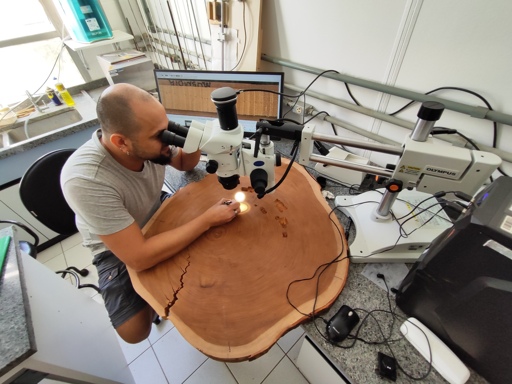
Tree rings from the Amazon show that the world’s largest rainforest has developed wetter wet seasons and drier dry seasons over the past four decades. The findings point to intense seasonal swings that can cause significant harm to biodiversity and suggest that widespread drying out across the entire Amazon basin is unlikely. Researchers collected tree cores from two species of floodplain trees; one species only grows in the wet season and another that only grows in dry conditions. They analyzed oxygen isotopes and the chronology of chemical marks left along the annual growth rings from each tree. They found that wet-season rainfall increased by 15-22% since 1980, while dry-season rainfall declined by 5.8-13.5%. “For a long time, there has been talk that it will dry up, and climate models created in the 1990s and early 2000s did indeed show that the Amazon was following that path,” study lead author Bruno Cintra, a biologist at the University of Birmingham, said, reported Mongabay contributor Luís Patriani. “But when we observe how the climate has developed over the last 40 or 50 years, what we see is that there is no clear pattern indicating that the biome as a whole is drying up.” The biome isn’t drying up entirely, because changes in weather patterns are not impacting all regions across the massive forest in the same way. The northern portion of the rainforest is receiving more rain during the wet season, while the southern Amazon region is facing longer and drier dry seasons.…This article was originally published on Mongabay
From Conservation news via This RSS Feed.